
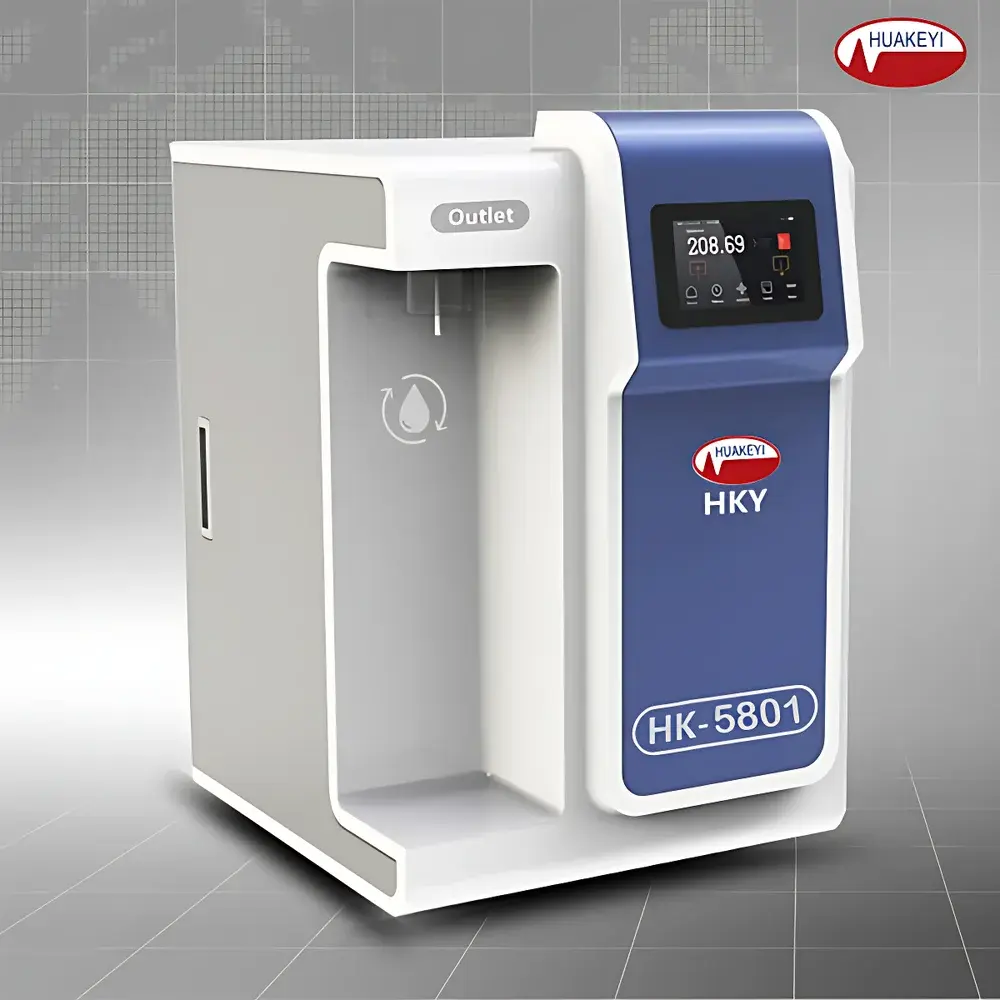
Huake Instrument HK-5801P40 Ultra Pure Water System
| Brand | Huake Instrument |
|---|---|
| Origin | Beijing, China |
| Model | HK-5801P40 |
| Purified Water Grade | Type I (ASTM D1193-20) |
| Resistivity | 18.2 MΩ·cm @ 25°C |
| Heavy Metals & Soluble Silica | < 0.01 ppb |
| Total Organic Carbon (TOC) | < 10 ppb |
| Microbial Count | < 1 CFU/mL |
| Endotoxins | < 0.001 EU/mL |
| Particles (>0.1 µm) | < 1 particle/mL |
| Flow Rate | 40 L/h @ 25°C |
| Power Supply | AC 100–120 V or 200–240 V, 50/60 Hz |
| Power Consumption | 120 W |
| Dimensions (L×W×H) | 380 × 485 × 570 mm |
Overview
The Huake Instrument HK-5801P40 Ultra Pure Water System is a laboratory-grade, Type I ultrapure water generator engineered for continuous production of water meeting or exceeding ASTM D1193-20 Type I specifications and ISO 3696 Class 1 requirements. It employs a multi-stage purification architecture integrating dual-stage reverse osmosis (RO) pretreatment, mixed-bed ion exchange, ultra-low TOC dual-wavelength UV oxidation (185 nm + 254 nm), and 0.1 µm final filtration — all housed in a fully enclosed, recirculating loop design to prevent ambient contamination. Unlike single-pass systems, the HK-5801P40 maintains dynamic equilibrium via continuous internal circulation and real-time resistivity feedback control, ensuring stable 18.2 MΩ·cm output across variable demand conditions. Its design prioritizes operational integrity in regulated environments: non-leaching polypropylene and PTFE-wetted components minimize extractables; the closed-loop distribution path eliminates air exposure; and integrated endotoxin-retentive filtration supports applications requiring low-endotoxin water per USP and EP 2.2.44.
Key Features
- Full-color capacitive touchscreen interface with intuitive navigation, supporting both English and Chinese language modes for global lab personnel
- Real-time, dual-parameter monitoring: inline conductivity/resistivity sensor (±0.01 MΩ·cm accuracy) and temperature-compensated TOC analyzer (detection limit <5 ppb)
- Precision volumetric dispensing with programmable setpoints (1 mL to 99.99 L), repeatability ±0.5% full scale, with audit-trail logging
- Multi-tier user management system with three configurable access levels (Operator, Technician, Administrator), each with role-specific permissions for parameter modification, service history access, and calibration lockout
- Automated consumables lifecycle tracking with predictive replacement alerts based on actual usage hours, flow volume, and sensor drift trends
- Dual-wavelength UV chamber (185 nm for TOC photolysis + 254 nm for microbial inactivation) validated to achieve ≥3-log reduction of gram-negative bacteria and <0.001 EU/mL endotoxin levels
- Integrated air-gap venting and hydrophobic vent filter (0.2 µm PTFE) to prevent back-contamination during idle periods
Sample Compatibility & Compliance
The HK-5801P40 accepts feed water meeting ASTM D1193 Type III or equivalent distilled/deionized water (conductivity ≤5 µS/cm). It is certified compliant with ISO 9001:2015 manufacturing standards and conforms to electromagnetic compatibility (EMC) requirements per IEC 61326-1. All wetted materials comply with USP Class VI biocompatibility testing. The system supports GLP/GMP workflows through optional 21 CFR Part 11-compliant software modules (available upon request), enabling electronic signatures, secure audit trails, and instrument qualification documentation (IQ/OQ/PQ templates provided). Output water meets critical application thresholds for HPLC mobile phase preparation (ASTM E2654), cell culture media formulation (ATCC guidelines), trace metal analysis (EPA Method 1638), and semiconductor wafer rinsing (SEMI F57).
Software & Data Management
The embedded firmware logs all operational events—including resistivity excursions, UV lamp operating hours, filter saturation status, and dispense records—with timestamped, tamper-resistant storage (retention: 12 months minimum). Data export is supported via USB 2.0 port in CSV format for integration into LIMS or ELN platforms. Optional Ethernet connectivity enables remote monitoring, alarm notification via SMTP email/SNMP trap, and centralized fleet management across multi-instrument laboratories. Calibration data is digitally signed and version-controlled; sensor recalibration requires administrator-level authentication and generates an immutable log entry.
Applications
- HPLC, UHPLC, and LC-MS mobile phase and blank preparation where low TOC and silica content prevent column fouling and baseline drift
- Atomic absorption spectroscopy (AAS) and ICP-MS diluent preparation requiring sub-ppt metal contamination limits
- Preparation of electrophysiology buffers, stem cell culture media, and transfection reagents sensitive to endotoxin and nucleases
- Calibration standards for clinical chemistry analyzers and reference material certification
- Cleaning of optical components, photomasks, and MEMS devices in cleanroom environments
- Feed water for steam generators in pharmaceutical autoclaves where chloride and silica must remain below boiler code thresholds
FAQ
What feed water quality is required for optimal performance?
The HK-5801P40 requires inlet water with conductivity ≤5 µS/cm (ASTM Type III or better). Use of distilled or RO water is strongly recommended; direct tap water feed is not supported.
Does the system support external distribution loops?
Yes—optional 1.5 m sterile tubing kits with 0.2 µm terminal filters are available for point-of-use extension; loop configurations require separate pump module (HK-PUMP-01, sold separately).
How often must consumables be replaced under typical lab use?
Mixed-bed cartridge: 6–12 months (dependent on feed water quality and daily usage volume); UV lamp: 9,000 operating hours; 0.1 µm final filter: 12 months or after 10,000 L throughput—whichever occurs first.
Is third-party validation support available?
Huake Instrument provides IQ/OQ protocol templates, factory test reports, and material compliance certificates (RoHS, REACH, USP Class VI). On-site PQ execution is available through authorized service partners.
Can the system be integrated into a building management system (BMS)?
Yes—via Modbus RTU (RS-485) or optional analog 4–20 mA output for resistivity and flow status signals, enabling facility-wide water quality oversight.



