
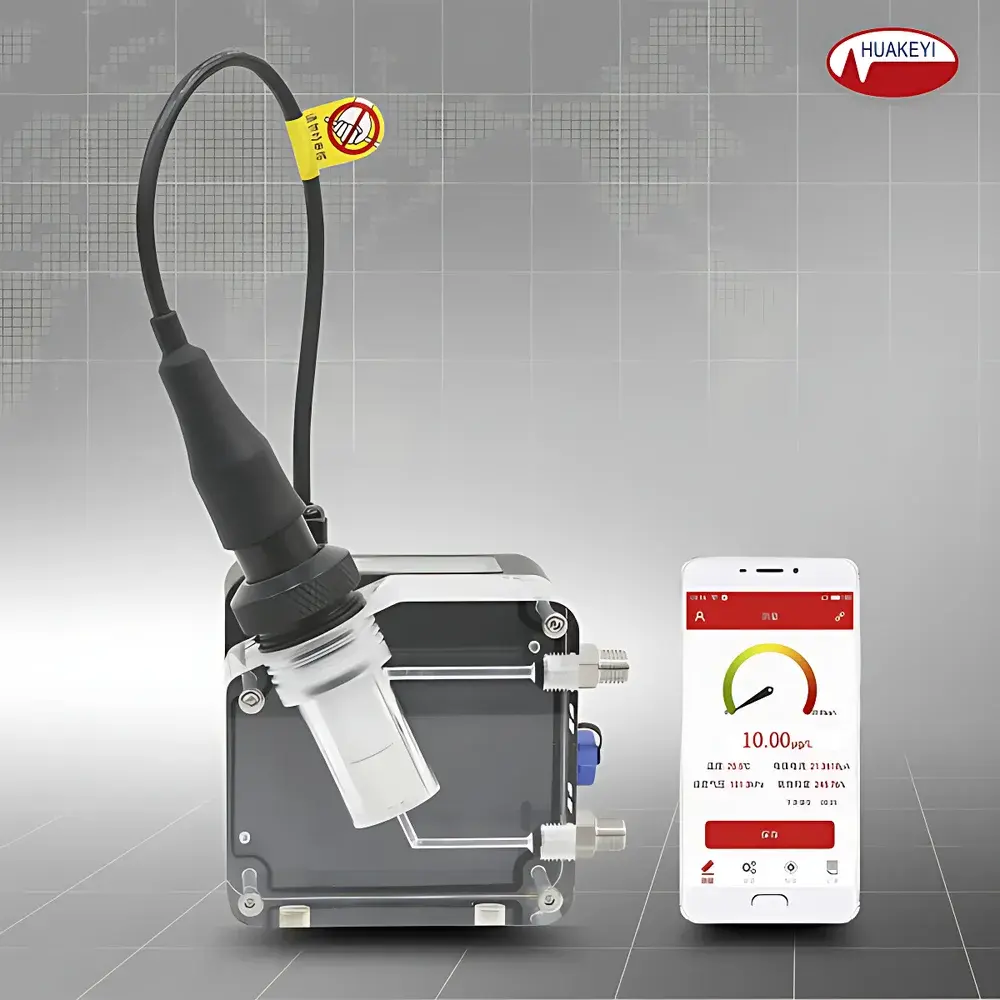
Huakeyi HK-258 Portable Trace Dissolved Oxygen Analyzer
| Brand | Huakeyi |
|---|---|
| Origin | Beijing, China |
| Model | HK-258 |
| Instrument Type | Portable |
| Measurement Principle | Polarographic Electrochemical Sensor |
| Measurement Range | 0.00–200 µg/L |
| Accuracy | ±0.3% FS or 1 µg/L (whichever is greater) |
| Repeatability | 0.05% |
| Detection Limit | 0.1 µg/L |
| Resolution | 0.1 µg/L, 0.01 mg/L |
| Temperature Compensation Range | 0–50 °C (manual or automatic) |
| Temperature Accuracy | ±0.5 °C |
| Temperature Resolution | 0.1 °C |
| Response Time (T90) | ≤60 s at 25 °C |
| Power Supply | Built-in 3.7 V rechargeable Li-ion battery |
| Battery Life | ≥40 h per charge |
| IP Rating | IP68 |
| Dimensions (Transmitter) | 123 mm × 86 mm × 267 mm (L×W×H) |
| Weight (Transmitter) | 1.5 kg |
Overview
The Huakeyi HK-258 Portable Trace Dissolved Oxygen Analyzer is a field-deployable, high-sensitivity electrochemical instrument engineered for precise quantification of dissolved oxygen (DO) in ultra-pure water and low-conductivity aqueous matrices. It employs a polarographic Clark-type sensor with a gas-permeable membrane and silver/silver chloride reference system, operating under controlled cathodic polarization to generate a diffusion-limited current proportional to molecular oxygen concentration. Unlike conventional galvanic DO meters, the polarographic design enables stable zero-point calibration, reduced drift, and sub-microgram-per-liter detection capability—critical for monitoring feedwater, condensate, and boiler cycles in power generation, semiconductor rinse water, pharmaceutical water-for-injection (WFI), and high-purity process streams in petrochemical and metallurgical facilities.
Key Features
- Polarographic trace DO sensor with integrated temperature compensation, optimized for measurements down to 0.1 µg/L in deionized and ultrapure water (UPW) systems.
- Modular architecture: standalone transmitter unit (IP68-rated housing) communicates wirelessly via IEEE 802.11 b/g/n Wi-Fi to Android-based mobile controller—eliminating dedicated hardware handsets and enabling remote real-time supervision.
- High-resolution segment LCD display on transmitter supports dual-range auto-switching: 0–20 µg/L, 0–200 µg/L, and 0–20 mg/L—ensuring optimal signal-to-noise ratio across trace and conventional DO ranges.
- Long-duration operation: 3.7 V lithium-ion battery delivers ≥40 hours of continuous measurement without recharging; battery status and remaining runtime are continuously reported in-app.
- Multi-user access protocol: one transmitter supports up to four concurrent Android devices—only one device operates in control mode (calibration, configuration, data export), while others function in read-only monitoring mode—ideal for shift handovers and cross-functional QA/QC oversight.
- Rugged mechanical design: compact form factor (123 × 86 × 267 mm), lightweight construction (1.5 kg), and versatile mounting options—including handheld, tripod, wall-bracket, or submersible deployment—enable rapid deployment in confined spaces, turbine pits, or mobile lab vans.
Sample Compatibility & Compliance
The HK-258 is validated for use with low-ionic-strength samples (conductivity < 1 µS/cm), including ASTM D1125-grade ultrapure water, USP Purified Water, and EP/JP WFI. Its polarographic sensor exhibits minimal interference from common ions (Cl⁻, SO₄²⁻, NO₃⁻) and is insensitive to flow velocity above 10 cm/s—making it suitable for inline bypass loop monitoring and grab-sample analysis. While not certified to IEC 61508 or SIL standards, the instrument’s firmware architecture supports audit-ready operation: all calibration events, parameter changes, and measurement logs are time-stamped, user-tagged, and stored locally on-device and synchronized to encrypted cloud storage via the Android application. Data integrity aligns with GLP/GMP documentation requirements, and optional CSV/Excel export facilitates integration into LIMS or electronic batch record (EBR) systems compliant with FDA 21 CFR Part 11 when paired with appropriate organizational controls.
Software & Data Management
The proprietary Android application serves as a full-featured analytical interface—not merely a display tool. It implements SQLite-based local database management to store time-series DO, temperature, and diagnostic metadata with millisecond-level timestamp resolution. Advanced analytics include trend visualization (linear, logarithmic, derivative plots), configurable alarm thresholds (high/low, rate-of-change), and automated report generation (PDF/CSV) with embedded instrument ID, operator signature, and calibration certificate references. All data transfers between transmitter and app are encrypted using TLS 1.2; no raw sensor data is transmitted to third-party servers. Firmware updates are delivered over-the-air (OTA) via signed packages, ensuring version traceability and cryptographic verification. The app supports multi-language UI (English, Chinese, Spanish) and adheres to Android Accessibility Guidelines for visually impaired operators.
Applications
- Power plant chemistry control: real-time monitoring of dissolved oxygen in turbine condensate, feedwater, and deaerator outlet—supporting ASME PTC 19.11 and EPRI guidelines for corrosion mitigation.
- Semiconductor fab UPW loops: verification of DO < 5 µg/L at point-of-use to prevent oxidation of copper interconnects during wafer cleaning.
- Pharmaceutical water systems: routine verification of WFI and purified water per USP and EP 2.2.45, including post-sanitization cool-down profiling.
- Research laboratories: kinetic studies of oxygen scavenging reactions, membrane permeability testing, and low-oxygen bioreactor validation.
- Environmental field surveys: spot-checking of hypolimnetic oxygen depletion in stratified reservoirs or groundwater plume delineation where microaerophilic conditions prevail.
FAQ
What calibration protocols does the HK-258 support?
The analyzer supports zero-point calibration using nitrogen-saturated water (or certified zero standard) and span calibration with air-saturated water or certified DO standard solution (e.g., 8.26 mg/L at 25 °C, 1 atm). Both calibrations are fully guided within the Android app with step-by-step prompts and acceptance criteria validation.
Can the transmitter operate independently without the mobile app?
Yes—the transmitter functions autonomously with onboard LCD, real-time measurement, and internal data logging (up to 10,000 records). The app is required only for configuration, calibration, advanced analytics, and data export.
Is the sensor compatible with aggressive cleaning agents used in pharmaceutical CIP cycles?
The polarographic electrode features a chemically resistant PTFE membrane and stainless-steel body rated for intermittent exposure to 1–2% NaOH, 0.5–1% HNO₃, and hydrogen peroxide solutions—but prolonged immersion or ultrasonic cleaning is not recommended. A dedicated sensor protection cap is supplied for transport and storage.
How is temperature compensation implemented?
Temperature is measured by a Pt1000 RTD embedded in the electrode tip. Compensation follows the ISO 5814:2012 algorithm for oxygen solubility in water, with optional manual offset adjustment to account for localized thermal gradients in insulated piping.
Does the system meet any international metrological standards?
While the HK-258 itself is not CE-marked or UKCA-certified, its measurement methodology conforms to ISO 5814:2012 (electrochemical determination of dissolved oxygen) and ASTM D888-12 (standard test methods for dissolved oxygen in water). Calibration traceability is maintained to NIST-traceable standards upon user-provided certification.
Related Products







