
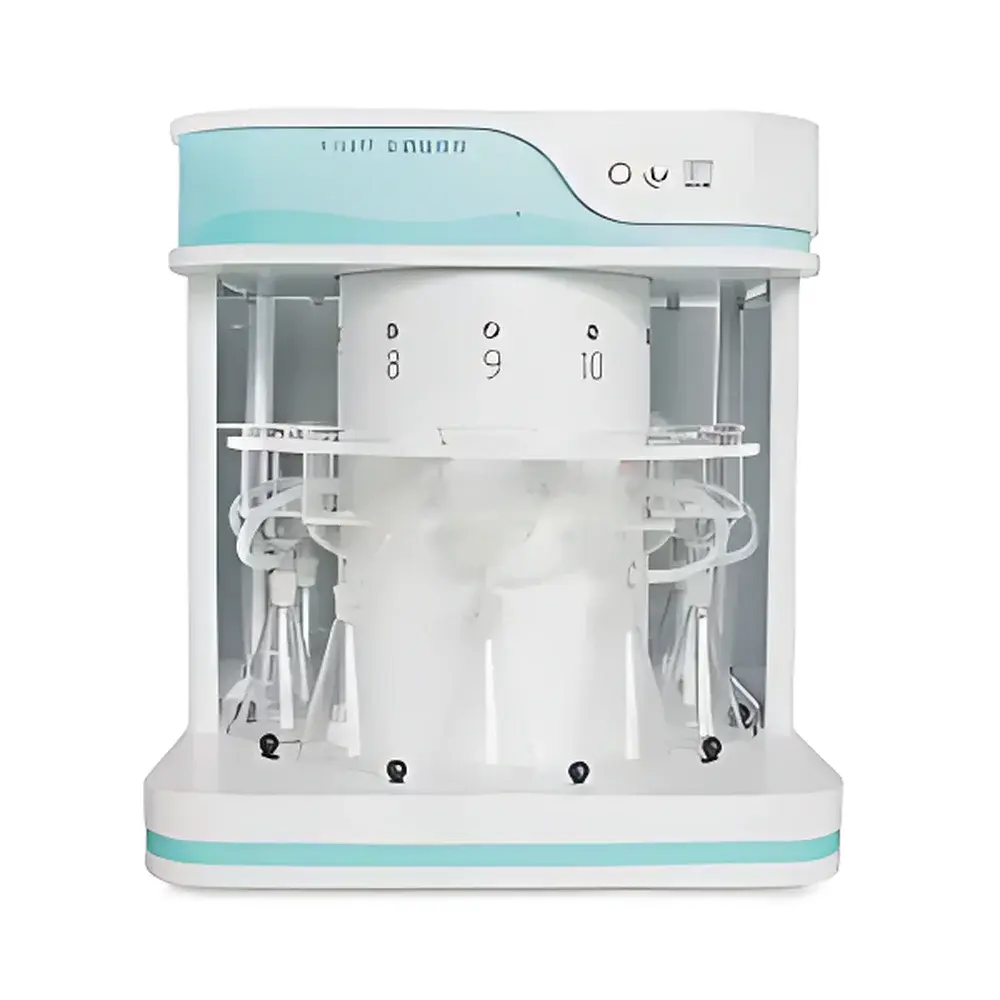
HUANKONG 4100 Multi-Channel Vacuum Filtration System
| Brand | HUANKONG |
|---|---|
| Origin | Shandong, China |
| Manufacturer Type | Direct Manufacturer |
| Product Origin | Domestic (China) |
| Model | 4100 |
| Pricing | Available Upon Request |
| Filtration Channels | 6 independent programmable channels |
| Filtration Diameter | 90 mm |
| Filter Support | 316 stainless steel perforated support plate |
| Collection Vessels | PTFE-sealed, auto-closing, volumetrically controlled receivers |
| Fluid Path Material | PTFE tubing only |
| Sample Introduction | Automated peristaltic dosing with precise volume delivery |
| Platform Motion | Motorized rotary stage with auto-engagement/disengagement mechanism |
| Cleaning Protocol | Integrated vacuum-assisted purge and rinse cycle |
Overview
The HUANKONG 4100 Multi-Channel Vacuum Filtration System is an engineered solution for high-throughput, reproducible solid-phase separation of aqueous environmental samples—specifically designed to meet the rigorous preprocessing demands of marine monitoring programs. It operates on the principle of controlled vacuum-driven membrane filtration, where differential pressure across a defined pore-size membrane drives particulate capture while preserving sample integrity. Unlike manual or single-channel systems, the 4100 integrates synchronized mechanical actuation, fluidic isolation, and volumetric precision to eliminate operator-induced variability in filtration time, applied vacuum level, and filtrate volume. Its architecture supports unattended operation over extended cycles, making it suitable for laboratories conducting routine analysis under ISO/IEC 17025-accredited workflows or EPA Method 160.1–compliant suspended solids protocols.
Key Features
- Six independently addressable filtration channels enable parallel processing of up to six seawater samples without cross-contamination—each channel features isolated vacuum control and real-time pressure monitoring.
- PTFE-sealed collection vessels with positive-seal latching ensure leak-tight containment during filtration and transport; integrated volumetric calibration allows automatic cutoff at user-defined volumes (e.g., 500 mL or 1 L per sample).
- Standard 90 mm diameter filtration area accommodates widely available analytical-grade membranes (e.g., GF/F, polycarbonate, or PVDF), supported by corrosion-resistant 316 stainless steel perforated plates rated for repeated autoclaving.
- Motor-driven rotating platform precisely indexes each sample position beneath the filtration head, engaging the seal pneumatically and disengaging automatically post-filtration—eliminating manual alignment errors.
- Entire fluid path—from sample inlet through PTFE peristaltic tubing to membrane holder and collector—is constructed exclusively from inert fluoropolymer materials, minimizing adsorption and extractables in trace-metal or organic analyses.
- Onboard cleaning sequence executes vacuum-assisted air purge followed by solvent-compatible rinse (e.g., ultrapure water or dilute HNO₃), reducing carryover risk between batches and supporting GLP-aligned documentation requirements.
Sample Compatibility & Compliance
The system is validated for use with natural seawater, estuarine water, and brackish matrices containing suspended solids ranging from 0.1 to 500 mg/L. It complies with material compatibility standards outlined in ASTM D5116 (Standard Guide for Small-Scale Environmental Simulation) and supports method validation per ISO 5667-2 (Water quality — Sampling — Part 2: Guidance on sampling techniques). All wetted components conform to USP Class VI biocompatibility criteria, and the PTFE sealing interface meets FDA 21 CFR 177.1550 for repeated food-contact exposure—relevant for environmental labs performing dual-use analyses. The device supports audit-ready operation when paired with external electronic lab notebooks (ELNs) or LIMS via RS-232 or optional USB-to-serial interface.
Software & Data Management
The 4100 operates via embedded firmware with a tactile LCD interface offering preset methods (e.g., “Seawater_6L”, “Estuary_2L”), adjustable vacuum setpoints (10–85 kPa absolute), and programmable dwell times per channel. While no proprietary PC software is bundled, ASCII-formatted log files—including timestamped start/stop events, channel-specific vacuum profiles, and volume confirmation signals—can be exported via serial output for integration into laboratory data management platforms. All operational parameters are retained in non-volatile memory across power cycles, and the system maintains a local event history buffer (≥1,000 entries) with timestamps compliant with ALCOA+ data integrity principles.
Applications
- Pre-concentration of phytoplankton, microplastics, and particulate organic carbon (POC) from large-volume seawater collections for subsequent microscopy, FTIR, or elemental analysis.
- Field-deployable preprocessing in mobile labs or research vessels where space, power stability, and operator fatigue are constraints.
- Quality control filtering of reagent water prior to ICP-MS or IC analysis to prevent column fouling and detector contamination.
- Method development for EPA 1613B (dioxins/furans) or ISO 17294-2 (ICP-MS water analysis), where consistent filtration efficiency directly impacts recovery accuracy.
- Support of long-term ecological monitoring programs requiring strict inter-laboratory comparability—enabled by standardized channel timing, vacuum ramp rates, and membrane wetting protocols.
FAQ
Can the system accommodate filter membranes other than 90 mm diameter?
No—the mechanical design, sealing geometry, and support plate dimensions are fixed for 90 mm circular membranes. Non-standard sizes require custom tooling not supported under standard warranty.
Is the vacuum level adjustable per channel?
Vacuum is regulated globally via a shared diaphragm pump and proportional valve; however, individual channel isolation valves allow sequential activation without affecting active channel pressure stability.
What maintenance intervals are recommended for the PTFE tubing and seals?
Peristaltic tubing should be replaced every 6 months under continuous operation; PTFE vessel seals require inspection quarterly and replacement annually—or after 200 autoclave cycles—per manufacturer’s service bulletin HB-4100-MNT-2023.
Does the system comply with FDA 21 CFR Part 11 for electronic records?
The unit itself does not include audit-trail generation or electronic signature capability; however, its serial data output enables full traceability when ingested into validated third-party LIMS or ELN systems meeting Part 11 requirements.
Can it be integrated with autosamplers or robotic liquid handlers?
Yes—via TTL-level trigger inputs and analog voltage outputs for start/stop coordination; mechanical interface dimensions and mounting hole patterns are documented in the Installation & Integration Manual (IM-4100-REV4).



