
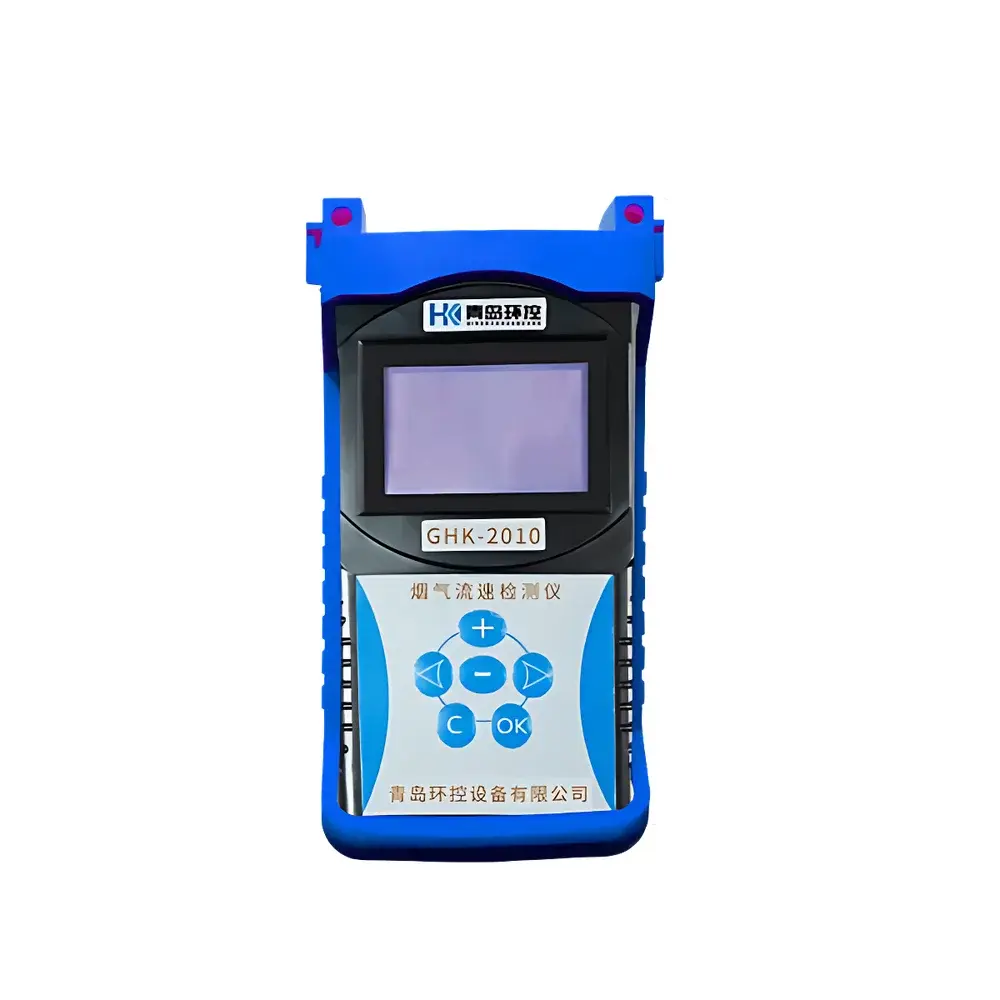
HUANKONG GHK-2010 Portable Flue Gas Velocity Analyzer
| Brand | HUANKONG |
|---|---|
| Model | GHK-2010 |
| Type | Portable Flue Gas Analyzer |
| Measurement Principle | Pitot Tube Method |
| Compliance | JJG 518–1998, GB/T 16157–1996 |
| Power Supply | Rechargeable Li-ion Battery (≥48 h operation) |
| Data Storage | 800 measurement sets |
| Display | High-brightness wide-temperature color LCD |
| Connectivity | Built-in Bluetooth v4.2 |
| Pressure Sensors | High-accuracy differential pressure transducers (±0.5 Pa resolution) |
| Parameters Measured | Flue gas velocity, volumetric flow rate, dry standard flow rate, dynamic pressure, static pressure, flue gas temperature |
Overview
The HUANKONG GHK-2010 Portable Flue Gas Velocity Analyzer is an engineered field instrument designed for accurate in-situ determination of gas velocity and related volumetric parameters in industrial exhaust ducts, boiler stacks, and process flues. It operates on the well-established Pitot tube principle—measuring the differential pressure between stagnation (total) and static pressure to derive local gas velocity according to Bernoulli’s equation under compressible flow assumptions. This method is widely accepted in regulatory monitoring frameworks for emissions compliance and energy efficiency audits. The analyzer integrates a calibrated stainless-steel Pitot probe with temperature compensation and real-time pressure transduction to deliver traceable velocity readings across typical flue gas operating ranges (0–30 m/s), while supporting calculation of normalized dry standard flow rates (Nm³/h) per ISO 10780 and EPA Method 1/2/4 conventions.
Key Features
- High-stability differential pressure sensing module with ±0.5 Pa resolution and thermal drift compensation ensures repeatable velocity profiling across ambient temperatures from −10 °C to 50 °C.
- Integrated flue gas temperature sensor (Type K thermocouple, range: 0–600 °C) enables automatic density correction for volumetric flow computation.
- Onboard microprocessor performs real-time averaging of multi-point traverse data, applying ISO 16911-compliant weighting algorithms for representative cross-sectional mean velocity.
- Automated traverse point recommendation engine calculates optimal sampling locations per GB/T 16157–1996 and EPA Method 1—accounting for duct geometry, aspect ratio, and flow profile asymmetry.
- Zero-point auto-correction and software-based calibration verification reduce field recalibration frequency without compromising metrological integrity.
- Large-format color TFT display (4.3″, 480×272 pixels) maintains legibility under direct sunlight and low-illumination stack environments.
- Internal rechargeable lithium-ion battery sustains continuous operation for ≥48 hours—validated under mixed-use conditions including data logging, display backlighting, and Bluetooth transmission.
Sample Compatibility & Compliance
The GHK-2010 is validated for use with non-corrosive and mildly corrosive flue gases containing particulate matter ≤100 mg/m³. It complies with national verification regulation JJG 518–1998 for Pitot tube calibration traceability and aligns with sampling methodology requirements in GB/T 16157–1996 for fixed-source emission monitoring. While not intrinsically safe, it meets IP54 ingress protection for dust and splash resistance during routine stack-side deployment. All firmware and measurement algorithms adhere to GLP-aligned documentation practices, supporting audit-ready data export with timestamps, operator ID, and environmental metadata.
Software & Data Management
Data are stored in non-volatile memory with full timestamping (YYYY-MM-DD HH:MM:SS), including raw pressure differentials, thermocouple readings, calculated velocities, and user-defined duct dimensions. Each of the 800 record slots retains complete traverse metadata: number of points, probe insertion depth, and computed standard flow. Bluetooth 4.2 connectivity supports secure wireless transfer to Windows or Android platforms via HUANKONG’s certified PC application—enabling CSV export, PDF report generation (with configurable headers and company branding), and integration into LIMS or EMS platforms. Audit trail functionality logs all configuration changes and calibration events in accordance with 21 CFR Part 11–compatible access control protocols.
Applications
- Regulatory stack testing for CEMS performance validation and periodic compliance reporting under China’s HJ 75–2017 and HJ 76–2017 standards.
- Thermal efficiency evaluation of coal-, gas-, or biomass-fired boilers through mass balance analysis using measured flue gas flow and O₂/CO₂ concentration inputs.
- Industrial hygiene assessments of ventilation system performance in foundries, cement kilns, and chemical reactors.
- Pre-commissioning verification of ductwork design against ASHRAE Guideline 12 and ISO 13790 airflow specifications.
- Field validation of computational fluid dynamics (CFD) models by providing empirical velocity profiles at strategic duct sections.
FAQ
What is the recommended maintenance interval for the Pitot probe and pressure sensors?
Annual verification against NIST-traceable pressure standards is advised; field zero checks before each sampling campaign are required per JJG 518–1998.
Can the GHK-2010 be used for wet flue gas applications?
Yes—provided condensate is mechanically removed upstream and the gas remains unsaturated at the probe tip; optional heated probe accessories are available for high-humidity environments.
Does the device support custom gas composition input for density correction?
Yes—users may manually enter O₂, CO₂, CO, and moisture content to refine standard flow calculations per ISO 10780 Annex B.
Is firmware upgradable in the field?
Yes—via USB-C interface and HUANKONG’s signed firmware package, ensuring version-controlled updates compliant with IEC 62443-4-2 security requirements.
How is measurement uncertainty quantified for velocity output?
Combined standard uncertainty is ≤±2.5% of reading (k=2) under nominal conditions, derived from sensor accuracy, temperature compensation error, and traverse point distribution variance.
Related Products







