
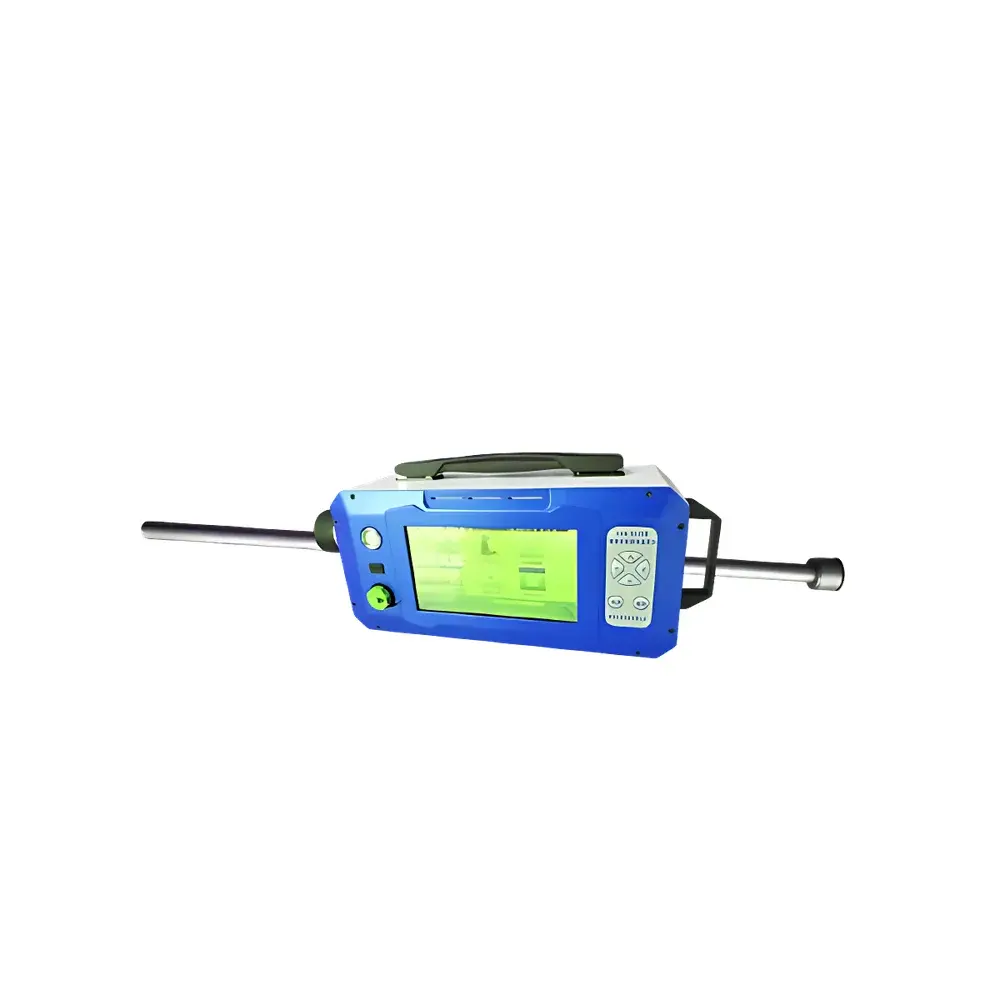
HUANKONG GHK-5010 Portable Greenhouse Gas Emissions Monitor (NDIR-Based)
| Brand | HUANKONG |
|---|---|
| Model | GHK-5010 |
| Detection Principle | Non-Dispersive Infrared (NDIR) |
| Measurable Gases | CO₂, CO, CH₄, N₂O, O₂ (configurable) |
| Operating Power | AC/DC dual-mode with rechargeable Li-ion battery |
| Data Storage Capacity | >100,000 records |
| Display | High-brightness color touchscreen |
| Sample Interface | Heated titanium alloy probe with detachable front section |
| Humidity Compensation | Built-in algorithm with optional humidity sensor |
| Environmental Compliance | Designed for EPA Method 3A, ISO 14064-1 support, and EU EN 15267-3 field verification contexts |
| Connectivity | USB data export, Bluetooth printer interface |
| Units | ppm, mg/m³, % (user-selectable) |
| Preheat Time | <90 s (typical for NDIR gas cells) |
| Cross-Interference | Optimized optical filtering to minimize spectral overlap between CO₂/CH₄/N₂O bands |
Overview
The HUANKONG GHK-5010 Portable Greenhouse Gas Emissions Monitor is an engineered field-deployable instrument designed for regulatory-grade measurement of carbon-containing and climate-relevant gases at stationary emission sources. It operates on the physical principle of non-dispersive infrared (NDIR) absorption spectroscopy—where target gas molecules absorb specific mid-infrared wavelengths in proportion to their concentration. The GHK-5010 employs individually optimized optical filters and thermopile detectors calibrated for CO₂ (4.26 µm), CO (4.67 µm), CH₄ (3.31 µm), N₂O (4.54 µm), and O₂ (via paramagnetic or electrochemical auxiliary channel). Its architecture integrates gas sampling, conditioning, and analysis into a single ruggedized chassis—enabling compliance-aligned stack testing per EPA Performance Specification 3A (PS-3A), ISO 14064-1 verification workflows, and EU Directive 2010/75/EU (IED) monitoring requirements.
Key Features
- Integrated heated sampling train: Titanium alloy probe with full-length trace heating (≥180 °C) prevents condensation and adsorption losses of polar gases (e.g., N₂O, CO) during hot/wet flue gas sampling.
- Multi-parameter real-time acquisition: Simultaneous measurement of gas concentrations, stack temperature (±0.5 °C), static pressure (±0.1 kPa), and volumetric flow velocity (±1.5% FS) enables direct calculation of mass emission rates (g/s, tCO₂-eq/h) per IPCC Tier 2 methodology.
- Onboard humidity compensation: Integrated capacitive humidity sensor feeds data into a physics-based correction algorithm that adjusts NDIR signal baseline and cross-sensitivity coefficients—critical for accuracy in high-moisture biomass or waste incineration exhausts.
- Robust power architecture: Dual-mode operation (100–240 VAC / 12–24 VDC) with intelligent Li-ion battery management—including undervoltage lockout, overvoltage clamping, and reverse-polarity protection—ensures uninterrupted operation during extended field campaigns.
- Self-maintaining optics: Automated post-measurement purge cycle directs clean, dry air through the optical cell and sample path, reducing particulate accumulation and extending NDIR source/detector service life beyond 5 years under typical industrial use.
- Regulatory-ready data handling: All measurements are timestamped, geotagged (via optional GNSS module), and stored with audit-trail metadata—including calibration history, zero/span drift logs, and user authentication IDs—to support GLP-compliant reporting and 21 CFR Part 11–aligned electronic records.
Sample Compatibility & Compliance
The GHK-5010 is validated for continuous or grab sampling of flue gases from coal-fired boilers, cement kilns, municipal solid waste incinerators, biogas upgrading units, and landfill gas collection systems. Its heated sampling system accommodates gas matrices with moisture content up to 30% v/v and particulate loading ≤100 mg/m³ (filtered). The instrument meets mechanical and electromagnetic compatibility requirements per IEC 61326-1:2020 and carries CE marking for environmental monitoring applications. While not certified as a Type-Approved CEMS under EN 15267-3, its NDIR modules are factory-calibrated against NIST-traceable gas standards (certified reference materials: CRM 10002, CRM 10018), and its measurement uncertainty profile aligns with ISO 14064-3 Annex B guidance for Tier 2 greenhouse gas inventories.
Software & Data Management
Data acquisition and reporting are managed via embedded Linux-based firmware with a responsive 7-inch capacitive touchscreen UI. Measurement sessions are automatically archived in CSV and SQLite formats with configurable sampling intervals (1–60 s). Raw spectra (for diagnostic review) and processed concentration time-series are exportable via USB 2.0 to standard flash drives. Optional PC software provides spectral overlay visualization, drift trend analysis, and automated report generation compliant with China’s HJ 75-2017 and HJ 76-2017 technical specifications—as well as customizable templates aligned with GHG Protocol Corporate Standard disclosures. Bluetooth 5.0 connectivity supports pairing with certified thermal printers for on-site hardcopy verification.
Applications
- Stack testing for environmental permit compliance (e.g., China’s “Dual Carbon” policy enforcement, EU ETS monitoring plans)
- Verification of carbon capture unit efficiency by quantifying pre- and post-scrubber CO₂ slip
- Landfill gas LFG-to-energy project monitoring per CCAC (Climate and Clean Air Coalition) guidelines
- Biogas composition profiling in anaerobic digesters for engine fuel optimization
- Field validation of continuous emissions monitoring systems (CEMS) using EPA PS-3A relative accuracy test audits (RATA)
- Academic research on combustion stoichiometry and nitrogen oxide formation pathways
FAQ
What calibration standards are required for field verification?
NIST-traceable multi-component gas cylinders (e.g., 500 ppm CO₂ / 100 ppm CO / 50 ppm CH₄ in N₂) are recommended for span checks; zero gas must be certified CO₂-free synthetic air (≤0.1 ppm CO₂ residual).
Can the GHK-5010 measure nitrous oxide (N₂O) in high-CO₂ environments like cement kilns?
Yes—the optical filter bandwidth and multivariate regression algorithms are specifically tuned to resolve N₂O’s 4.54 µm band amid CO₂’s dominant 4.26 µm absorption, minimizing cross-sensitivity to <2% of full scale.
Is the instrument suitable for unattended long-term deployment?
It is rated for intermittent field use (≤8 h/day, 30 days/year); for continuous operation, integration with external power and climate-controlled enclosures is advised per IEC 60529 IP54 environmental rating.
Does the device support remote data transmission?
Not natively—cellular or LoRaWAN telemetry requires third-party gateway integration; however, all data files are structured for seamless ingestion into cloud platforms (e.g., AWS IoT Core, Azure IoT Hub) via post-export scripting.
How is measurement traceability maintained across multiple instruments?
Each unit ships with a factory calibration certificate referencing NIST SRM 1971 and includes a unique serial-numbered optical cell ID logged in firmware—enabling metrological chain-of-custody documentation per ISO/IEC 17025:2017 Clause 7.7.
Related Products







