
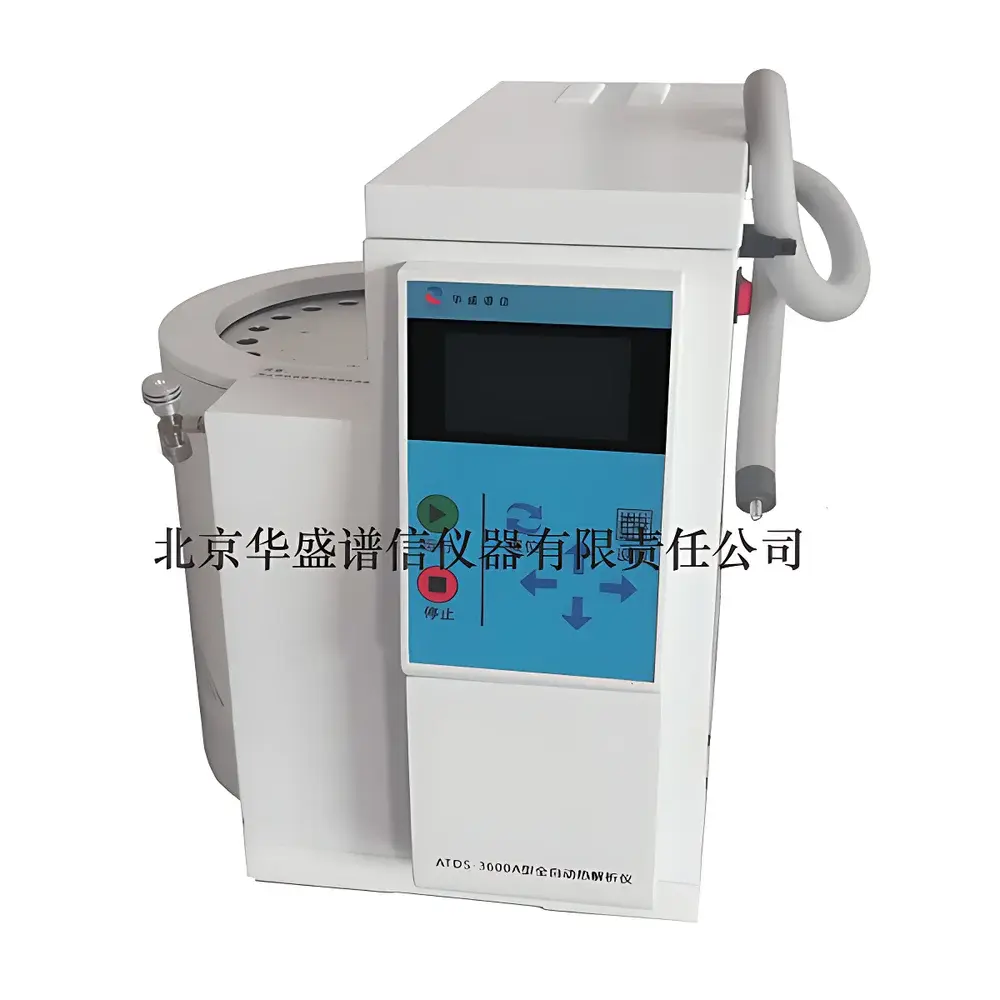
Huaspec ATDS-3600A Fully Automated Two-Stage Thermal Desorber
| Origin | Beijing, China |
|---|---|
| Manufacturer Type | Authorized Distributor |
| Product Origin | Domestic (China) |
| Model | ATDS-3600A |
| Price Range | USD 14,000 – 42,000 |
| Instrument Type | Two-Stage Thermal Desorber / Thermal Desorption Unit |
| Desorption Temperature Range | −30 °C to 400 °C |
| Cold Trap Temperature Range | −30 °C to 50 °C |
| Desorption Recovery Rate | >95% |
| Sample Capacity | 20 positions |
| Temperature Control Accuracy | <±0.1 °C |
| Heating Ramp Rate | >2000 °C/min |
| Carrier Gas Flow | 0–400 mL/min (continuously adjustable) |
| Dimensions | 450 × 360 × 510 mm |
Overview
The Huaspec ATDS-3600A is a fully automated two-stage thermal desorption system engineered for high-fidelity, quantitative analysis of volatile and semi-volatile organic compounds (VOCs and SVOCs) in environmental, occupational health, indoor air quality, and industrial emission monitoring applications. It operates on the principle of thermally driven analyte release from sorbent tubes—first-stage desorption transfers trapped volatiles into a cryogenically focused cold trap; second-stage flash desorption injects the concentrated analyte band onto the GC or GC-MS column with minimal band broadening. This dual-stage architecture ensures superior sensitivity, reproducibility, and recovery (>95%) across complex matrices—including ambient air, vehicle cabin air, stack emissions, building materials, and consumer products—while eliminating manual handling errors and enabling unattended batch processing of up to 20 samples.
Key Features
- Fully automated 20-position sample carousel with auto-positioning and self-diagnostic startup sequence, including real-time fault detection and visual/audible alerts
- Independent, precision temperature control (±0.1 °C) for three critical zones: sample bed (up to 400 °C), valve manifold (up to 220 °C), and transfer line (up to 220 °C), all programmable in 1 °C increments
- Electronically cooled cold trap operating from −30 °C to +50 °C—eliminating dependency on liquid nitrogen and supporting robust method development for low-boiling compounds (e.g., C2–C6 hydrocarbons)
- High-speed thermal ramp capability (>2000 °C/min) for sharp, narrow-band second-stage desorption—critical for chromatographic resolution and detection limit optimization
- Integrated carrier gas regulation module compatible with both internal and external GC/GC-MS systems; no hardware modification required to existing instruments
- Dual-mode operation interface: intuitive LED touchscreen plus physical keypad, supporting method storage (up to 10 user-defined protocols) and time-based event sequencing (desorption, injection, back-flush, bake-out)
- Active back-flush functionality for both transfer line and inlet valve—preventing carryover and cross-contamination between sequential analyses
- Optional accessories include ambient-temperature or cryogenic secondary desorption modules, purge-and-trap integration, and fused silica or deactivated quartz transfer tubing for reactive analytes (e.g., aldehydes, acids, amines)
Sample Compatibility & Compliance
The ATDS-3600A is validated for use with standard 6-mm OD stainless steel or glass sorbent tubes (e.g., Tenax TA, Carbopack B/C, Carboxen series) and supports both single- and multi-bed configurations. Its performance meets or exceeds requirements specified in multiple regulatory and standard methods, including but not limited to: EPA TO-17, HJ 644–2013 (ambient air VOCs), HJ/T 400–2007 (in-vehicle VOCs), HJ 734–2014 (stationary source emissions), GB/T 18883–2002 (indoor air quality), HJ 583–2010 (solid-phase adsorption–thermal desorption–GC/MS), and GB 50325–2010 (civil construction IAQ control). All temperature ramps, dwell times, and gas flows are fully traceable and auditable—supporting GLP-compliant workflows and 21 CFR Part 11–ready data integrity when integrated with compliant chromatography data systems.
Software & Data Management
Instrument control is managed via embedded microprocessor firmware with real-time status visualization (including animated workflow diagrams, elapsed time counters, and zone-specific temperature plots). Method parameters—including desorption profiles, cold trap focusing duration, transfer line equilibration, and GC trigger timing—are defined in ASCII-based configuration files, ensuring portability and version control. The system provides TTL-level synchronization outputs for direct GC/GC-MS start command initiation and accepts external TTL triggers for coordinated instrument orchestration. Raw thermal event logs (timestamped temperature setpoints, actual readings, valve actuation events, and gas flow values) are exported in CSV format for LIMS integration or audit trail reconstruction. Optional software modules enable remote monitoring via Ethernet and support scheduled maintenance reminders based on operational hour counters.
Applications
The ATDS-3600A serves laboratories performing routine and research-grade analysis of trace-level organics in regulated and non-regulated matrices. Typical use cases include: quantification of benzene, toluene, ethylbenzene, xylenes (BTEX), polycyclic aromatic hydrocarbons (PAHs), chlorinated solvents, oxygenated VOCs (e.g., formaldehyde, acetaldehyde), and emerging contaminants (e.g., siloxanes, fluorotelomers) in ambient and workplace air; screening of VOC emissions from polymers, adhesives, paints, and composite materials per ISO 16000 series; validation of HVAC filtration efficiency; and forensic identification of odor sources in residential or commercial buildings. Its modular design also accommodates custom method development for pharmaceutical residual solvent analysis (ICH Q3C) and semiconductor cleanroom monitoring.
FAQ
Does the ATDS-3600A require liquid nitrogen for cold trapping?
No—the system employs solid-state electronic cooling to achieve −30 °C without cryogens, reducing operational cost and safety hazards.
Can it be used with Agilent, Thermo, or Shimadzu GC/GC-MS systems?
Yes—it features universal pneumatic and electrical interfaces, including OEM-specific signal adapters for bidirectional communication and hardware-triggered synchronization.
Is method validation documentation available?
Yes—Huaspec provides factory calibration certificates, temperature uniformity test reports, and recovery validation data against certified reference standards (e.g., NIST SRM 1649b).
What maintenance intervals are recommended?
Quarterly inspection of O-rings, valve seals, and sorbent tube ports is advised; annual verification of temperature accuracy and cold trap performance is recommended for GLP environments.
Can the system be integrated into an automated laboratory workflow?
Yes—it supports RS-232, Ethernet, and dry-contact I/O for integration with robotic sample handlers, LIMS, and enterprise scheduling platforms.
Related Products





