
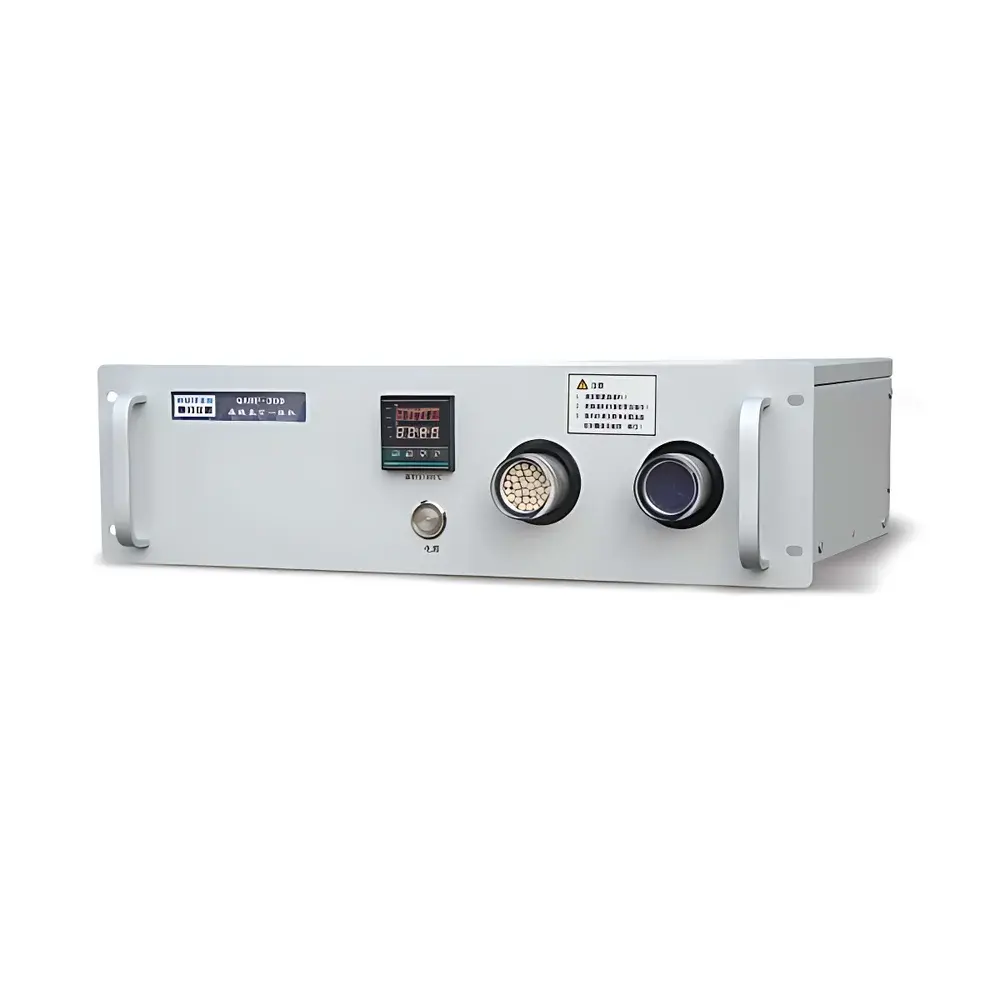
Huifen Instruments QTHF-80 Online Hydrocarbon Scrubber
| Brand | Huifen Instruments |
|---|---|
| Origin | Shandong, China |
| Manufacturer Type | Authorized Distributor |
| Country of Origin | China |
| Model | QTHF-80 |
| Price Range | USD 700 – 1,400 |
| Output Flow Rate | 0–2 L/min |
| Outlet Hydrocarbon Concentration (e.g., CH₄) | <0.1 ppm |
| Inlet Hydrocarbon Concentration (e.g., CH₄) | <100 ppm |
| Catalytic Reaction Temperature | 350 °C |
| Dimensions | 339 × 486 × 132 mm (3U rack-mountable) |
Overview
The Huifen Instruments QTHF-80 Online Hydrocarbon Scrubber is an engineered gas purification system designed for continuous, real-time removal of trace hydrocarbons—primarily methane (CH₄), ethane, propane, and other volatile organic compounds (VOCs)—from compressed air streams used in analytical laboratories and high-purity gas supply networks. It operates on the principle of catalytic oxidation: ambient or instrument-grade compressed air passes through a fixed-bed reactor containing a high-activity platinum-palladium (Pt-Pd) bimetallic catalyst, where hydrocarbons are quantitatively oxidized to CO₂ and H₂O at a precisely controlled temperature of 350 °C. Unlike adsorption-based purifiers, this thermal-catalytic approach ensures stable, non-saturating performance over extended operation periods—critical for applications demanding uninterrupted baseline stability in GC-FID, TO-CAE, FTIR, and zero-air generation systems.
Key Features
- High-efficiency Pt-Pd catalyst with certified conversion efficiency >99.9% for C₁–C₄ hydrocarbons at rated flow;
- Integrated pressure-regulated, temperature-stabilized airflow control module ensuring consistent residence time and thermal uniformity across the catalyst bed;
- Rack-mountable 3U form factor (339 × 486 × 132 mm) compliant with standard 19-inch laboratory equipment enclosures;
- Maximum inlet pressure tolerance: ≤0.6 MPa (87 psi), compatible with common oil-free compressors and central air systems;
- No consumables or replaceable cartridges—catalyst lifetime exceeds 12,000 hours under typical lab conditions (≤5 ppm inlet hydrocarbons);
- Passive thermal management architecture; no external cooling water or forced-air fans required;
- CE-marked power supply (220 VAC ±10%, 50/60 Hz) with internal overtemperature and overpressure safety interlocks.
Sample Compatibility & Compliance
The QTHF-80 is validated for use with dry, particle-free compressed air meeting ISO 8573-1 Class 2:2:2 specifications (solid particles ≤0.1 µm, dew point ≤−40 °C, oil content ≤0.1 mg/m³). It is not intended for direct integration into hydrocarbon-laden process streams (e.g., refinery off-gas) or corrosive gas matrices (e.g., Cl₂, H₂S, NH₃). The unit complies with IEC 61000-6-2 (EMC immunity) and IEC 61000-6-4 (EMC emissions) standards. While not FDA 21 CFR Part 11–certified as a standalone device, its output air meets ASTM D6166-22 requirements for “hydrocarbon-free air” in calibration gas preparation and satisfies ISO 14644-1 Class 5 cleanroom air support protocols when paired with upstream filtration.
Software & Data Management
The QTHF-80 is a hardware-only, analog-operated unit with no embedded firmware, touchscreen interface, or digital communication ports (e.g., RS-485, Modbus, Ethernet). All operational parameters—including inlet pressure, catalyst bed temperature (monitored via redundant K-type thermocouples), and status indicators—are displayed via front-panel LED indicators and mechanical gauges. For labs requiring audit-ready documentation, optional third-party data loggers (e.g., Omega OM-DAQPRO-5300) can be connected to analog 4–20 mA outputs for catalyst temperature and outlet pressure. No proprietary software is provided; integration into LIMS or SCADA environments relies solely on standard 4–20 mA signal interpretation per ISA-50.00.01 guidelines.
Applications
- Zero-air generation for flame ionization detectors (FID) in gas chromatography (GC-FID) and total hydrocarbon analyzers (THA);
- Purification of instrument air for Fourier-transform infrared (FTIR) spectrometers and cavity ring-down spectroscopy (CRDS) systems;
- Supplying ultra-low-hydrocarbon air to environmental monitoring stations (e.g., EPA Method 25A compliance testing);
- Support gas conditioning in semiconductor metrology tools requiring sub-ppb VOC-free purge air;
- Pre-purification stage in multi-stage gas purification trains for high-resolution mass spectrometry (HRMS) and PTR-TOF instruments.
FAQ
What is the recommended maximum inlet hydrocarbon concentration for sustained catalyst life?
For optimal longevity (>10,000 h), inlet hydrocarbon load should remain below 50 ppm (as methane equivalent). Operation above 100 ppm requires pre-filtration with activated carbon or cryogenic traps.
Does the QTHF-80 require periodic catalyst regeneration?
No. The Pt-Pd catalyst is non-regenerable in situ and does not require scheduled thermal cycling or chemical treatment. Replacement is only necessary after confirmed performance decay (e.g., outlet >0.2 ppm CH₄ at 2 L/min flow), typically after ≥12,000 h of continuous use.
Can it be installed vertically or horizontally?
Yes—orientation is unrestricted. However, horizontal mounting is recommended to minimize thermal gradient effects across the catalyst bed and ensure uniform gas distribution.
Is the unit suitable for use with nitrogen or synthetic air?
It is validated exclusively for compressed air. Use with N₂ or synthetic air is not supported due to insufficient oxygen partial pressure (<20.9%) required for stoichiometric hydrocarbon oxidation.
What maintenance schedule is advised?
Monthly visual inspection of inlet filter (if installed upstream), quarterly verification of inlet pressure and temperature readings against calibrated references, and annual validation of outlet hydrocarbon concentration using a certified FID analyzer per ISO 17025-accredited procedure.



