
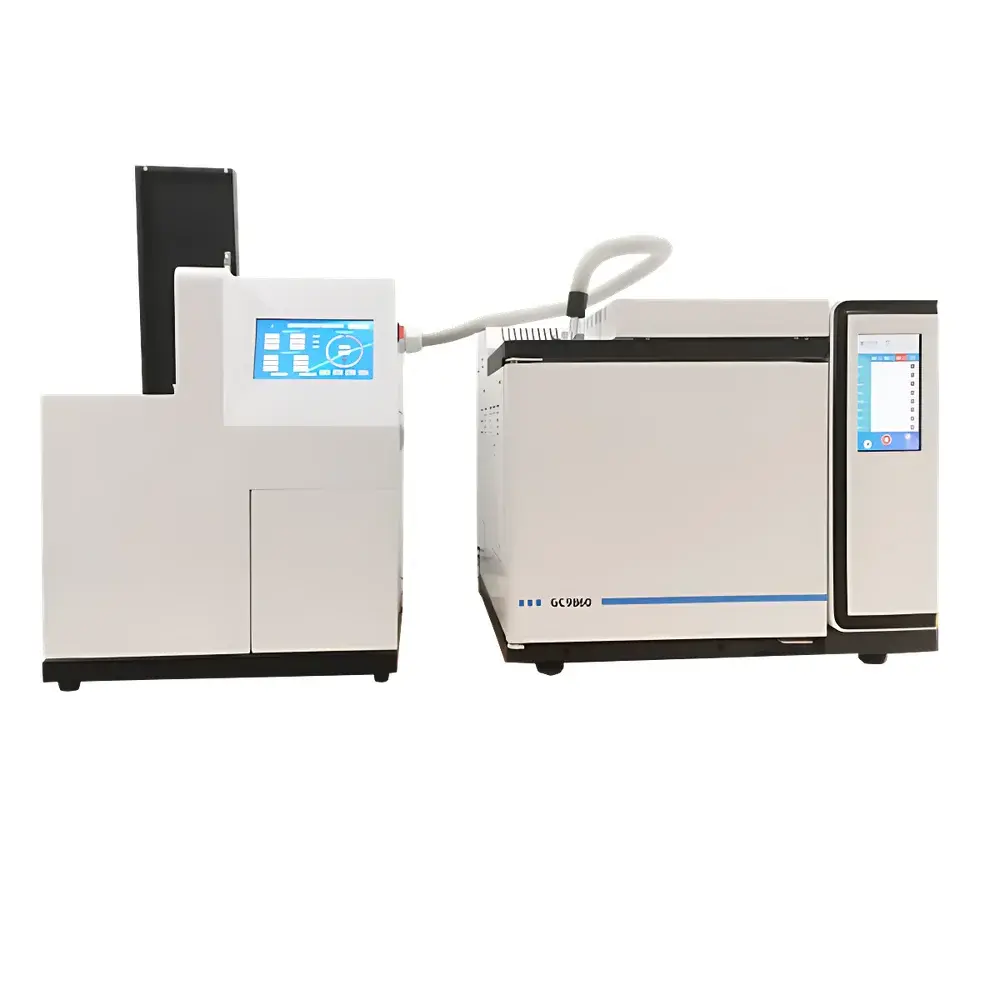
Huipu GC-9860 Gas Chromatograph with AHS-20A Plus Automated Headspace Sampler for EO and 2-Chloroethanol (ECH) Residue Analysis in Medical Devices
| Brand | Huipu |
|---|---|
| Origin | Hebei, China |
| Manufacturer Type | Direct Manufacturer |
| Instrument Type | Laboratory Gas Chromatograph |
| Application Field | Pharmaceutical & Medical Device Residue Analysis |
| Detection Method | Headspace-GC/FID |
| Column | PEG-20M, 30 m × 0.32 mm × 0.5 µm |
| Oven Temp | 120 °C (isothermal) |
| Injector & Detector Temp | 150 °C |
| Carrier Gas | High-Purity N₂ (35 mL/min) |
| H₂ Flow | 35 mL/min |
| Air Flow | 350 mL/min |
| Headspace Temp | 80 °C (10 min equilibration) |
| Quantitation Range | EO: 0.1–100 µg/g |
| ECH | 3–100 ppm |
| Compliance Standards | GB/T 14233.1–2008, GB/T 16886.7–2015, ISO 10993-7:2008 |
Overview
The Huipu GC-9860 Gas Chromatograph integrated with the AHS-20A Plus Automated Headspace Sampler is a validated analytical system engineered for precise quantification of residual ethylene oxide (EO) and 2-chloroethanol (ECH) in sterilized medical devices. It operates on the principle of static headspace gas chromatography coupled with flame ionization detection (GC-FID), enabling selective, sensitive, and reproducible measurement of volatile sterilant residuals without matrix interference. EO—widely used for low-temperature terminal sterilization of heat-sensitive devices—is classified as a Group 1 human carcinogen (IARC); ECH, its hydrolysis byproduct, exhibits acute toxicity and mutagenic potential. Regulatory frameworks including ISO 10993-7:2008 and GB/T 16886.7–2015 mandate strict control of both analytes prior to device release. This system meets the methodological requirements for validation per ICH Q2(R2), supporting linearity, accuracy, precision, LOD/LOQ, and robustness assessments under GLP-compliant laboratory environments.
Key Features
- 6th-generation Electronic Pressure Control (EPC) ensuring ±0.01 °C oven temperature stability and <0.5% thermal accuracy across 8 independently controlled zones (range: 5–380 °C)
- Integrated Bluetooth 5.0 and 10/100M Ethernet interface enabling remote instrument control, real-time parameter monitoring, and LIMS interoperability via Modbus/TCP protocol
- FID detector with detection limit ≤3×10⁻¹² g/s (n-hexadecane), linear dynamic range ≥10⁶, and automated ignition/failure recovery logic
- AHS-20A Plus autosampler featuring 20-position vial capacity, programmable equilibration (40–220 °C), pressurization (0–0.25 MPa), and quantitative loop injection (1 mL standard, customizable)
- Inert, heated transfer lines (up to 220 °C) and deactivation-treated six-port valve minimize adsorption, carryover, and degradation of polar analytes such as ECH
- DOTHUNET chromatography workstation supporting up to 300 concurrent GC units, 21 CFR Part 11-compliant audit trail, electronic signatures, and automated report generation per USP and Ph. Eur. 2.4.24
Sample Compatibility & Compliance
The system accommodates solid and liquid medical device samples—including polymeric catheters, syringes, IV sets, and surgical drapes—following extraction protocols specified in GB/T 14233.1–2008. Samples are immersed in water (5.0 mL) at 37 °C for ≥1 h; headspace analysis eliminates derivatization or solvent cleanup steps. All hardware and software comply with ISO/IEC 17025:2017 general requirements for testing laboratories. Data integrity adheres to FDA 21 CFR Part 11 through role-based access control, immutable audit logs, and electronic record retention. Method validation documentation supports regulatory submissions to NMPA, FDA, and EU MDR Annex II technical file requirements.
Software & Data Management
DOTHUNET workstation provides full bidirectional GC control, peak integration with baseline correction algorithms, and automated calibration curve fitting (linear, quadratic, or weighted). It generates compliant reports listing compound name, retention time, peak area/height, concentration (µg/g), %RSD, and pass/fail status against user-defined acceptance criteria. Raw data files (.cdf) are stored with metadata (operator ID, timestamp, instrument configuration, sequence log), and backup is supported via network-attached storage (NAS) or cloud-synced repositories. The system supports direct export to Excel, PDF, and LIMS-compatible XML formats. Optional GxP modules enable electronic batch records and deviation tracking aligned with GMP Annex 11.
Applications
This configuration is routinely deployed in QC laboratories of Class II/III medical device manufacturers, contract testing organizations (CTOs), and national institutes for metrology and drug control. Primary use cases include: validation of EO sterilization cycles; routine lot-release testing of finished devices; stability studies assessing residual migration over shelf life; investigation of ECH formation kinetics under accelerated aging conditions; and method transfer between sites per ASTM E2554 guidance. Secondary applications extend to residual solvent analysis in pharmaceutical excipients (ICH Q3C), packaging leachables (USP ), and environmental monitoring of sterilization chamber exhaust.
FAQ
What regulatory standards does this system support for EO/ECH testing?
It fully implements GB/T 16886.7–2015, ISO 10993-7:2008, and aligns with USP , EP 2.4.24, and ASTM F2737 for method validation parameters.
Can the system quantify ethylene glycol (EG) alongside EO and ECH?
While EG is thermally labile and poorly volatile, optional derivatization with BSTFA or use of a TCD detector may extend capability—but EG is not routinely monitored per ISO 10993-7 due to negligible biological risk when EO is controlled.
Is method validation assistance available from the manufacturer?
Yes—Huipu provides IQ/OQ documentation templates, system suitability test protocols, and application notes covering LOD/LOQ determination, specificity testing against common polymer extractables, and robustness evaluation per ICH Q2(R2).
How is carryover mitigated during high-throughput ECH analysis?
The AHS-20A Plus incorporates programmable post-injection bake-out (up to 220 °C), inert fused-silica transfer lines, and a dedicated purge flow (0–100 mL/min) to eliminate residual ECH from the sampling path.
Does the system support unattended overnight operation?
Yes—the GC-9860 features scheduled shutdown/startup, automatic leak check before sequence initiation, and fault-tolerant queue management that resumes interrupted sequences upon recovery.
Related Products





