
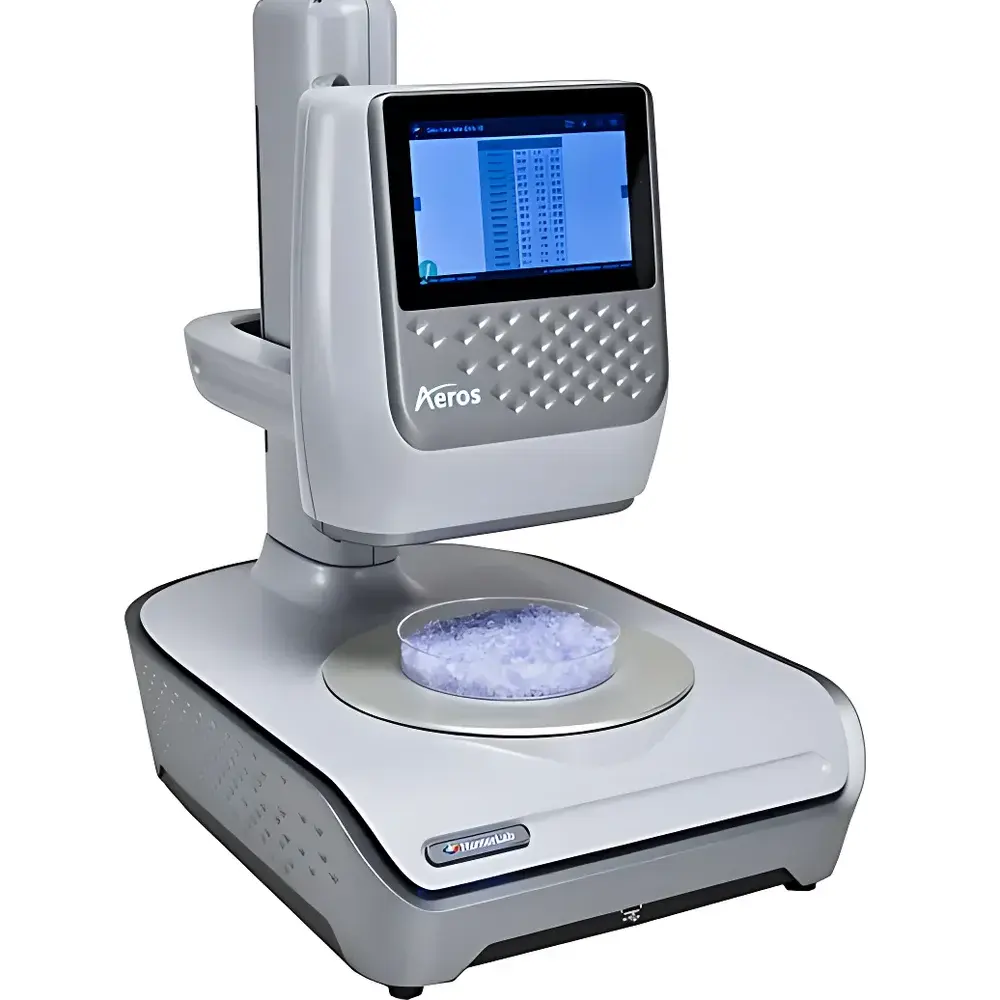
HunterLab Aeros Non-Contact Spectrophotometer
| Brand | HunterLab |
|---|---|
| Origin | USA |
| Model | Aeros Non-Contact Spectrophotometer |
| Instrument Type | Benchtop |
| Optical Geometry | 0/45° Integrating Sphere |
| Light Source | Full-Spectrum LED (Cold White) |
| Spectral Range | 400–700 nm |
| Repeatability | ΔE*ab ≤ 0.03 (mean, CIE Lab, standard tile) |
Overview
The HunterLab Aeros Non-Contact Spectrophotometer is a benchtop spectral color measurement system engineered for high-fidelity, non-destructive analysis of heterogeneous, irregular, and textured surfaces—without physical contact or sample preparation. Based on diffuse reflectance spectroscopy in a calibrated 0/45° optical geometry, the Aeros captures spectrophotometric data across the visible spectrum (400–700 nm) using a stable, thermally managed full-spectrum LED illuminant. Unlike conventional contact-based instruments constrained by flatness, homogeneity, or surface compliance, the Aeros employs a patented height-sensing probe and motorized rotating sample platform to dynamically adapt measurement conditions to real-world industrial samples—including coffee beans, snack foods, plastic granules, ceramic powders, and mineral aggregates. Its core innovation lies in spatial averaging over large surface areas (up to 223.2 cm² per scan), enabling statistically robust color characterization where traditional spot measurements fail.
Key Features
- Auto-Height Positioning: Integrated ultrasonic distance sensor detects sample topography in real time and adjusts probe-to-sample working distance to the optimal focal plane—ensuring consistent illumination geometry and minimizing specular interference.
- Non-Contact Measurement: Eliminates cross-contamination, surface abrasion, and compression artifacts common with contact probes; critical for hygienic food, pharmaceutical, and high-value material applications.
- Rotating Sample Platform: Motor-driven stage completes one full 360° rotation in 5 seconds, acquiring 35 discrete spectral readings per revolution—providing comprehensive spatial coverage and reducing sampling bias in particulate or granular materials.
- Industrial-Grade Touch Interface: 7-inch high-resolution capacitive touchscreen with chemically strengthened industrial glass; supports swipe, tap, and gesture navigation—operable with gloves and resistant to ambient light washout.
- Embedded Color Management Software: EasyMatch Essentials® runs natively on the instrument’s ARM-based processor—supporting CIE L*a*b*, L*C*h*, ΔE*ab, ΔE00, Yellowness Index (YI), Whiteness Index (WI), and custom tolerancing without external PC dependency.
- Sealed Optomechanical Architecture: Fully enclosed LED light engine and precision-machined integrating sphere; brushless DC motor housed in an IP54-rated shielded enclosure—designed for long-term stability in production environments with dust, vibration, or thermal fluctuation.
Sample Compatibility & Compliance
The Aeros is validated for use with non-planar, high-relief, and optically complex samples that violate assumptions of classical colorimetry. It meets ASTM D2244 (Standard Practice for Calculation of Color Tolerances), ISO 11664-4 (CIE colorimetric observers), and ISO 7724-1 (Colorimetry – Part 1: CIE Standard Illuminants). Its measurement protocol aligns with FDA guidance for color consistency in food and packaging (21 CFR §101.22), and its audit-trail-capable software architecture supports GLP/GMP workflows under 21 CFR Part 11 when deployed with networked authentication and electronic signature controls. Calibration traceability is maintained to NIST-traceable standards via factory-certified white tiles and annual verification protocols.
Software & Data Management
EasyMatch Essentials® provides embedded color analysis, pass/fail evaluation against user-defined tolerances, batch reporting, and statistical summary (mean, SD, min/max ΔE). Data export supports CSV, PDF, and XML formats—with direct email transmission (SMTP), local/network printer output (PCL/PostScript), and secure API-driven integration into LIMS (e.g., Thermo Fisher SampleManager, LabVantage) and SPC systems (e.g., Minitab, InfinityQS). Remote Access Support (RAS) enables encrypted, session-limited technician access for diagnostics, firmware updates, and guided troubleshooting—fully compliant with ISO/IEC 27001 information security principles. All instrument events—including calibration, user login, and measurement history—are logged with timestamps and operator IDs for regulatory review.
Applications
- Food & Beverage: Roasted coffee bean lot consistency, confectionery coating uniformity, extruded snack color grading, spice blend homogeneity assessment.
- Plastics & Polymers: Recycled PET flake color sorting, masterbatch dispersion validation, injection-molded part batch release testing.
- Pharmaceuticals & Nutraceuticals: Tablet coating color uniformity (per USP ), capsule shell hue verification, herbal powder batch-to-batch comparability.
- Minerals & Ceramics: Kaolin whiteness index tracking, pigment-coated sand color stability, refractory aggregate batch qualification.
- Consumer Goods: Fabric swatch matching for irregular weaves, leather grain color consistency, wood composite panel surface tone verification.
FAQ
Does the Aeros require daily calibration?
No—its thermally stabilized LED source and sealed optical path ensure drift <0.01 ΔE*ab/month. A single daily verification with the included calibration tile is sufficient for most QC environments.
Can the Aeros measure liquids or translucent materials?
It is optimized for opaque, diffusely reflecting solids. Liquids, gels, or semi-transparent films require specialized accessories (e.g., transmission cell, integrating sphere with port adapter) not included in the base configuration.
Is RAS (Remote Access Support) enabled by default?
RAS is disabled at factory shipment. Activation requires explicit user consent, network configuration, and time-limited session keys generated per support request—ensuring no persistent remote access.
What spectral resolution does the Aeros provide?
The instrument reports reflectance at 10-nm intervals across 400–700 nm (31 data points), conforming to CIE 15:2018 spectral sampling requirements for colorimetric computation.
How is measurement area defined during rotation?
The 223.2 cm² coverage is calculated from the effective illuminated footprint (Ø 45 mm) multiplied by the angular sweep density (35 readings × 360°), ensuring representative spatial sampling—not continuous imaging.





