
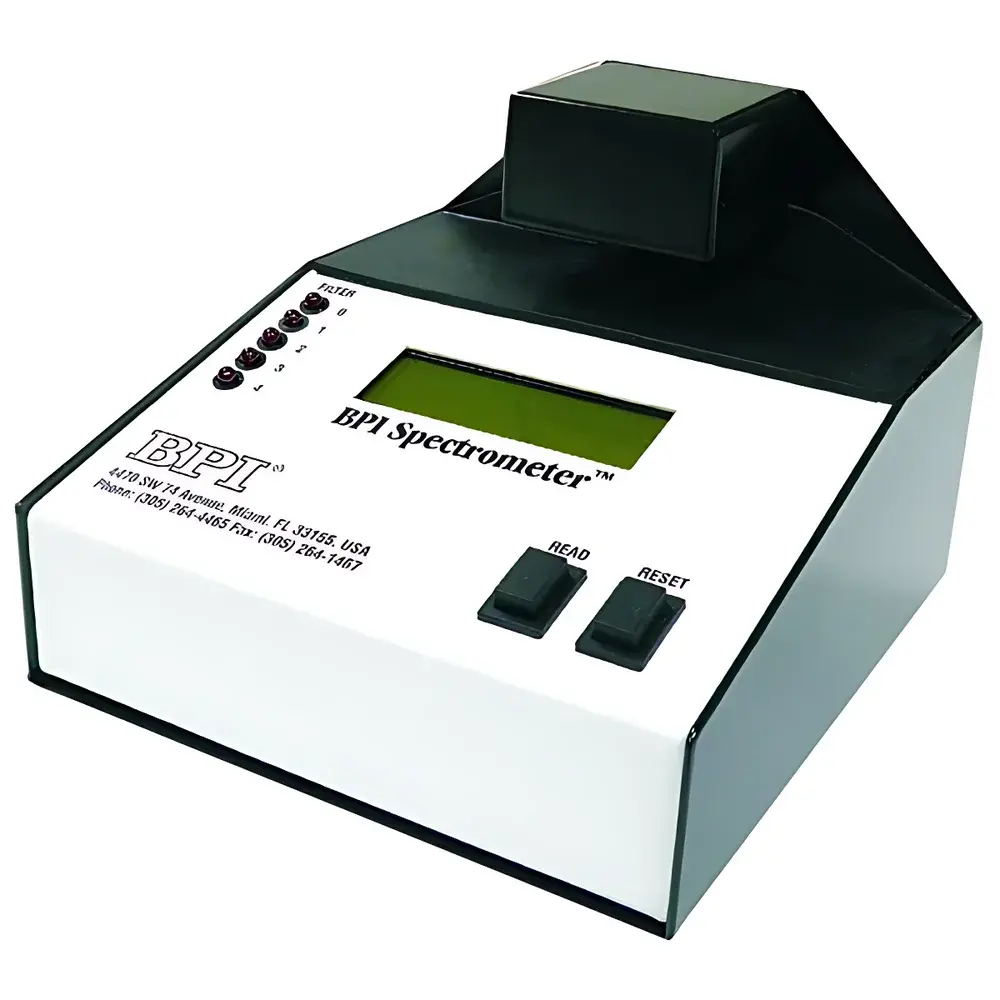
HunterLab BPI Spectrophotometer for Lens Chromatic Aberration Analysis
| Brand | HunterLab |
|---|---|
| Origin | USA |
| Model | BPI |
| Optical Configuration | Single-beam |
| Wavelength Range | 350–710 nm |
| Spectral Bandwidth | 10 nm |
| Wavelength Automation | Automatic |
| Dimensions | 6.75" L × 6.25" W × 5" H |
| Weight | 8.5 lb |
| Power Supply | 110 V AC, 50/60 Hz, 1 A |
| Color Space Output | CIELAB (L*, a*, b*) |
| Transmittance Metrics | Visible Light Transmittance (Tv), UVA Transmittance (315–400 nm) |
| Compliance | Meets U.S. DOT and ECE R43 requirements for traffic signal visibility |
Overview
The HunterLab BPI Spectrophotometer is a purpose-engineered single-beam visible spectrophotometer designed specifically for objective color and transmittance characterization of ophthalmic lenses, safety eyewear, automotive glazing, and optical filters. Operating on the principle of monochromator-based UV-Vis absorption/transmission spectroscopy, the BPI delivers calibrated spectral data across the photobiologically relevant range of 350 nm to 710 nm—fully covering the human photopic response (CIE 1931 standard observer) and extending into near-UV for UVA transmittance assessment. Its fixed 10 nm spectral bandwidth ensures reproducible, industry-comparable measurements while maintaining sufficient resolution to resolve characteristic absorption features of tinted polymer lens materials (e.g., polycarbonate, CR-39, Trivex). Unlike general-purpose spectrophotometers, the BPI integrates a stabilized tungsten-halogen light source and optimized optical path geometry to minimize stray light and maximize signal-to-noise ratio in transmission mode—critical for accurate Tv and chromatic coordinate derivation.
Key Features
- Single-beam architecture with integrated, thermally stabilized tungsten-halogen lamp and precision grating monochromator
- Automated wavelength scanning from 350 nm to 710 nm in user-defined increments (1 nm default)
- Direct CIELAB color space output (L*, a*, b*) calculated per CIE Publication 15:2004 and ISO 11664-4:2019
- Simultaneous calculation of visible light transmittance (Tv, per ISO 13666 and EN 1836) and UVA transmittance (315–400 nm)
- Onboard LCD display showing real-time spectral data, color coordinates, and transmittance values
- USB 2.0 interface for connection to Windows-based PCs (Windows 10/11, 64-bit recommended)
- Embedded database for local storage of up to 1,000 sample records with timestamp, operator ID, and measurement metadata
- Compliance-ready reporting: preconfigured templates aligned with U.S. Department of Transportation (DOT) FMVSS No. 205 and European ECE Regulation No. 43 for traffic signal recognition
Sample Compatibility & Compliance
The BPI accommodates plano and curved lenses up to 8 mm thickness and 80 mm diameter via its fixed sample holder with spring-loaded aperture alignment. It supports both clear and dyed organic lenses, photochromic materials (in activated and bleached states), and coated substrates—including anti-reflective, blue-light filtering, and polarization layers. All optical measurements adhere to ASTM E308-22 (computing tristimulus values from spectral data) and ISO/CIE 11664-1:2019 (colorimetry fundamentals). Tv results are traceable to NIST SRM 930e filter standards. The instrument’s firmware and software support audit trails and electronic signatures compliant with FDA 21 CFR Part 11 when deployed in regulated quality assurance environments (e.g., ISO 13485-certified medical device manufacturing).
Software & Data Management
HunterLab’s proprietary BPI Control Software (v3.x) provides full instrument control, spectral visualization, and comparative analysis. Users can overlay multiple transmittance curves on a single graph, perform delta-E*ab (CIEDE2000) calculations between samples, and export data in CSV, XML, or PDF formats. The software enforces role-based access control (administrator, analyst, reviewer), logs all parameter changes and measurement events, and generates GMP-compliant reports with embedded calibration certificates and uncertainty statements. Raw spectral data (.spc files) are stored with embedded instrument configuration metadata, enabling retrospective reprocessing using updated color-matching functions without rescanning.
Applications
- Quantitative matching of lens tint batches against master standards during QC release testing
- Determination of color shift induced by thermal aging, UV exposure, or chemical cleaning protocols
- Validation of UVA-blocking performance for occupational safety eyewear per ANSI Z87.1-2020
- Development of custom-tint formulations using spectral difference mapping and inverse modeling
- Verification of compliance with chromaticity limits for red/green/yellow signal lens filters in transportation applications
- Correlation of instrumental color coordinates (L*, a*, b*) with subjective visual assessments under standardized D65 illumination
FAQ
Does the BPI require external calibration standards for routine operation?
No—the instrument performs automatic zero and reference calibration at startup using internal shutter and reference tile. NIST-traceable calibration verification is recommended annually using HunterLab’s optional CR-2000 reference set.
Can the BPI measure reflectance or only transmittance?
The BPI is configured exclusively for transmission-mode measurement. Reflectance analysis requires a separate integrating sphere accessory not supported by this model.
Is the software validated for use in FDA-regulated environments?
Yes—BPI Control Software v3.2+ includes 21 CFR Part 11 modules (electronic signatures, audit trail, secure login) and is supplied with IQ/OQ documentation packages for laboratory validation.
What is the minimum measurable transmittance value?
The system achieves <0.1% transmittance detection limit at 400 nm with 1 s integration time, sufficient for high-density neutral density filters and deep-tinted safety lenses.
Does the BPI support GLP-compliant data archiving?
Yes—data files include digital signatures, timestamped operator IDs, instrument serial numbers, and calibration history; archived datasets meet ALCOA+ principles (Attributable, Legible, Contemporaneous, Original, Accurate, Complete, Consistent, Enduring, Available).





