
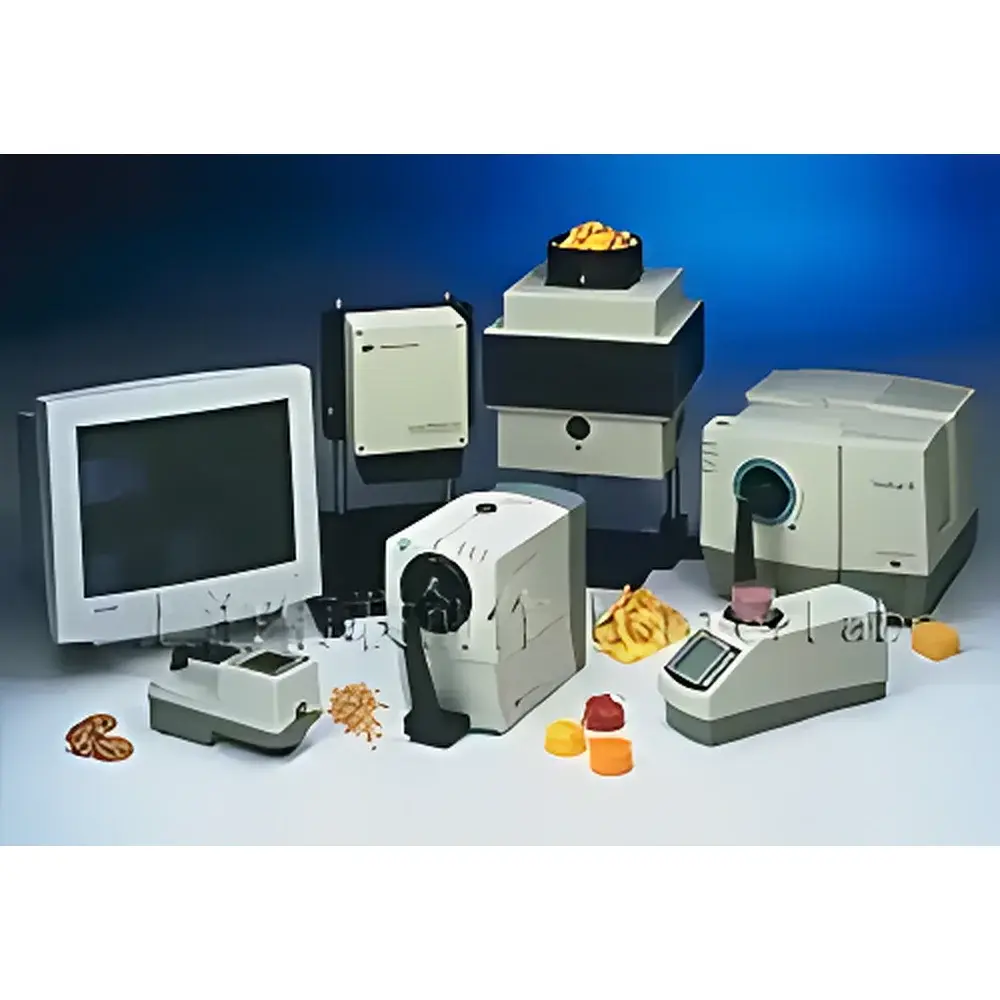
HunterLab ColorQuest XE Food Colorimeter
| Brand | HunterLab |
|---|---|
| Origin | USA |
| Model | ColorQuest XE |
| Application Domain | Food & Edible Oil Quality Analysis |
| Color Space Support | CIE L*a*b*, Hunter L,a,b, YI (ASTM D1925 & E313), WI (ASTM E313), ΔE*ab, ΔE00, etc. |
| Illuminant Options | D65, A, C, F2, F7, F11 |
| Observer Angle | 10° |
| Measurement Geometry | d/8° (diffuse illumination / 8° viewing, SCI & SCE modes) |
| Repeatability | σ ≤ 0.02 ΔE*ab (white tile, 10 readings) |
| Portability | Benchtop |
| Compliance | ISO 5-4:2022, ASTM E308, CIE No. 15:2018, FDA 21 CFR Part 11 ready (with optional software module) |
Overview
The HunterLab ColorQuest XE Food Colorimeter is a benchtop spectrophotometric color measurement system engineered for high-precision, traceable color evaluation in food manufacturing, edible oil refining, and ingredient quality control laboratories. Operating on the principle of diffuse d/8° geometry with integrated sphere technology, it captures full spectral reflectance data across the visible range (400–700 nm) at 10-nm intervals, enabling robust quantification of color attributes in accordance with internationally recognized colorimetric standards. Its optical architecture incorporates dual-beam compensation and thermally stabilized solid-state detectors to ensure long-term photometric stability—critical for batch-to-batch consistency in regulated food production environments. The instrument implements the foundational Hunter L,a,b color scale, originally developed by Dr. Richard S. Hunter in the 1950s and later harmonized with CIE standards, providing direct compatibility with decades of historical food color specification data.
Key Features
- Comprehensive color space support including CIE L*a*b*, Hunter L,a,b, CIE XYZ, Yxy, and specialized indices such as Yellowness Index (ASTM D1925 and E313) and Whiteness Index (ASTM E313)—essential for edible oil clarity, flour whiteness, sugar browning, and dairy product consistency.
- Dual-mode measurement capability: Specular Component Included (SCI) for total reflectance (ideal for formulation R&D) and Specular Component Excluded (SCE) for surface-appearance assessment (aligned with consumer perception in packaged foods).
- Integrated UV calibration and fluorescence correction—enabling accurate measurement of optically brightened food matrices (e.g., bleached starches, treated whey powders) without spectral artifact.
- Automated aperture recognition and lens-based sample positioning ensure reproducible measurement area definition (25 mm standard port), minimizing operator-induced variability across viscous, granular, or semi-solid food samples.
- Rugged, IP52-rated enclosure with corrosion-resistant sample compartment—designed for sustained operation in humid processing labs and ambient-controlled QC rooms.
Sample Compatibility & Compliance
The ColorQuest XE accommodates a broad spectrum of food-related physical forms: transparent liquids (edible oils, syrups, beverages), translucent gels (pectin solutions, agar preparations), opaque solids (ground spices, roasted coffee beans, dried fruits), and powdered commodities (wheat flour, milk powder, cocoa). Optional accessories—including liquid cells (10–50 mm pathlength), powder cups with pressure plates, and temperature-controlled sample holders—extend analytical flexibility. Regulatory alignment includes full traceability per ISO/IEC 17025:2017 requirements for testing laboratories, compliance with ASTM D6866 for bio-based content color correlation studies, and support for GLP/GMP documentation workflows. When configured with Vision software and audit trail licensing, the system meets FDA 21 CFR Part 11 requirements for electronic records and signatures in food safety validation protocols.
Software & Data Management
Vision Essential and Vision Pro software platforms provide scalable data handling—from single-instrument calibration management to enterprise-level color database synchronization across global manufacturing sites. Vision supports automated pass/fail tolerancing against master standards, statistical process control (SPC) charting (X-bar/R, Cp/Cpk), and cross-instrument color matching via networked spectral library sharing. All raw spectral data, measurement metadata (operator ID, timestamp, environmental conditions), and calibration history are stored in encrypted SQLite databases with configurable backup policies. Audit trail functionality logs every user action—including method edits, tolerance adjustments, and result deletions—with immutable timestamps and digital signature verification.
Applications
- Edible oil grading: Quantifying yellowness index drift during deodorization; detecting thermal oxidation in frying oils via b* value trends.
- Bakery & cereal QA: Monitoring Maillard reaction progression in toasted grains and extruded snacks using ΔE*ab thresholds.
- Dairy quality assurance: Assessing whey protein denaturation through spectral shifts in the 450–490 nm region correlated with L* and b*.
- Confectionery color consistency: Validating batch uniformity of caramelized sugars and fruit-based fillings under multiple illuminants (D65 for daylight, A for incandescent retail lighting).
- Regulatory reporting: Generating ASTM-compliant color test reports for FDA food labeling submissions and EU Regulation (EC) No 1333/2008 colorant documentation.
FAQ
Does the ColorQuest XE comply with FDA 21 CFR Part 11 for electronic records?
Yes—when deployed with Vision Pro software, licensed audit trail module, and validated user access controls, the system satisfies electronic signature and record integrity requirements for food safety documentation.
Can it measure highly viscous or non-homogeneous food samples?
Yes—using optional powder cups with compaction plates or heated liquid cells, the instrument maintains measurement repeatability for molasses, nut butters, and fermented pastes when standardized sample preparation protocols are followed.
Is spectral data export supported for third-party chemometric analysis?
Yes—full 400–700 nm reflectance spectra can be exported in CSV or XML format, compatible with MATLAB, Unscrambler, and Python-based PLS regression modeling pipelines.
What calibration standards are supplied with the instrument?
Each unit ships with NIST-traceable white and green ceramic tiles, certified for reflectance stability over 5 years; annual recalibration services are available through HunterLab-accredited labs globally.
How does the system handle ambient light interference during measurement?
The d/8° integrating sphere design inherently rejects external light; additionally, motorized shutter sequencing and synchronized detector gating eliminate stray-light artifacts—even in unshielded lab environments.





