
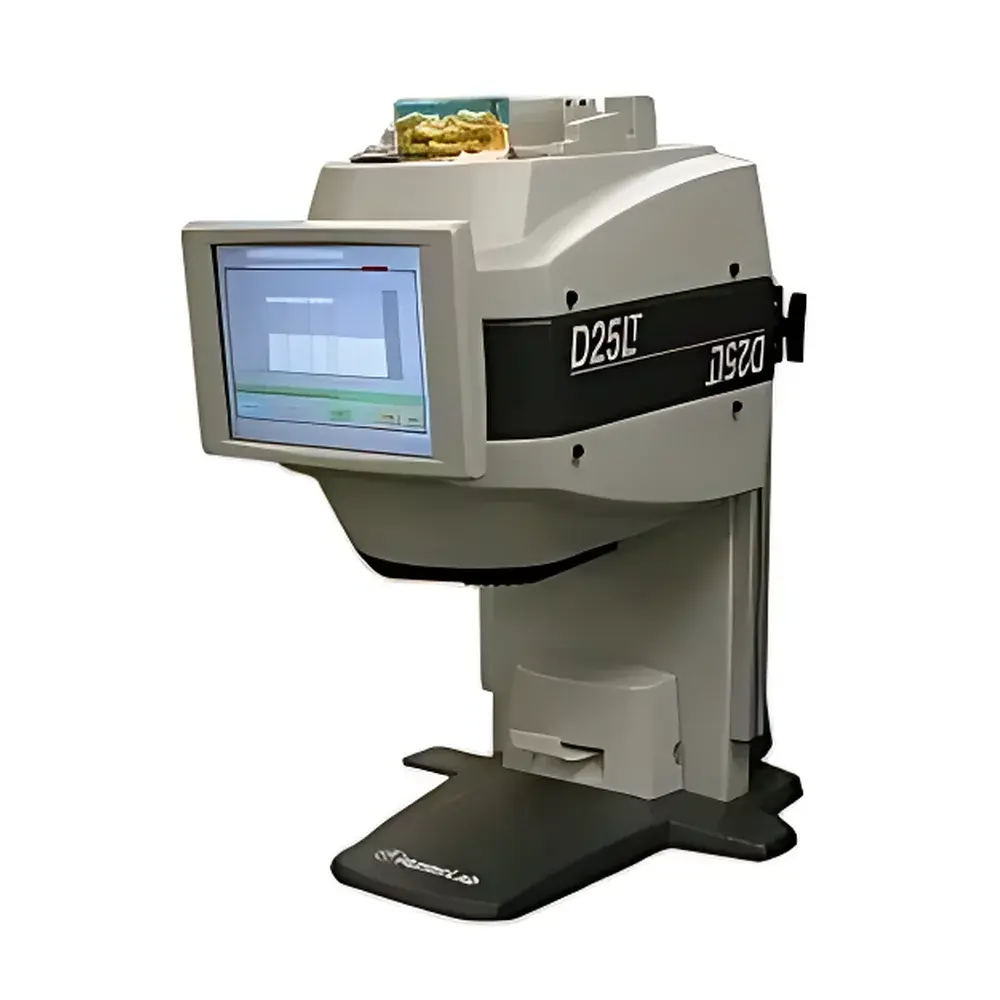
HunterLab D25LT Desktop Color Measurement System
| Brand | HunterLab |
|---|---|
| Origin | USA |
| Model | D25LT |
| Instrument Type | Benchtop Colorimeter |
| Optical Geometry | 45°/0° (Annular Illumination, Central Viewing) |
| Measurement Area | 3.75 in (9.5 cm) diameter |
| Observer Angle | 2° |
| Illuminant | C (Simulated via Tungsten-Halogen Lamp) |
| Display | 10.4 in (26.4 cm) Full-Color LCD Touchscreen |
| Data Output | USB 2.0 & Ethernet (10/100BASE-T) |
| Internal Storage | Thousands of Standard & Sample Records |
| Print Output | Integrated Thermal Printer |
| Color Spaces | CIE XYZ, Yxy, Hunter Lab, CIELAB (L*a*b*), CIELCH (L*C*h), Rdab, X |
| Color Difference Metrics | ΔXYZ, ΔYxy, ΔLab, ΔRdab, ΔCIELAB, ΔCIELCH |
| Color Difference Indices | ΔE (CIE 1976), ΔEcmc (CIE 1995), ΔC*, ΔE*, ΔC, WIE313-96, YIE313-96, YID1925, Z% |
| Pass/Fail Evaluation | User-Defined Tolerances per Color Space |
| CMC (2 | 1) Tolerance Support |
| Environmental Rating | Industrial-Grade Enclosure (IP52 Equivalent), Designed for Factory Floor Use |
Overview
The HunterLab D25LT Desktop Color Measurement System is a high-precision, benchtop colorimeter engineered for robust, repeatable color evaluation of challenging industrial samples—including textured, non-uniform, irregular, and heterogeneous surfaces. Based on the standardized 45°/0° optical geometry (annular illumination with central viewing), the D25LT eliminates directional bias associated with surface texture or gloss variation—making it particularly suited for quality control in food manufacturing (e.g., baked goods, snack foods), ceramics, tiles, carpeting, plastics, coatings, and bulk chemical or mineral products. Its large 9.5 cm (3.75 in) measurement aperture ensures representative averaging across macroscopically variable areas, significantly improving measurement reproducibility compared to smaller-spot instruments when assessing real-world production samples. The system employs a stable tungsten-halogen lamp calibrated to simulate Illuminant C, enabling consistent spectral output over extended operational life without requiring frequent recalibration.
Key Features
- Large-area 45°/0° optical configuration optimized for textured, matte, and geometrically complex specimens
- 10.4-inch full-color capacitive touchscreen interface with intuitive icon-driven navigation and real-time data visualization
- Dual-orientation sample port: configurable for upward-facing (ideal for liquids in cups or shallow trays) or downward-facing (optimized for flat solids, tiles, or conveyor-mounted fixtures)
- Integrated thermal printer for immediate hardcopy reporting of standards, samples, statistics, and PASS/FAIL outcomes
- Built-in embedded operating system (Linux-based) ensuring deterministic response, firmware stability, and resistance to external malware or OS-level interference
- Industrial-grade mechanical housing rated for continuous operation in ambient temperatures from 10–40 °C and relative humidity up to 80% non-condensing
- Comprehensive onboard statistical engine supporting mean, standard deviation, min/max, range, and histogram generation across batches
Sample Compatibility & Compliance
The D25LT accommodates opaque solids, translucent films, viscous liquids, powders (in standardized cells), and granular materials without requiring custom fixtures. Its wide aperture and diffuse 45° illumination mitigate edge effects, specular reflection artifacts, and shadowing common in low-gloss or rough-surfaced substrates. The instrument complies with ASTM E308 (Standard Practice for Computing the Colors of Objects by Using the CIE System), ISO/CIE 11664 (Colorimetry series), and supports traceable calibration via NIST-traceable ceramic tile standards. While not FDA 21 CFR Part 11–certified out-of-the-box, audit trails, user access logs, and electronic signature readiness can be enabled via optional software modules aligned with GLP/GMP documentation requirements.
Software & Data Management
Data acquisition, analysis, and reporting are managed through the instrument’s native UI or via optional PC-based Vision software (v7.x). All measurements are timestamped and tagged with operator ID, sample ID, and batch metadata. Raw spectral reflectance (where applicable) and tristimulus values are stored in open CSV and XML formats. Network integration supports DHCP-assigned IP addresses, SNMP monitoring, and secure file transfer via SFTP. Internal memory retains >5,000 standard references and >10,000 sample records. USB host port enables direct export to flash drives; Ethernet port supports integration into centralized LIMS or MES platforms using standard TCP/IP protocols.
Applications
- Food QA/QC: Monitoring batch-to-batch consistency of extruded snacks, baked goods, dairy powders, and confectionery coatings
- Ceramics & Building Materials: Quantifying shade variation across fired tiles, porcelain slabs, and architectural glazes
- Plastics & Polymers: Verifying pigment dispersion uniformity in injection-molded components and extruded profiles
- Chemical Manufacturing: Tracking color drift during synthesis, purification, or aging of dyes, pigments, and pharmaceutical intermediates
- Textiles & Carpets: Objective assessment of dye lot matching under controlled illuminants
- Regulatory Reporting: Generating compliant color deviation reports for ISO 9001, IATF 16949, or customer-specific AQL protocols
FAQ
What does “45°/0°” geometry mean, and why is it preferred for textured samples?
It denotes annular 45° illumination with a coaxial 0° viewing angle—minimizing sensitivity to surface orientation, micro-gloss, and directional scattering. This geometry is specified in ASTM D2244 and ISO 13655 for non-metallic, diffusely reflecting materials.
Can the D25LT measure transparent or translucent liquids?
Yes—when used in transmission mode with optional liquid cell holders and calibrated against air and reference white, though its primary design emphasis remains reflectance measurement of solids and semi-solids.
Is remote calibration verification supported?
Yes—via downloadable calibration verification kits (e.g., HunterLab CV-100) and periodic validation using certified ceramic standards traceable to NIST SRM 2001 series.
Does the system support multi-instrument network synchronization?
Yes—through Vision software’s Instrument Manager module, enabling synchronized measurement protocols, shared standard libraries, and centralized tolerance management across multiple D25LT units.
How is data integrity ensured during power interruption?
All active measurements are buffered in non-volatile RAM; pending print jobs and unsaved records persist through brief outages and resume upon reboot without loss.



