
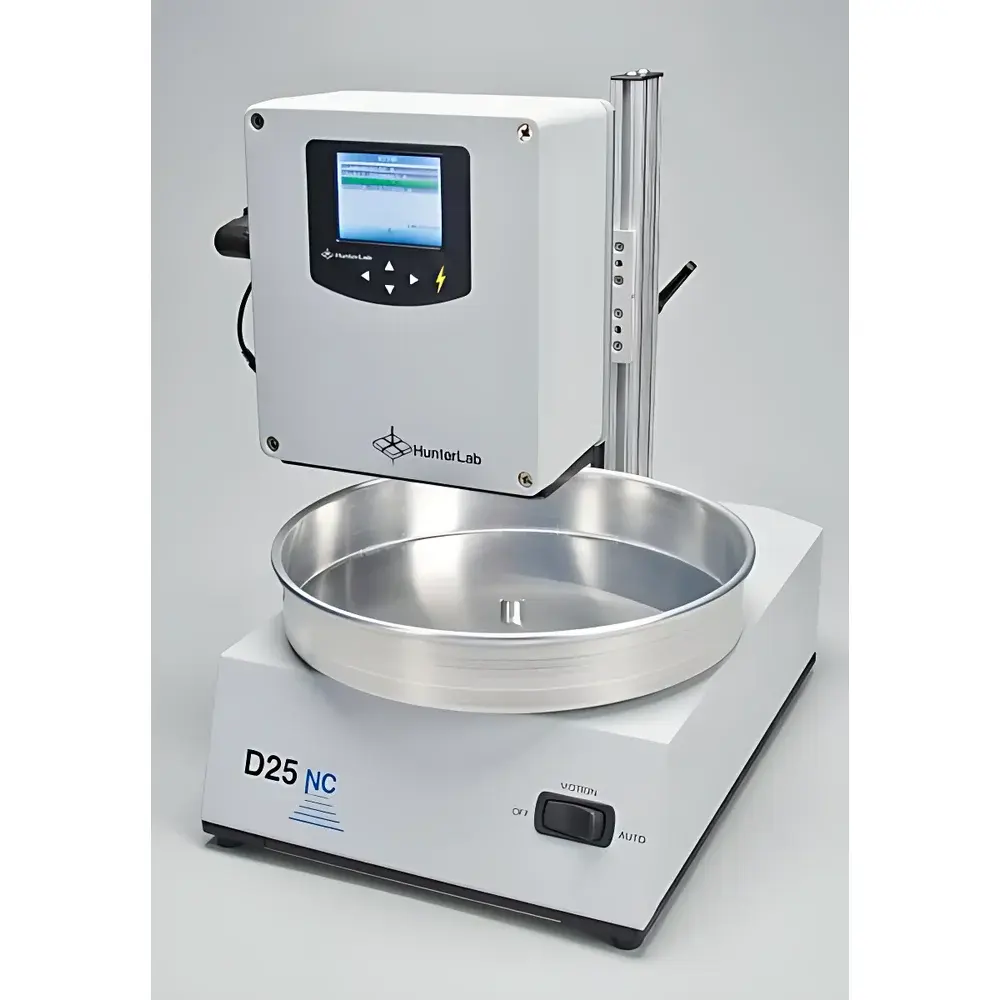
HunterLab D25NC Non-Contact Desktop Spectrophotometer
| Brand | HunterLab |
|---|---|
| Origin | USA |
| Model | D25NC |
| Product Type | Benchtop Spectrophotometric Colorimeter |
| Optical Geometry | d/8° integrating sphere |
| Light Source | Long-life LED |
| Spectral Range | 400–700 nm |
| Repeatability (ΔE*ab) | ≤0.03 |
| Measurement Area | 129 cm² |
| Sampling Rate | 5 measurements/sec, up to 25 measurements per rotation |
| Data Storage | 2000 sample records + 250 user configurations |
| Interface | USB for printer, keyboard, PC, barcode scanner |
| Software Compatibility | EasyMatch QC (optional) |
| Power | Low-energy LED architecture |
| Compliance | Designed for GLP/GMP environments |
Overview
The HunterLab D25NC is a non-contact, benchtop spectrophotometric color measurement system engineered for high-repeatability color evaluation of challenging, irregular, heterogeneous, or fragile samples—without physical contact, pressure, or sample preparation. It operates on the principle of diffuse reflectance spectroscopy using a d/8° optical geometry with an integrated 129 cm² measurement aperture and a precisely calibrated long-life LED light source spanning the full visible spectrum (400–700 nm). Unlike traditional contact-based colorimeters, the D25NC employs a fixed-height, motorized rotating sample platform combined with a vertically aligned, auto-focused measurement head that maintains consistent working distance and illumination uniformity across variable topographies. This architecture eliminates height-dependent color bias and enables true spatial averaging over large surface areas—critical for granular, particulate, textured, or multi-colored materials where conventional spot measurements fail to represent bulk appearance.
Key Features
- Non-contact measurement head with automatic height compensation—ensures consistent ΔE*ab repeatability ≤0.03 regardless of sample thickness or surface contour
- Motorized 360° rotating sample tray enabling full-cycle spatial averaging (up to 25 readings per revolution at 5 Hz acquisition rate)
- Large 129 cm² measurement area optimized for bulk solids, pellets, flakes, powders, and irregular geometries (e.g., coffee beans, animal feed, extruded plastics, baked goods)
- Tool-free modular design: rapid disassembly of optical head, tray, and housing for cleaning and maintenance without calibration drift
- Onboard memory stores 2000 sample records and 250 instrument configurations—supports standalone operation in production environments
- USB connectivity for direct integration with printers, barcode scanners, keyboards, and host PCs—enabling traceable data capture in regulated settings
- Low-power LED illumination with >100,000-hour lifetime and spectral stability compliant with CIE illuminant D65 and A standards
Sample Compatibility & Compliance
The D25NC is validated for use with highly variable substrates including but not limited to: extruded polymer pellets, ground coffee, cereal grains, meat patties, snack foods (chips, crackers), pharmaceutical granules, recycled plastic flakes, decorative aggregates, and powdered food ingredients. Its non-contact methodology avoids compression artifacts, surface gloss interference, or particle displacement—common sources of error in contact-based systems. The instrument meets ISO 11664-4 (CIE colorimetry), ASTM E308 (computing color coordinates from spectral data), and ISO 27677 (performance criteria for color-measuring instruments). When deployed with validated EasyMatch QC software under controlled SOPs, it supports data integrity requirements per FDA 21 CFR Part 11, including electronic signatures, audit trails, and role-based access control—making it suitable for quality assurance in GMP-compliant food, pharma, and industrial manufacturing facilities.
Software & Data Management
While fully functional as a stand-alone unit with intuitive front-panel navigation and real-time color display (L*, a*, b*, ΔE*ab, Yellowness Index, Whiteness Index, etc.), the D25NC integrates seamlessly with HunterLab’s EasyMatch QC software suite. This platform provides method-driven workflow management, statistical process control (SPC) charting, tolerance band definition, batch reporting, and automated pass/fail classification. All raw spectral data (10-nm intervals across 400–700 nm) are retained and exportable in CSV, XML, or proprietary .qcd formats. Audit-trail-enabled sessions log operator ID, timestamp, instrument configuration, and environmental metadata—supporting laboratory accreditation to ISO/IEC 17025 and internal quality system audits.
Applications
The D25NC delivers robust color consistency assessment across industries where sample heterogeneity or handling constraints preclude conventional measurement: food processing (potato chips, breakfast cereals, roasted nuts, frozen dough products), animal nutrition (pelleted feed, mineral supplements), plastics recycling (mixed flake batches), building materials (stone chips, architectural coatings), and agricultural commodities (coffee beans, wheat kernels, soy flakes). Its ability to average color over macroscopic regions mitigates sampling bias inherent in small-aperture devices—particularly valuable for R&D formulation validation, incoming raw material inspection, and in-line release testing where representative color metrics directly correlate with consumer perception and regulatory compliance.
FAQ
Does the D25NC require calibration with physical standards before each use?
No—factory-calibrated with NIST-traceable ceramic tiles; routine verification using supplied calibration check tile is recommended daily or per shift.
Can the D25NC measure transparent or translucent samples?
It is optimized for opaque and semi-opaque diffusely reflecting surfaces; transmission or haze-sensitive applications require complementary instrumentation such as the HunterLab UltraScan VIS.
Is the rotation speed of the sample tray adjustable?
Yes—three preset rotational modes (slow, standard, fast) are configurable via front panel or EasyMatch QC to match sample stability and required averaging density.
How is height independence achieved without mechanical contact sensors?
Through synchronized vertical focus detection using near-field optical triangulation within the measurement head—ensuring constant 12 mm working distance across ±15 mm sample height variation.
What spectral resolution does the D25NC provide?
10 nm nominal bandwidth with photodiode array detection; spectral data reported at 10 nm intervals from 400 to 700 nm.






