
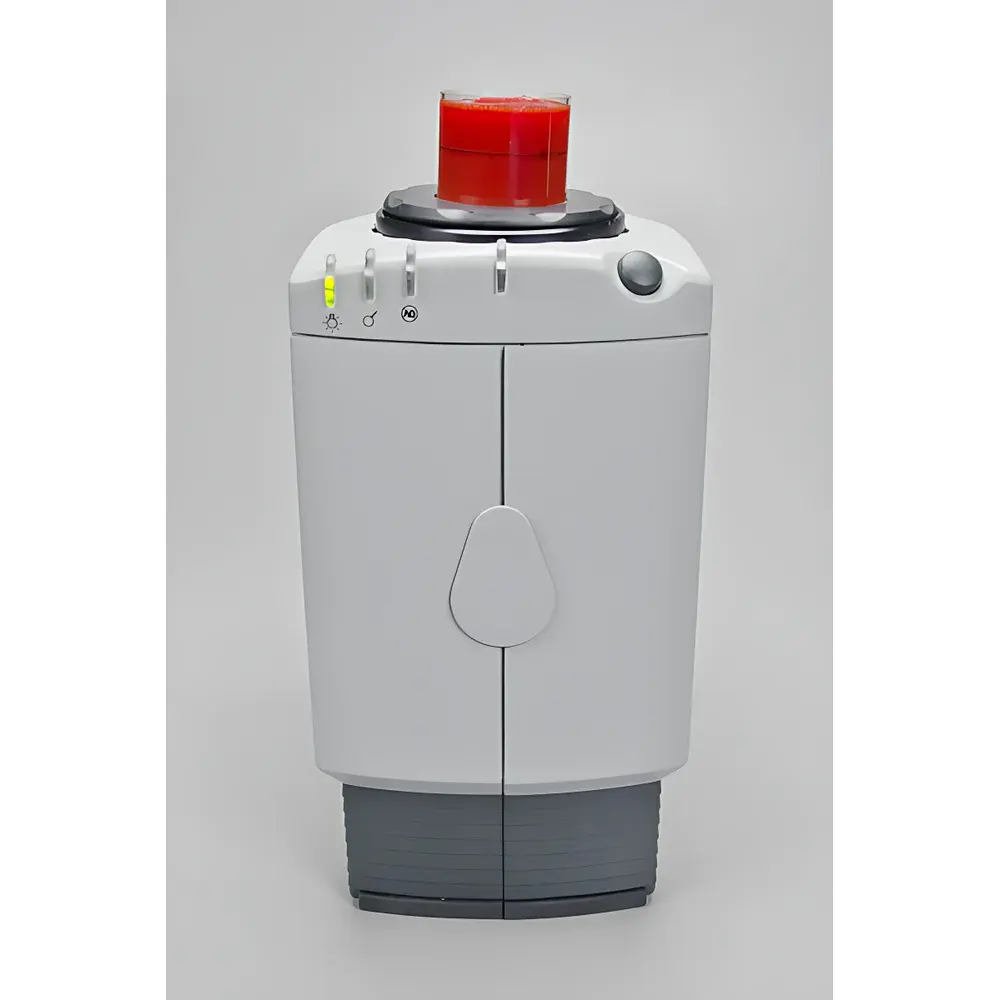
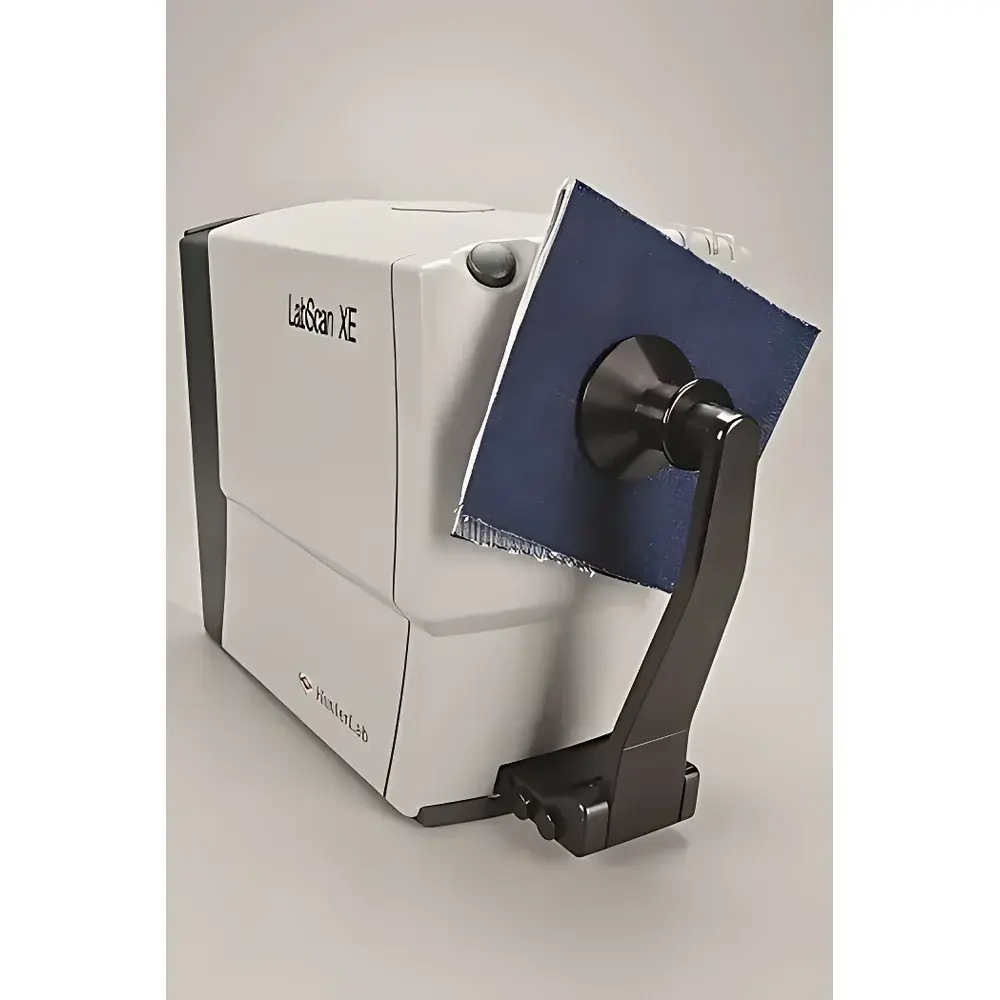
HunterLab LabScan XE Benchtop Color Spectrophotometer
| Brand | HunterLab |
|---|---|
| Origin | USA |
| Model | LabScan XE |
| Instrument Type | Benchtop |
| Optical Geometry | 0°/45° Integrating Sphere |
| Light Source | Pulsed Xenon Lamp |
| Spectral Range | 400 nm – 700 nm |
| Repeatability (ΔE*ab) | ≤ 0.09 |
| Measurement Aperture | Adjustable from 3 mm to 44 mm (VSI) |
| Sample Port Orientation | Top- or Front-Loading |
| Compliance | ASTM E308, ISO 11664-4, CIE No. 15, USP <1061>, FDA 21 CFR Part 11 (with optional software module) |
Overview
The HunterLab LabScan XE is a high-precision benchtop spectrophotometer engineered for objective, repeatable color measurement across diverse industrial and laboratory environments. It operates on the CIE standard 0°/45° optical geometry—designed to emulate human visual perception under controlled illumination—making it especially suitable for evaluating surface color where texture, gloss, and microstructure influence appearance. Unlike diffuse/8° or d/0° instruments, the LabScan XE employs a circular 0°/45° configuration with 15-point fiber-optic sampling arranged at 360° around the measurement area, enabling spatial averaging of reflected light and minimizing directional bias caused by surface irregularities. Its pulsed xenon lamp delivers stable, full-spectrum illumination (400–700 nm) without thermal drift, ensuring consistent spectral output across thousands of measurements. The dual-beam optical path actively compensates for source intensity fluctuations and detector aging, maintaining long-term photometric stability critical for QC laboratories operating under GLP or GMP frameworks.
Key Features
- Variable Sample Illumination (VSI) aperture system: mechanically adjustable from 3 mm to 44 mm diameter—enabling optimized signal-to-noise ratio for small particles, granules, or large textured surfaces such as concrete slabs or corrugated paperboard.
- Top- or front-access sample port: accommodates liquids in cuvettes, powders in petri dishes, opaque solids on staging plates, and semi-transparent films without repositioning—reducing operator-induced variability.
- Integrated tactile measurement button located adjacent to the sample port: allows standalone operation without PC connection—ideal for production-floor use where network access or software dependency is constrained.
- Single-unit, space-efficient enclosure with internal power regulation: eliminates external power supplies or cooling fans—reducing electromagnetic interference and simplifying installation in regulated lab environments.
- Robust mechanical design certified for continuous operation in ambient temperatures from 10 °C to 35 °C and relative humidity up to 80% non-condensing—validated per IEC 61000-4 EMC standards.
Sample Compatibility & Compliance
The LabScan XE supports an extensive range of physical sample forms—including powders (e.g., pigments, pharmaceutical excipients), granular materials (sugar, spices, catalyst beads), opaque solids (painted panels, ceramic tiles), translucent gels (yogurt, sauces), and liquid suspensions (detergents, resins). Its 44 mm maximum measurement area ensures representative sampling of heterogeneous or structured surfaces common in construction materials (cement, asphalt), food products (cheese blocks, fruit slices), and textile composites. All optical calibrations are traceable to NIST-standard ceramic tiles and liquid standards. Regulatory alignment includes compliance with ASTM E308 (computing tristimulus values), ISO 11664-4 (CIE colorimetric observers), and USP (color assessment in pharmaceutical dosage forms). Optional software modules support audit trails, electronic signatures, and data integrity features required under FDA 21 CFR Part 11 and EU Annex 11.
Software & Data Management
The LabScan XE operates natively with EasyMatch QC software—providing real-time pass/fail evaluation against user-defined tolerances in CIELAB (ΔE*ab, ΔL*, Δa*, Δb*), CMC, or ΔE00 metrics. Raw spectral data (10 nm intervals) is exportable in CSV or XML formats for integration into LIMS or MES platforms. Advanced reporting tools generate ISO-compliant certificates of conformance, batch trend charts, and multivariate SPC control charts. For enterprise deployment, the instrument supports secure LDAP authentication, role-based access control, and encrypted database logging—all configurable to meet internal SOPs and external regulatory audits.
Applications
This spectrophotometer serves as a reference-grade color verification tool in quality assurance workflows across regulated and high-volume manufacturing sectors. In paints and coatings, it quantifies batch-to-batch metamerism and weathering-induced hue shift. In food science, it monitors browning reactions in fruit juices or Maillard development in baked goods. Pharmaceutical labs apply it to verify color uniformity of tablets and capsules per USP . Textile QA teams use its VSI capability to assess dye lot consistency across woven, knitted, and nonwoven substrates—even when surface nap or weave pattern varies. Cement producers rely on its large-area measurement to characterize pigment dispersion in ready-mix formulations, while dairy processors validate shade consistency in flavored yogurts and cheese analogs without homogenization artifacts.
FAQ
What does “0°/45°” mean in color measurement geometry?
It specifies that light illuminates the sample at 0° normal incidence while detection occurs at 45° from the normal axis—mimicking typical viewing conditions and excluding specular reflectance to isolate colorant-related appearance.
Can the LabScan XE measure transparent or translucent samples?
Yes—when used with the optional transmission cell holder and rear-mounted auxiliary port, it supports transmittance mode for clear liquids, films, and gels per ASTM D1003.
Is calibration traceable to national standards?
All factory calibrations are performed using NIST-traceable white tile standards and verified against HunterLab’s internal master instruments calibrated annually against NIST SRM 2010 and 2030.
How is repeatability of ≤0.09 ΔE*ab achieved?
Through pulsed xenon illumination stability, dual-beam photometric correction, temperature-compensated silicon photodiode array detection, and 15-point spatial averaging—each contributing to minimized inter-measurement variance under controlled ambient conditions.
Does the instrument support Good Manufacturing Practice (GMP) documentation requirements?
When configured with EasyMatch QC Enterprise Edition and validated IQ/OQ protocols, it fulfills ALCOA+ data integrity principles—including attributable, legible, contemporaneous, original, and accurate records—with full electronic audit trail functionality.





