
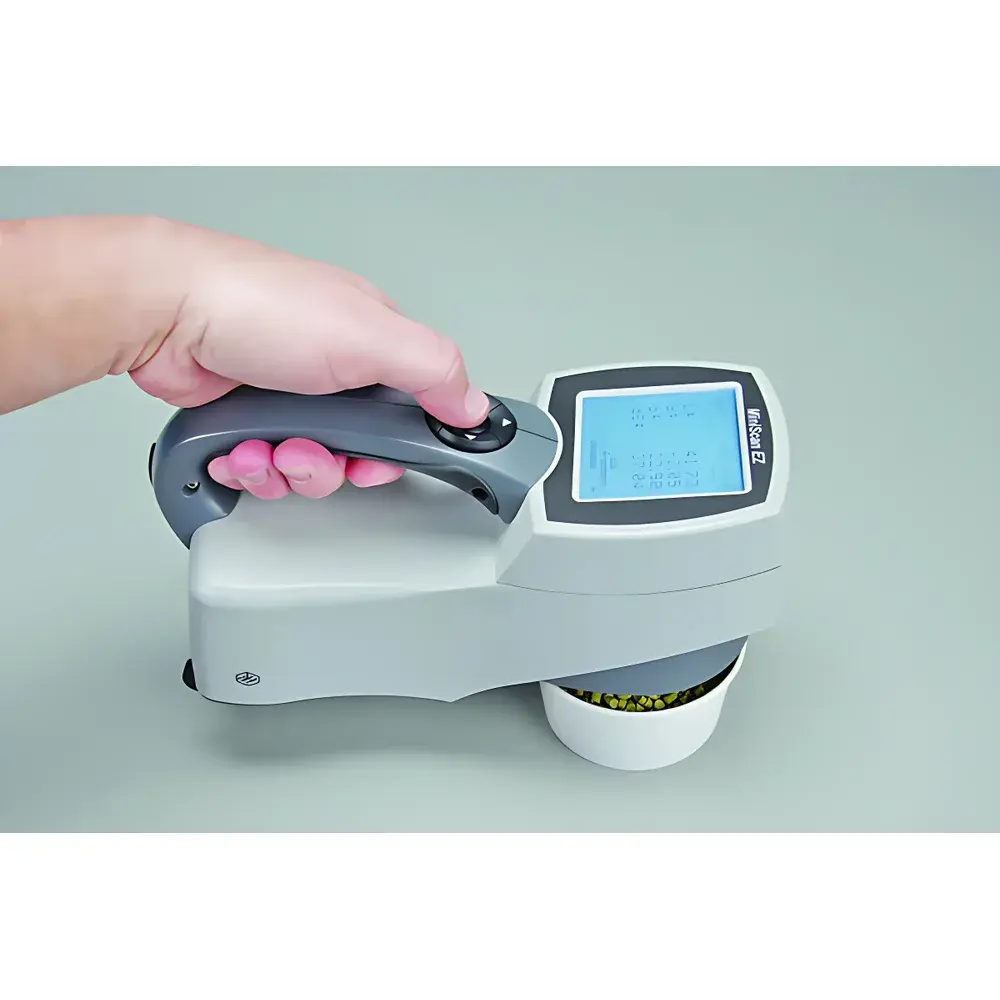
HunterLab MiniScan EZ Portable Colorimeter
| Brand | HunterLab |
|---|---|
| Origin | USA |
| Model | MiniScan EZ Portable Colorimeter |
| Product Type | Color Difference Meter |
| Instrument Type | Portable |
| Optical Geometry | 0°/45° Integrating Sphere |
| Light Source | Xenon Flash Lamp |
| Spectral Range | 400–700 nm |
| Repeatability | ΔE* (CIE Lab) ≤ 0.05 (LAV, BCRA II Tile Set) |
| Aperture Options | LAV 31.8 mm (25.0 mm view area), SAV 6.0 mm (5.0 mm view area), Integrating Sphere LAV 25.0 mm (20.0 mm view area), Integrating Sphere SAV 14.3 mm (8.0 mm view area) |
| Weight | <1.5 kg |
| Dimensions | ~254 mm (L) × 95 mm (W) × 127 mm (H) |
| Display Orientation | 0°, 90°, 180°, or 270° selectable |
| Power Supply | AC adapter or rechargeable Li-ion battery |
Overview
The HunterLab MiniScan EZ Portable Colorimeter is a high-precision, field-deployable spectrophotometric color measurement instrument engineered for rigorous color quality control across industrial and laboratory environments. Based on the proven 0°/45° optical geometry with an integrating sphere configuration, it delivers CIE-compliant tristimulus values (XYZ), chromaticity coordinates (x, y; u′, v′), and color difference metrics (ΔE*ab, ΔE*00, ΔE*cmc) in accordance with ISO 11664, CIE Publication 15, and ASTM D2244. Unlike conventional handheld devices relying on filtered LED sources, the MiniScan EZ employs a pulsed xenon flash lamp—ensuring stable spectral output across the full visible range (400–700 nm) without thermal drift or aging-related intensity loss. Its dual calibration capability—using both white and green ceramic reference tiles—actively compensates for spectral sensitivity shifts across the detector array, significantly enhancing long-term stability and inter-instrument agreement. Designed as the successor to the MiniScan XE Plus, it retains backward compatibility with legacy HunterLab software platforms while introducing ergonomic refinements critical for extended daily use in production lines, R&D labs, and supplier audits.
Key Features
- Integrated probe-and-processor architecture eliminates cable coupling losses and signal latency—enabling real-time spectral acquisition and on-device calculation of CIE L*a*b*, L*C*h*, and whiteness/yellowness indices (e.g., CIE Whiteness, Ganz, ASTM E313).
- Ergonomic housing with textured rubber grip and balanced weight distribution (<1.5 kg) supports one-handed operation—even when wearing gloves or in constrained workspaces.
- Four user-selectable display orientations (0°, 90°, 180°, 270°) ensure optimal readability under varying lighting conditions and mounting configurations (e.g., vertical panel mounting, overhead inspection).
- Multiple aperture options—including Large Area View (LAV) and Small Area View (SAV)—allow precise adaptation to sample heterogeneity: LAV (31.8 mm / 25.0 mm) for bulk material averaging; SAV (6.0 mm / 5.0 mm) for localized defect assessment or patterned surfaces.
- Integrating sphere variants support measurement of translucent, metallic, and fluorescent samples—complying with ISO 7724-1 for diffuse illumination and specular component exclusion (SCI/SCE modes configurable via software).
- Rechargeable lithium-ion battery and universal AC/DC power input enable continuous operation in off-grid locations, cleanrooms, or mobile QC stations without compromising measurement integrity.
Sample Compatibility & Compliance
The MiniScan EZ accommodates diverse physical forms—including opaque solids, powders, pastes, films, and fluorescent materials—without requiring sample preparation beyond standard conditioning per ISO 2813 or ASTM D523. Its xenon-based illumination ensures accurate excitation of optical brightening agents (OBAs), enabling reliable whiteness evaluation per ISO 11475 and TAPPI T485. The instrument meets electromagnetic compatibility requirements per IEC 61326-1 and carries CE marking for conformity with EU directives. Data traceability complies with FDA 21 CFR Part 11 when used with QualiTrak™ or EasyMatch QC software, supporting audit-ready electronic records, user authentication, and immutable audit trails for GLP/GMP-regulated environments.
Software & Data Management
HunterLab’s EasyMatch QC software provides full instrument control, method creation, statistical process control (SPC), and report generation—including PDF, CSV, and XML exports. Method templates align with industry-specific standards: ASTM D6290 for plastics, AATCC Evaluation Procedure 1 for textiles, ISO 18314-2 for paint formulation, and USP for pharmaceutical packaging. The MiniScan EZ supports direct USB and Bluetooth 5.0 connectivity, enabling seamless integration into MES and LIMS platforms. Firmware updates are delivered via secure HTTPS, maintaining cryptographic integrity and version-controlled deployment logs.
Applications
- Plastics: Batch-to-batch color consistency verification for injection-molded components, extruded profiles, and masterbatch qualification.
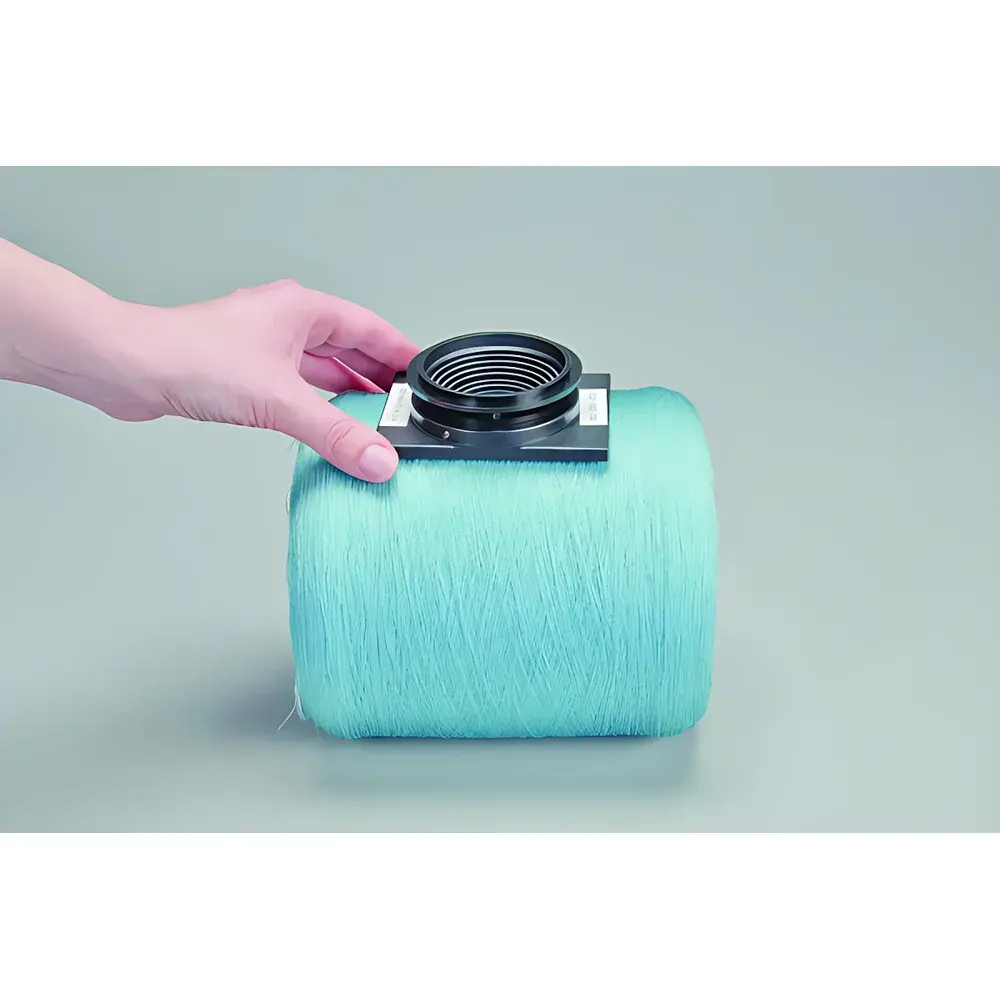
- Textiles: Shade matching of dyed fabrics, yarns, and nonwovens—particularly critical for automotive interiors and medical gowns where metamerism must be minimized.
- Coatings & Inks: Quantitative assessment of gloss-independent color shift during curing, weathering, or solvent evaporation.
- Food & Beverage: Objective evaluation of natural pigment variation in dairy powders, confectionery coatings, and cereal flakes—supporting HACCP-aligned visual quality gates.
- Pharmaceuticals: Verification of tablet film-coat uniformity and capsule shell color compliance per ICH Q5C and USP .
FAQ
Does the MiniScan EZ support both SCI and SCE measurement modes?
Yes—when configured with the integrating sphere optical module, users can select specular component included (SCI) for total reflectance or excluded (SCE) for appearance-matching applications.
What reference standards are required for routine calibration?
The instrument requires certified white and green ceramic tiles traceable to NIST SRM 2011 and SRM 2035, respectively; annual recalibration is recommended per ISO/IEC 17025 accredited providers.
Can it measure fluorescent samples accurately?
Yes—the xenon flash source provides broad-spectrum excitation (including UV-A up to 400 nm), and the detector’s spectral response is corrected for fluorescence yield using HunterLab’s proprietary F-factor algorithm.
Is the device suitable for ISO/IEC 17025-accredited laboratories?
Yes—when operated with documented procedures, validated methods, and traceable reference materials, the MiniScan EZ satisfies metrological requirements for accredited color testing per ILAC-G8:2021.
How does the dual-tile calibration improve long-term stability?
White tile calibration corrects for overall photometric gain, while green tile calibration detects and compensates for wavelength-specific responsivity drift—particularly critical in the 500–560 nm region where silicon detector quantum efficiency varies most significantly.




