
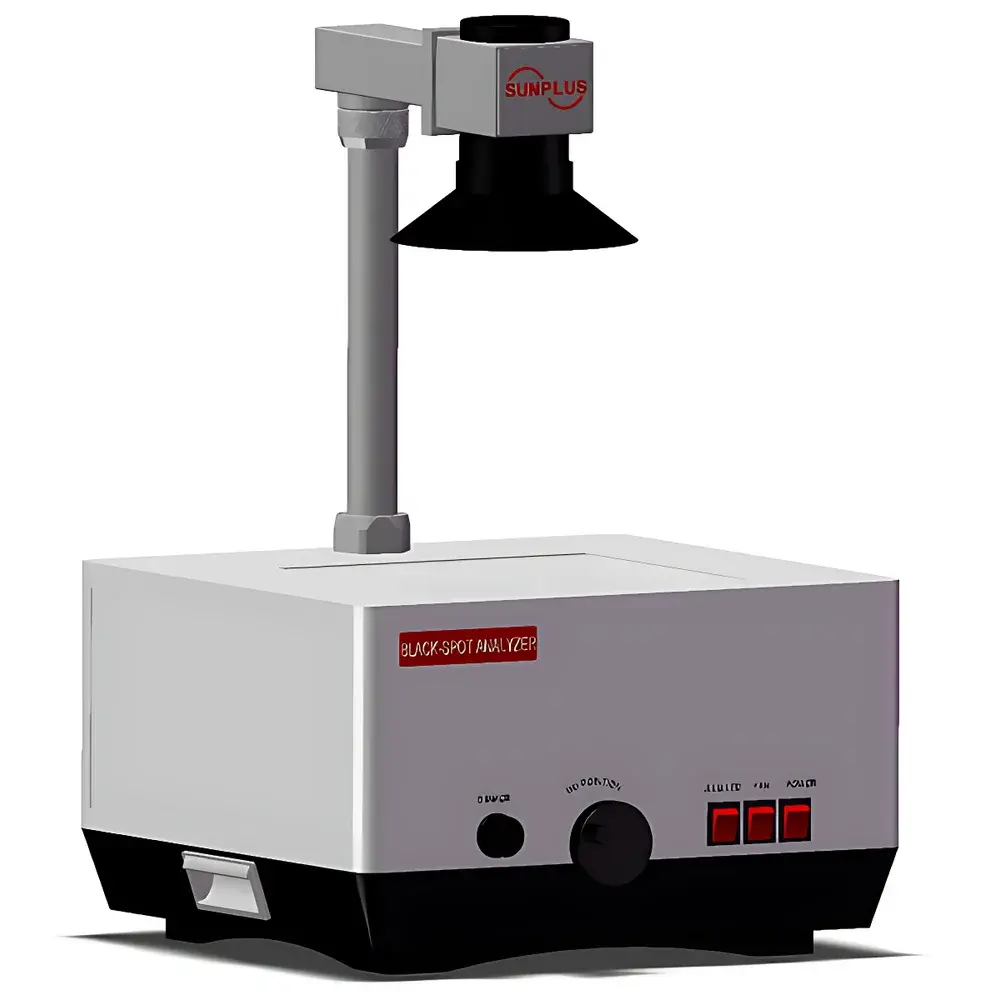
HunterLab SP-BS-1908 Blackspot Detection System
| Brand | HunterLab |
|---|---|
| Origin | Canada |
| Model | SP-BS-1908 |
| Minimum Detectable Spot Size | 0.1 mm |
| Detection Accuracy | < 0.035 mm |
| Detection Area | ≥ 200 × 200 mm |
| Optical Magnification | >20× |
| Light Output | ≥ 6000 lumens |
| Illumination Source | 24 V / 60 W |
| Power Supply | 220 V, 50 Hz |
| Dimensions | ~459 × 426 × (276 + 380) mm |
| Sample Tray Size | 200 × 200 mm (net usable area) |
Overview
The HunterLab SP-BS-1908 Blackspot Detection System is a dedicated optical inspection platform engineered for quantitative analysis of foreign particulate contaminants—specifically black specks—in polymeric materials. It operates on high-contrast transmissive imaging principles: samples are backlit under uniform, high-intensity illumination (≥6000 lumens), and a calibrated CCD imaging system captures grayscale digital images with resolution sufficient to resolve features down to 0.1 mm. Image processing algorithms then segment, classify, and measure individual blackspots based on user-defined size thresholds (e.g., 0.1, 0.2, 0.3 mm, etc.), enabling precise enumeration, dimensional characterization (area, equivalent diameter, circularity), and statistical reporting of contamination load as both absolute count and percentage of total sample surface or mass-equivalent area. Designed for compliance-driven environments, the system supports traceable calibration via included NIST-traceable standard plates and accommodates multiple international material testing standards—including ASTM D7209 (for plastic pellets), ISO 18064 (polyolefin quality assessment), and GB/T 2918 (Chinese national standard for plastic film and sheet evaluation).
Key Features
- Automated blackspot detection and classification across three material categories: transparent films (e.g., BOPP, PET), semi-crystalline pellets (PP, PE, PPS), and opaque granules (PVC, engineering thermoplastics)
- Configurable size threshold matrix supporting incremental binning from 0.1 mm to ≥1.2 mm in 0.1 mm increments, aligned with industry-standard defect grading protocols
- High-fidelity optical path featuring >20× effective magnification and uniform collimated backlighting, eliminating edge falloff and ensuring consistent contrast across full 200 × 200 mm field-of-view
- Batch-mode pellet inspection using standardized 200 × 200 mm transparent trays—no solvent treatment, carbon coating, or adhesive backing required
- Direct lay-flat film inspection without preprocessing; eliminates artifacts introduced by mounting or dye enhancement
- Real-time zoom and pan functionality for manual verification of algorithm-identified defects, including morphology assessment of striations, gel particles, and embedded carbon agglomerates
- Comprehensive data export: CSV for LIMS integration, TIFF/PNG for archival, PDF reports with embedded metadata (operator ID, timestamp, standard reference, instrument serial number)
Sample Compatibility & Compliance
The SP-BS-1908 accommodates rigid and flexible polymeric substrates ranging from 25 µm-thick cast films to 5 mm-diameter injection-molded granules. Its non-contact, non-destructive methodology meets GLP and GMP documentation requirements for raw material release testing. All measurement parameters—including pixel-to-mm calibration, brightness threshold, and minimum area filter—are logged with audit trail capability. The system supports 21 CFR Part 11-compliant software configuration when deployed with validated workstation firmware and electronic signature modules. Calibration verification against certified standard plates satisfies ISO/IEC 17025 internal audit criteria and aligns with supplier qualification workflows per IATF 16949 Annex A.
Software & Data Management
The proprietary SP-Analysis Suite provides a deterministic image processing pipeline: background subtraction → adaptive thresholding → morphological filtering → connected-component labeling → geometric feature extraction. Each detected object is assigned a unique identifier, spatial coordinates, and metrological attributes (area, Feret diameter, aspect ratio, solidity). Statistical summaries include cumulative distribution functions, histogram-based size-class frequency tables, and batch-level pass/fail status per configurable acceptance criteria (e.g., “≤3 spots ≥0.3 mm per 100 cm²”). Raw images and processed datasets are stored with SHA-256 hash integrity checks. Export interfaces support direct integration into SAP QM, LabWare LIMS, and custom MES platforms via RESTful API or ODBC drivers.
Applications
- Quality control of polymer resins prior to extrusion or molding—quantifying carbonized degradation products in PP/PE feedstock
- Supplier qualification audits for automotive interior trim materials (ISO 105-X12 compliant blackspot limits)
- Root cause analysis of melt filtration inefficiencies via time-series blackspot trend monitoring
- Validation of cleaning protocol efficacy in shared compounding lines handling multi-resin campaigns
- Regulatory submission support for medical-grade polymers (USP , ISO 10993-12 extractables screening)
- Process capability studies (Cp/Cpk) for blackspot count as a critical process parameter (CPP) in film casting lines
FAQ
Does the SP-BS-1908 require sample preparation for opaque pellets?
No—opaque pellets are placed directly onto the 200 × 200 mm transparent tray; no grinding, slicing, or staining is necessary.
Can the system distinguish between carbon black agglomerates and metal oxide contaminants?
It classifies based on optical density and morphology only; elemental identification requires complementary SEM-EDS or FTIR.
Is the calibration plate certified to ISO/IEC 17025?
Yes—the included standard plate carries a certificate of calibration traceable to NRC Canada with stated uncertainty (k=2) of ±0.008 mm.
What file formats does the software export for long-term archiving?
TIFF (uncompressed, 16-bit grayscale), PDF/A-2b (ISO 19005-2 compliant), and CSV with UTF-8 encoding and RFC 4180 formatting.
How is measurement repeatability verified across operators?
The system logs operator ID, session timestamp, and all active processing parameters; inter-operator R&R studies show ≤2.1% variation (n=15, ANOVA p>0.05) for spot counts ≥0.2 mm.



