
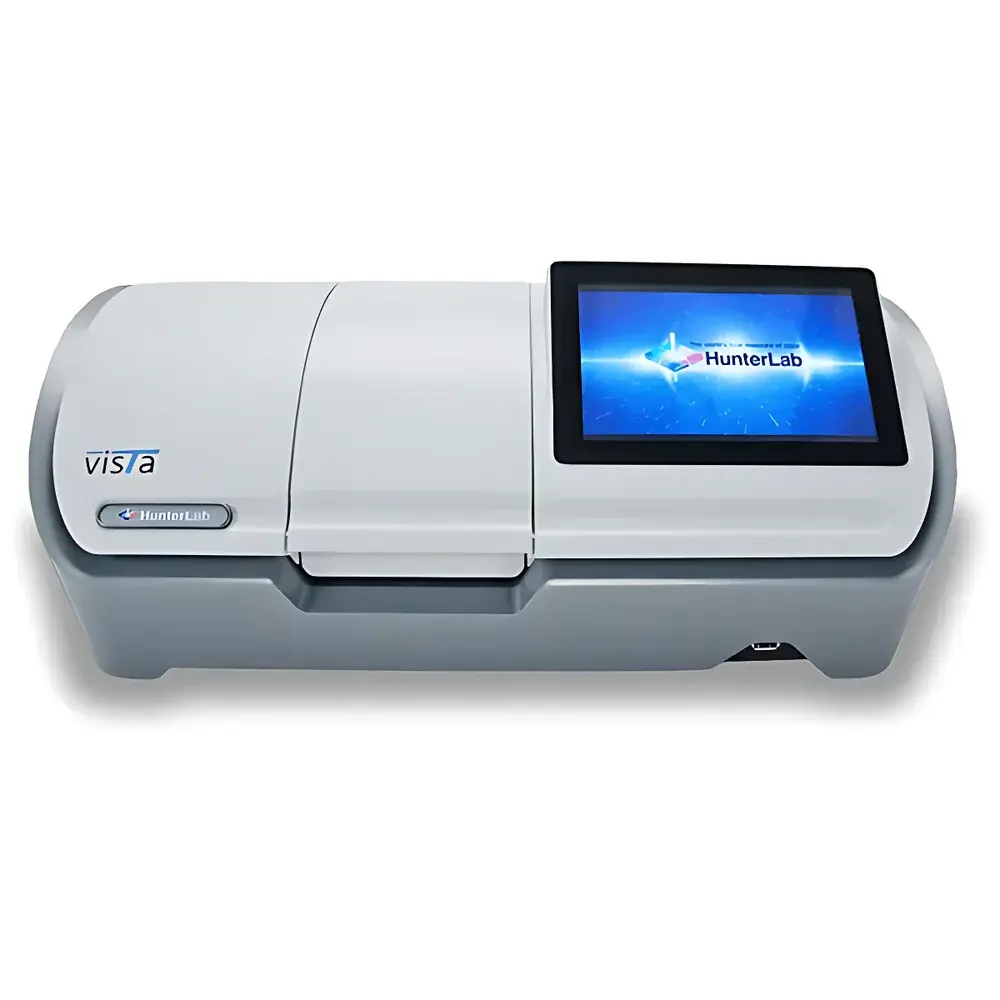
HunterLab Vista d/8° Integrating Sphere Transmittance Colorimeter for Molten State APHA/Pt-Co Measurement
| Brand | HunterLab |
|---|---|
| Origin | USA |
| Model | VTS-Vista |
| Instrument Type | Benchtop |
| Optical Geometry | d/8° Integrating Sphere |
| Light Source | Full-Spectrum LED Array |
| Spectral Range | 400 nm – 700 nm |
| Repeatability | ≤ 0.02 ΔE* (30 measurements) |
Overview
The HunterLab VTS-Vista is a precision benchtop spectrophotometer engineered specifically for quantitative color measurement of organic chemical products in the molten state—particularly those compliant with GB/T 6324.7–2014, “Test Methods for Organic Chemical Products — Part 7: Determination of Molten Color.” This standard applies to solid organic intermediates—including maleic anhydride (MA), bisphenol A (BPA), phenol, phthalic anhydride, trimellitic anhydride (TMA), dimethyl terephthalate (DMT), and di-2-ethylhexyl phthalate (DOP)—that become optically clear upon melting. The VTS-Vista implements CIE-compliant transmittance colorimetry using a dual-beam optical architecture with a 76 mm integrating sphere, enabling simultaneous acquisition of APHA (Pt-Co) color units, haze, and full spectral transmittance data across the visible spectrum (400–700 nm). Its d/8° geometry ensures compliance with ASTM E1164, ISO/CIE 15:2004, and JIS Z 8722 Condition E, making it suitable for regulated quality control environments requiring traceable, reproducible color assessment under GLP or GMP frameworks.
Key Features
- Dual-Mode Transmittance Measurement: Captures total transmittance (TTRAN), regular transmittance (RTRAN), and haze (per ASTM D1003) in a single 5-second measurement cycle—eliminating sequential instrument reconfiguration.
- Full-Spectrum LED Illumination: Stable, drift-free 5-year-life light source delivering uniform irradiance across 400–700 nm; eliminates lamp replacement and warm-up delays associated with tungsten-halogen systems.
- High-Fidelity Optical Architecture: 256-element diode array detector coupled with a high-resolution concave holographic grating (effective bandwidth: 10 nm; wavelength resolution: <3 nm) ensures spectral fidelity and long-term photometric stability.
- Molten-State Workflow Integration: Designed for use with standardized 50 mL colorimetric tubes and external molten sample heaters; accommodates high-temperature, low-viscosity liquid samples without condensation or thermal lensing artifacts.
- Automated Calibration & Diagnostics: Onboard reference tile validation, automatic zero calibration, and real-time signal-to-noise monitoring ensure measurement integrity across shifts and operators.
- Compact, Robust Enclosure: Space-efficient footprint (W × D × H: 320 × 390 × 280 mm); sealed optical path and spill-resistant sample compartment minimize contamination risk in industrial lab settings.
Sample Compatibility & Compliance
The VTS-Vista supports transparent to semi-transparent molten organic liquids with no visible turbidity or particulate suspension—consistent with the scope defined in GB/T 6324.7–2014 and aligned with ASTM D1209 (APHA), ASTM D6166 (Hazen), and ISO 6271 (Gardner). It directly reports APHA/Pt-Co values traceable to NIST-traceable liquid standards and meets the repeatability requirement (≤ 0.02 ΔE* over 30 replicates) mandated for QC-grade instrumentation. Instrument performance is validated against certified transmission filters per CIE 15:2004 and demonstrates inter-instrument agreement of ΔE* < 0.15 (D65/10°, avg.) for transmittance applications—ensuring consistency across multi-site manufacturing networks subject to FDA 21 CFR Part 11 audit requirements.
Software & Data Management
VistaTouch™ software provides intuitive touchscreen operation (1280 × 800 color display) and secure data handling capabilities compliant with 21 CFR Part 11 Annex 11. Features include electronic signature capture, role-based user access control, full audit trail logging (including calibration events, method changes, and result modifications), and export to CSV, PDF, or XML formats. All color metrics—including APHA, ASTM D1500, Saybolt, Gardner, YI E313/D1925, ADMI, Lovibond Red/Yellow, and CIE L*a*b*—are computed in real time using CIE 1931 2° and 10° observer functions under D65 and C illuminants. Raw spectral data (10 nm intervals) is stored with metadata (operator ID, timestamp, sample ID, ambient temperature/humidity) to support root cause analysis and regulatory submissions.
Applications
- Quality release testing of maleic anhydride and phthalic anhydride per GB/T 6324.7–2014 and ISO 105-X12.
- Batch-to-batch consistency verification for BPA used in epoxy resin synthesis.
- Impurity profiling of molten phenol and DMT via yellowing index (YI) trend analysis.
- Stability studies tracking thermal degradation-induced color shift in acid anhydrides during storage or processing.
- Supplier qualification where APHA ≤ 10 or ≤ 20 is specified as a purity criterion per contractual technical data sheets.
- Regulatory documentation for REACH, ICH Q5, and USP extractables/leachables color assessments.
FAQ
Does the VTS-Vista require external heating equipment for molten color measurement?
Yes—molten samples must be prepared using a calibrated heating block or immersion heater capable of maintaining stable temperature within ±1 °C of the target melt point (e.g., 52–55 °C for maleic anhydride). The instrument itself does not provide heating.
Can the VTS-Vista measure APHA values for non-molten liquids such as solvents or aqueous solutions?
Yes—it supports all standard liquid color scales (APHA, ASTM, Saybolt, Gardner) across the full 400–700 nm range; however, molten-state protocols require adherence to GB/T 6324.7–2014 sample preparation guidelines.
Is haze measurement validated per ASTM D1003 on this platform?
Yes—the optical path includes dedicated collimated beam detection for haze, with built-in validation against NIST-traceable haze standards; results are reported as % haze with uncertainty < ±0.3% at 10% nominal haze.
How is instrument-to-instrument variability managed in multi-lab deployments?
HunterLab provides inter-instrument agreement (IIA) characterization using transmission filter sets; factory-certified ΔE* < 0.25 (D65/10°, max) ensures consistent pass/fail decisions across global sites.
Does VistaTouch software support automated report generation for QA documentation?
Yes—customizable templates generate PDF reports with embedded spectra, statistical summaries (mean, SD, CPK), and electronic signatures compliant with internal SOPs and external audit requirements.




