
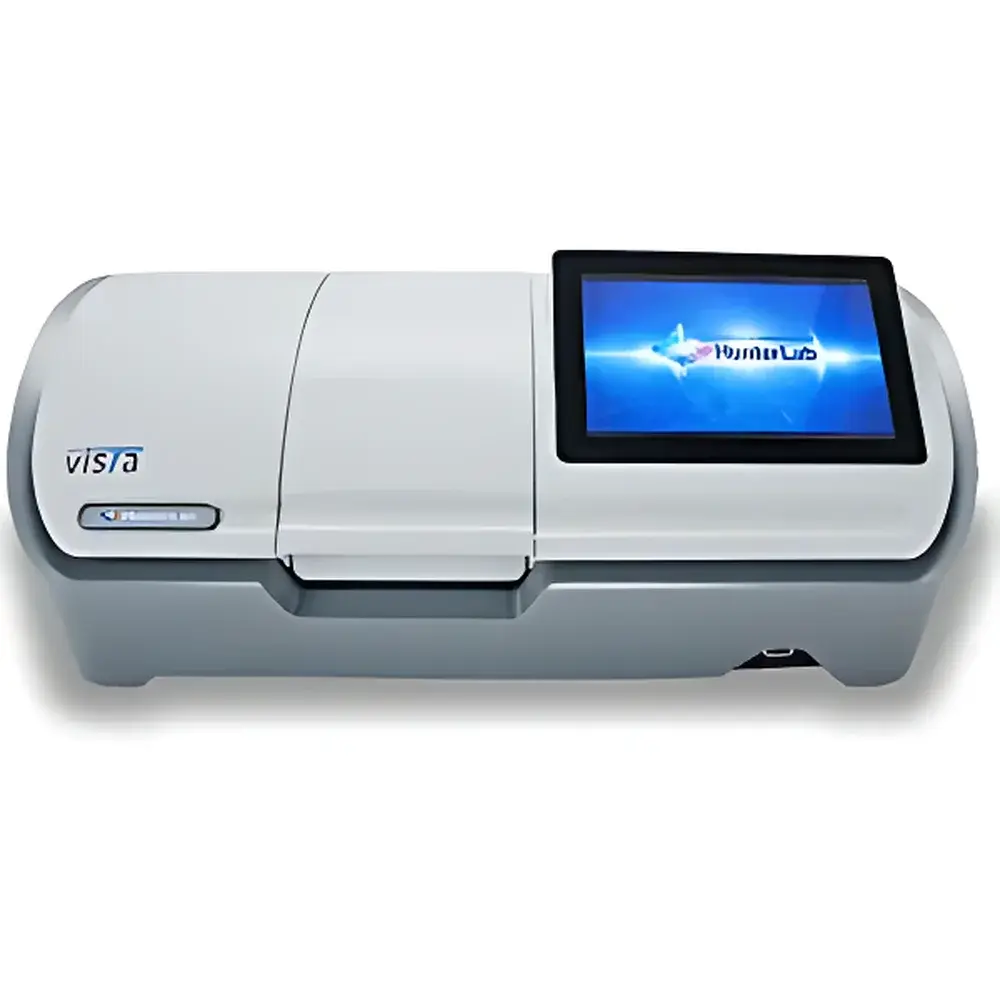
HunterLab Vista DTD Spectrophotometer
| Brand | HunterLab |
|---|---|
| Origin | USA |
| Model | Vista DTD |
| Instrument Type | Benchtop |
| Optical Geometry | d/8° integrating sphere |
| Light Source | Full-spectrum LED array |
| Spectral Range | 400 nm – 700 nm |
| Repeatability | < 0.025 ΔE* (30 measurements) |
| Compliance | ASTM D1003 (haze), ASTM E1164, CIE 15:2004, ISO/CIE 11664, JIS Z 8722 Condition E, DIN 5033-7 |
| Illuminant/Observer | D65/10°, C/2° |
| Display | 1280 × 800 color touchscreen |
| Power | 100–240 VAC, 47–63 Hz, 60 W |
Overview
The HunterLab Vista DTD is a high-precision benchtop spectrophotometer engineered for simultaneous measurement of transmission color, haze, and clarity in transparent and translucent liquid and solid samples. Utilizing dual-beam optical architecture with a 76 mm integrating sphere and a 256-element diode array detector coupled to a high-resolution concave holographic grating, the Vista DTD delivers photometric stability and spectral fidelity across the full visible range (400–700 nm). Its d/8° optical geometry—compliant with CIE 15:2004, ASTM E1164, and ISO/CIE 11664—ensures accurate colorimetric data under standardized illuminant/observer conditions (D65/10° and C/2°). Unlike conventional colorimeters, the Vista DTD integrates ASTM D1003-compliant haze quantification into the same optical path used for color measurement, eliminating inter-instrument variability and enabling traceable, single-step analysis of both chromatic and scattering properties. This capability is critical for quality control in pharmaceutical excipients, polymer resins, beverage concentrates, optical films, and specialty chemicals where raw material purity, batch consistency, and regulatory conformance are non-negotiable.
Key Features
- Dual-mode transmission optics supporting Total Transmittance (TTRAN), Regular Transmittance (RTRAN), and ASTM D1003 haze measurement within one optical configuration
- Full-spectrum LED illumination with >5-year lifetime, delivering stable spectral output without warm-up drift or lamp replacement cycles
- High-fidelity spectral acquisition: <3 nm nominal bandwidth, 10 nm equidistant wavelength intervals, 0.003% photometric resolution
- Automated self-calibration routine with integrated reference tile and diagnostic validation at startup and user-defined intervals
- Compact footprint (290 × 340 × 380 mm) and spill-resistant sample compartment designed for high-throughput lab environments
- Real-time spectral visualization and on-device pass/fail evaluation against user-defined tolerances using ΔE*, ΔL*a*b*, or custom index thresholds
Sample Compatibility & Compliance
The Vista DTD accommodates a broad range of sample formats—including cuvettes (10 mm, 20 mm, 50 mm, and 100 mm pathlength), Petri dishes, molded plastic plaques, and glass slides—without mechanical reconfiguration. Its 18.5 mm illumination / 9.1 mm measurement area ensures representative sampling even for heterogeneous or low-volume liquids. Regulatory compliance is embedded at the system level: all color and haze algorithms adhere to ASTM D1003 (Method A, 2022 edition), ASTM E1164, USP , and FDA-recommended practices for analytical instrument qualification. Audit trail functionality—including operator ID, timestamped calibration logs, spectral raw data export, and change history—is fully compatible with 21 CFR Part 11 requirements when deployed with HunterLink software and validated network infrastructure.
Software & Data Management
Vista DTD operates natively via its embedded 7-inch capacitive touchscreen running HunterLab’s proprietary firmware (v5.2+), enabling standalone operation without PC dependency. For enterprise integration, HunterLink software provides secure network deployment, multi-user role-based access control, automated report generation (PDF/CSV/XLSX), and direct linkage to LIMS and ERP systems via ODBC and RESTful API. All spectral data is stored in vendor-neutral, metadata-rich .HUN files compliant with ASTM E2758-21 for long-term archival and third-party reprocessing. Software validation packages—including IQ/OQ documentation, electronic signature workflows, and electronic audit trail configuration—are available for GxP-regulated environments.
Applications
- Pharmaceuticals: Quantification of YI E313 and APHA/PtCo indices in solvents, APIs, and injectables per USP and EP 2.2.17
- Chemicals & Polymers: Haze and Lovibond® (LovR/LovY) assessment of PET pellets, polycarbonate sheets, and silicone fluids per ASTM D1003 and ASTM D1209
- Foods & Beverages: Color stability monitoring of fruit juices, syrups, and dairy emulsions using Gardner, Saybolt, and ASTM D1209 scales
- Coatings & Inks: Batch-to-batch verification of transmission hue and clarity in solvent-based lacquers and UV-curable resins
- Water & Wastewater: Turbidity-related color indexing (ADMI, Hazen) aligned with EPA Method 180.1 and ISO 7027
FAQ
Does the Vista DTD require external calibration standards for daily use?
No. The instrument performs automatic internal calibration using a built-in white reference tile and dark current correction prior to each measurement session. NIST-traceable calibration verification kits are recommended annually or after impact events.
Can haze and color be measured simultaneously in a single scan?
Yes. The Vista DTD acquires full spectral data in <2.5 seconds, then computes CIE L*a*b*, haze (%), and up to 12 industry-specific color indices—including ASTM Color, YI E313, and ADMI—in one uninterrupted sequence.
Is the device compliant with FDA 21 CFR Part 11 for electronic records?
When configured with HunterLink v6.0+ and validated network authentication, the system supports electronic signatures, audit trails with immutable timestamps, and role-based permissions required for regulated QC laboratories.
What pathlength options are supported for liquid transmission measurements?
Standard configurations support 10 mm, 20 mm, 50 mm, and 100 mm pathlength cuvettes. Custom fixtures for irregular geometries (e.g., molded lenses, film strips) are available through HunterLab’s Application Engineering group.
How is spectral data archived and exported?
Raw spectra, metadata, and calculated indices are saved as encrypted .HUN files. Export options include CSV (spectral reflectance/transmittance), XML (CIE-compliant colorimetric data), and PDF reports with embedded spectral plots and tolerance overlays.




