
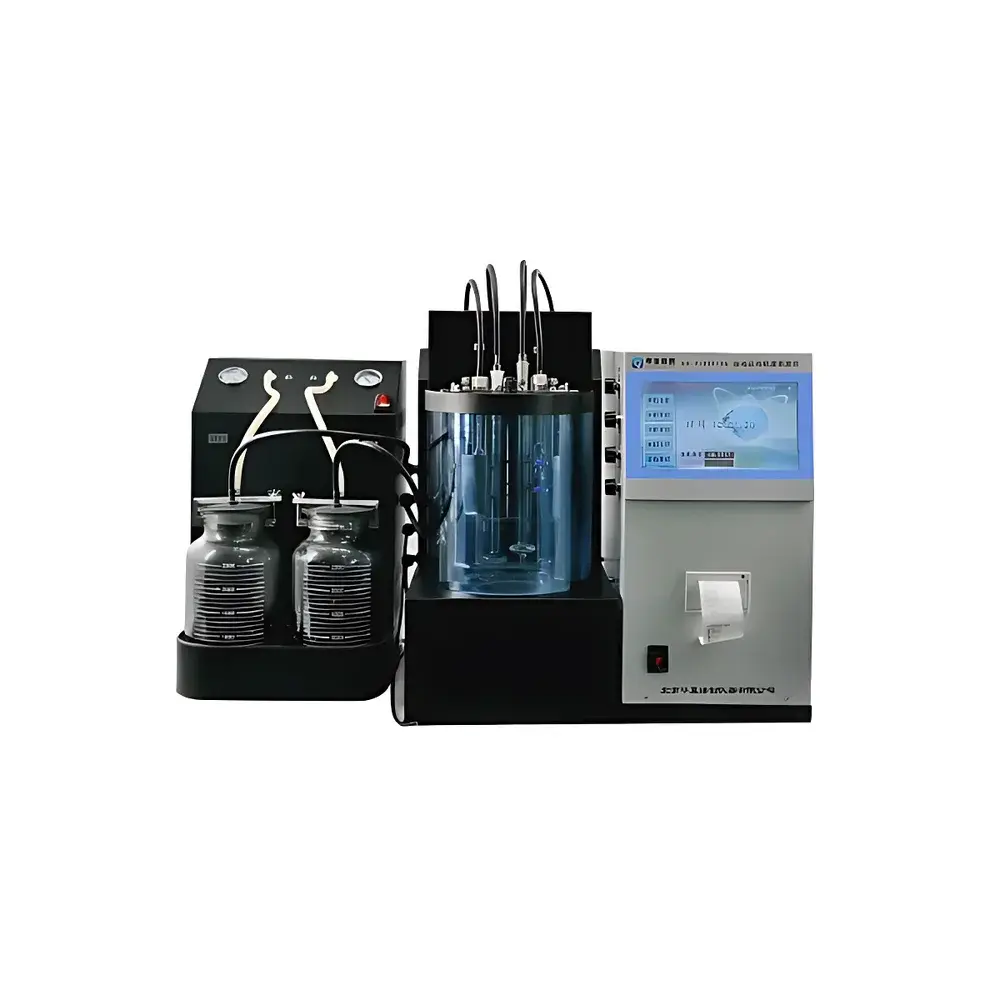
HX-VIS1010A Automatic Kinematic Viscosity Tester by Spectra Invent
| Brand | Spectra Invent |
|---|---|
| Origin | Beijing, China |
| Manufacturer Type | Authorized Distributor |
| Country of Manufacture | China |
| Model | HX-VIS1010A |
| Price Range | USD 150–15,000 |
Overview
The HX-VIS1010A Automatic Kinematic Viscosity Tester is an ASTM D445- and ISO 3104-compliant benchtop instrument engineered for precise, repeatable measurement of kinematic viscosity in transparent and opaque petroleum liquids—including crude oil, lubricants, fuel oils, diesel, jet fuels, and base stocks. It operates on the capillary flow principle: a precisely calibrated glass capillary viscometer (e.g., Ubbelohde or Cannon-Fenske type) is immersed in a temperature-controlled bath; sample fluid is drawn into the capillary via vacuum or gravity, and the efflux time between two etched marks is measured optically. Kinematic viscosity (ν, in mm²/s or cSt) is calculated as ν = C × t, where C is the capillary constant (determined via certified reference standards) and t is the average efflux time across multiple runs. The system integrates Peltier-based thermal regulation (±0.01 °C stability), dual optical sensors for bubble detection and timing synchronization, and automated aspiration/drain cycles—eliminating manual timing errors and operator variability.
Key Features
- Fully automated operation: Integrated vacuum pump, solenoid valves, and optical timing sensors enable unattended measurement of up to 12 samples per batch without manual intervention.
- High-precision temperature control: Dual-zone Peltier heating/cooling system maintains bath stability at ±0.01 °C across the operational range of 20 °C to 100 °C (optional extension to 150 °C with high-temp bath module).
- Capillary compatibility: Supports standard ASTM/ISO capillaries (Ubbelohde, Cannon-Fenske, Suspended-Level types) with automatic recognition via QR-coded capillary holders.
- Self-calibrating timing system: Optical sensors detect meniscus position with sub-millisecond resolution; real-time drift compensation ensures long-term timing accuracy.
- Robust architecture: Stainless-steel frame, corrosion-resistant fluid pathways, and sealed optical chambers meet IP54 environmental rating for laboratory and QC environments.
- GLP-ready audit trail: All measurements, calibration events, user actions, and system diagnostics are timestamped and logged with immutable digital signatures.
Sample Compatibility & Compliance
The HX-VIS1010A accommodates Newtonian and mildly non-Newtonian petroleum fluids with kinematic viscosities ranging from 0.2 to 25,000 mm²/s (cSt), depending on capillary selection. It handles both clear (e.g., kerosene, naphtha) and hazy/opaque samples (e.g., used engine oils, asphaltene-containing crudes) using adaptive optical detection algorithms. The instrument conforms to ASTM D445, ISO 3104, IP 71, GB/T 265, and DIN 51562 standards. Its firmware and data handling architecture support 21 CFR Part 11 compliance when deployed with optional electronic signature and role-based access modules—making it suitable for regulated QA/QC labs operating under GMP or ISO/IEC 17025 frameworks.
Software & Data Management
The included SpectraVis v3.2 software provides intuitive workflow-driven control via Windows-based GUI. It supports method templates aligned with ASTM procedures, automatic calculation of kinematic viscosity, density-corrected dynamic viscosity (via optional integrated densitometer interface), and statistical reporting (mean, SD, RSD, confidence intervals). Raw timing data, temperature logs, and capillary metadata are stored in vendor-neutral CSV and XML formats. Audit trails are exportable as PDF/A-1b for regulatory submission. Integration with LIMS is achieved via ASTM E1384-compliant HL7 and ODBC interfaces; secure TLS 1.2 encryption ensures data integrity during network transmission.
Applications
- Refinery QC: Routine verification of distillate fuel viscosity per ASTM D97 and D445 prior to blending or shipment.
- Lubricant formulation: Monitoring viscosity index improvers and shear stability in multi-grade engine oils.
- Research laboratories: Studying temperature-dependent flow behavior of biofuels and synthetic base oils.
- Third-party testing labs: Accredited viscosity certification for API licensing, customs clearance, and contract analysis.
- Condition monitoring: Trend analysis of in-service lubricant degradation through periodic kinematic viscosity shifts.
FAQ
Does the HX-VIS1010A require external calibration standards?
Yes—capillary constants must be verified annually using NIST-traceable viscosity standards (e.g., Cannon Standard Oils) per ASTM D445 Annex A1.
Can it measure highly viscous bitumen or heavy fuel oil?
With appropriate low-flow capillaries (e.g., Cannon-Fenske Dilution Viscometers) and pre-heated sample conditioning (up to 150 °C), yes—but viscosity >10,000 mm²/s requires dilution per ASTM D2161 protocol.
Is remote monitoring supported?
Yes—the system includes Ethernet and RS-232 ports; SpectraVis software supports secure remote desktop access and real-time status dashboards via optional SpectraLink Cloud Gateway.
What maintenance is required for long-term accuracy?
Quarterly optical sensor cleaning, annual capillary inspection/re-certification, and biannual verification of bath temperature uniformity per ISO/IEC 17025 Clause 6.4.
Does it support USP or pharmacopeial viscosity testing?
No—it is designed exclusively for petroleum and hydrocarbon applications; pharmaceutical viscosity testing requires instruments compliant with USP and equipped with rotational or rolling-ball geometry.




