
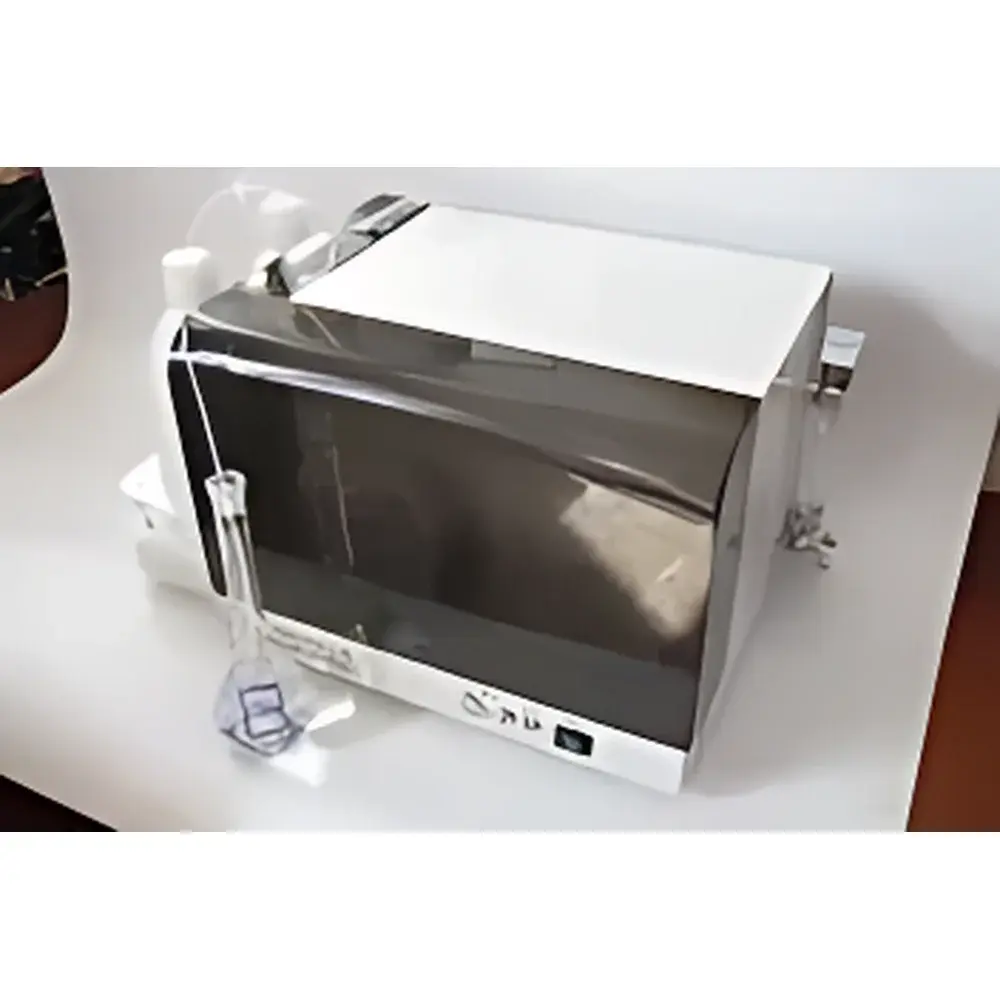
Hydride Generation System HG-B by SGM
| Brand | SGM |
|---|---|
| Origin | Beijing, China |
| Manufacturer Type | Authorized Distributor |
| Country of Origin | Domestic (China) |
| Model | HG-B |
| Price | USD 2,350 (approx.) |
Overview
The SGM HG-B Hydride Generation System is a dedicated accessory for atomic absorption spectrometry (AAS), engineered to enable trace-level determination of hydride-forming elements—including arsenic (As), selenium (Se), antimony (Sb), bismuth (Bi), tellurium (Te), lead (Pb), tin (Sn), and mercury (Hg)—via cold vapor or hydride generation atomic absorption spectroscopy (HG-AAS or CV-AAS). The system operates on the principle of acid-mediated reduction of analyte species (e.g., AsIII, SeIV) using sodium borohydride (NaBH4) in acidic medium, generating volatile covalent hydrides (e.g., AsH3, SeH2) that are swept into a quartz cell positioned in the optical path of an AAS instrument. This approach delivers sub-ng/mL detection limits, enhanced sensitivity (10–100× over conventional flame AAS), and improved selectivity by eliminating matrix interferences common in direct liquid nebulization.
Key Features
- Dual Peristaltic Pump Architecture: Independent control of reagent (NaBH4) and sample acid streams enables precise, programmable flow rate adjustment—critical for optimizing hydride formation efficiency and minimizing reagent consumption.
- Integrated Gas-Liquid Separator (GLS): A redesigned membrane-based separator ensures efficient phase separation with minimal carryover; features automatic waste drainage to prevent backpressure buildup and maintain stable vapor transport.
- Intelligent Pneumatic Control: Solenoid-valve-driven gas circuitry provides consistent carrier gas (Ar or N2) flow during both reaction and purge cycles, supporting reproducible hydride transfer and baseline stability.
- Thermostatically Regulated Reaction Chamber: Onboard temperature monitoring and feedback-controlled heating maintain optimal reaction zone temperature (typically 90–95 °C), ensuring complete and kinetically consistent hydride generation across diverse sample matrices.
- Universal AAS Interface Compatibility: Designed with standardized gas outlet fittings and electrical trigger I/O (TTL-compatible), the HG-B integrates seamlessly with all major benchtop and graphite furnace AAS platforms—including instruments from PerkinElmer, Agilent, Thermo Fisher Scientific, and Shimadzu—without requiring hardware modification.
Sample Compatibility & Compliance
The HG-B accommodates aqueous samples within pH 1–2 (adjusted with HCl or HNO3), including digested environmental waters, biological fluids (urine, serum), food extracts, and geological leachates. It supports both continuous-flow and batch-mode operation, with optional integration into automated sample introduction systems. While the HG-B itself is not certified to ISO/IEC 17025 or FDA 21 CFR Part 11, its operational parameters—including pump timing, reagent concentration, and reaction temperature—are fully documentable and repeatable, facilitating adherence to GLP and GMP-aligned analytical workflows. Method validation per ASTM D6725 (for As in water) or USP (for elemental impurities in pharmaceuticals) is achievable when paired with a compliant AAS platform and validated sample preparation protocols.
Software & Data Management
The HG-B operates in standalone mode with front-panel push-button controls and LED status indicators; no proprietary software is required for basic operation. For laboratories implementing LIMS or electronic lab notebooks (ELN), analog voltage outputs (0–5 V) and TTL trigger signals allow synchronization with external data acquisition systems. All critical operational parameters—including pump run time, reaction temperature setpoint, and gas-on duration—are manually logged during method setup, supporting audit-ready recordkeeping. When used with AAS instruments equipped with spectral data systems (e.g., WinLab32, AA Analyst Software), hydride peak area/intensity data is captured alongside instrument metadata, enabling full traceability in accordance with ALCOA+ principles (Attributable, Legible, Contemporaneous, Original, Accurate, Complete, Consistent, Enduring, Available).
Applications
- Regulatory monitoring of arsenic and selenium in drinking water per EPA Method 200.9 and ISO 11969
- Quantification of total mercury in fish tissue following EPA Method 1631E (with prior BrCl oxidation)
- Speciation-informed screening of inorganic antimony in pharmaceutical excipients (ICH Q3D Stage 4 compliance support)
- Quality control of high-purity acids and reagents used in semiconductor manufacturing (SEMI F57-0314)
- Research-scale investigation of hydride formation kinetics under varying redox and complexation conditions
FAQ
Is the HG-B compatible with graphite furnace AAS?
Yes—the system’s low-volume vapor output and fast response time make it suitable for coupling with GF-AAS, provided the quartz cell is installed in the light path and the instrument’s autosampler is configured for external vapor introduction.
What acid concentration is recommended for optimal hydride generation?
For most elements, 2–5% (v/v) hydrochloric acid is standard; selenium requires pre-reduction with KBr/KBrO3, while mercury analysis typically uses SnCl2 instead of NaBH4. Optimization must be performed per analyte and matrix.
Does the HG-B include safety interlocks for hydrogen gas handling?
The system does not generate or store hydrogen gas; hydride gases (e.g., AsH3) are produced *in situ* and immediately swept into the atomizer. Standard laboratory fume hood ventilation and leak-checked gas lines satisfy occupational exposure requirements (ACGIH TLVs apply).
Can the HG-B be used for semi-quantitative screening without calibration?
While not recommended for regulatory reporting, relative peak intensity comparison against reference standards enables rapid presence/absence assessment in field or teaching labs—provided matrix-matched blanks and controls are included.
What maintenance is required for long-term reliability?
Monthly inspection of pump tubing elasticity, quarterly cleaning of the gas-liquid separator chamber with dilute nitric acid, and annual verification of temperature sensor accuracy using a calibrated thermocouple probe.





