
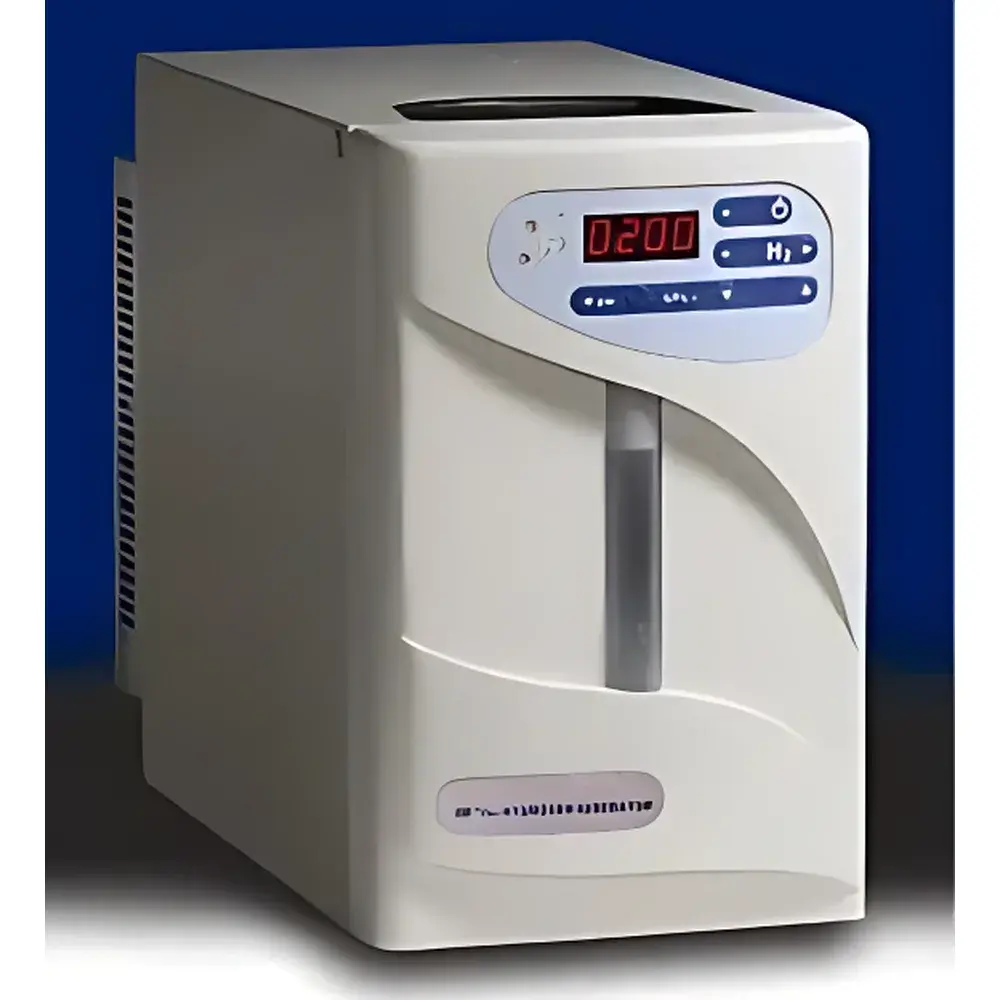
Hydrogen Generator GC300 & GC600 – PEM-Based Laboratory Hydrogen Supply System
| Origin | USA |
|---|---|
| Manufacturer Type | Authorized Distributor |
| Origin Category | Imported |
| Model | GC300, GC600 |
| Hydrogen Flow Rate | 300 mL/min, 600 mL/min |
| Purity | ≥99.9999% (6.0 N) |
| Output Pressure | Up to 200 psig (13.8 bar) |
| Water Feed | Automatic Deionized Water Intake |
| Core Technology | Proton Exchange Membrane (PEM) Electrolysis |
Overview
The GC300 and GC600 Hydrogen Generators are compact, high-purity laboratory-grade hydrogen supply systems engineered for continuous, on-demand gas generation via proton exchange membrane (PEM) electrolysis. Developed from foundational PEM technology first patented in 1953 and later deployed in NASA’s life-support systems during the Apollo-era oxygen generation programs, these generators eliminate reliance on high-pressure hydrogen cylinders—reducing safety hazards, logistical overhead, and supply-chain dependency. Unlike traditional alkaline or solid polymer electrolyzer (SPE) systems, the GC-series employs a zero-liquid-electrolyte architecture: deionized water is fed directly into the anode chamber, where it undergoes electrochemical dissociation under controlled DC current. H⁺ ions migrate across a Nafion®-based solid polymer membrane to the cathode, while electrons travel externally through the circuit; recombination at the cathode yields ultra-high-purity dihydrogen (H₂) with no catalyst carryover or metallic contamination. The system operates at ambient temperature, requires no warm-up time, and delivers stable output pressure up to 200 psig (13.8 bar), making it suitable for both low-flow analytical applications and higher-demand research protocols.
Key Features
- Proton Exchange Membrane (PEM) electrolysis core—no caustic KOH solution, no moving compressors, no gas purification cartridges
- Automated deionized water feed with level monitoring and dry-run protection
- Stable hydrogen output at rated flow: 300 mL/min (GC300) or 600 mL/min (GC600), scalable to 2 L/min peak capacity under optimized conditions
- Consistent purity ≥99.9999% (6.0 N), verified by onboard electrochemical sensors and compatible with residual oxygen detection modules (optional)
- Integrated pressure regulation with digital setpoint control (range: 0–200 psig) and real-time pressure feedback loop
- Front-panel LCD interface with status indicators for flow, pressure, water level, and system diagnostics
- CE-marked, RoHS-compliant enclosure; designed for Class I, Division 2 hazardous location readiness per NEC Article 500 (when installed per manufacturer guidelines)
Sample Compatibility & Compliance
The GC300/GC600 series is fully compatible with all major gas chromatography platforms requiring carrier or fuel gas—including Agilent, Thermo Fisher, Shimadzu, and PerkinElmer GC systems—as well as catalytic hydrogenation reactors, electrochemical cells, and proton-exchange membrane fuel cell (PEMFC) test stations. It meets ISO 8573-1:2010 Class 1 compressed air purity equivalency for gaseous hydrogen (particulate, moisture, oil content), and complies with ASTM D7622–21 for hydrogen purity verification in analytical applications. For regulated environments, the generator supports audit-ready operation: event logs capture power cycles, pressure deviations, and maintenance alerts; optional RS-485/Modbus RTU or Ethernet/IP interface enables integration into LIMS or SCADA systems compliant with FDA 21 CFR Part 11 requirements for electronic records and signatures.
Software & Data Management
While standalone operation requires no software, optional PC-based configuration and monitoring software (HydroGen Control Suite v3.2+) provides remote parameter adjustment, real-time trend visualization, and automated report generation (CSV/PDF). All operational data—including cumulative runtime, total H₂ volume produced, and water consumption—are timestamped and stored in non-volatile memory for GLP/GMP traceability. Firmware updates are delivered via secure HTTPS download with SHA-256 signature verification. The system supports scheduled self-diagnostics (membrane integrity check, leak verification, and pressure decay test) with pass/fail logging aligned to ISO/IEC 17025 internal quality procedures.
Applications
- Carrier and detector fuel gas for flame ionization (FID), thermal conductivity (TCD), and pulsed discharge helium ionization (PDHID) detectors in GC analysis
- Controlled-atmosphere hydrogenation in pharmaceutical process development (e.g., chiral reduction, nitro-group conversion)
- Reaction gas supply for online FTIR, Raman, and mass spectrometry-coupled catalysis studies
- Feedstock gas for PEM fuel cell polarization curve mapping and durability testing
- Calibration gas generation for hydrogen sensors and explosion-proof gas monitors
- Lab-scale metal hydride and chemical hydride storage material characterization
FAQ
What is the minimum water resistivity required for optimal operation?
Deionized water with resistivity ≥15 MΩ·cm (ASTM D1193 Type II) is recommended; integrated inline resistivity sensor triggers alarm below 10 MΩ·cm.
Can the GC600 be used as a direct replacement for cylinder-based hydrogen in existing GC installations?
Yes—standard CGA-350 inlet/outlet fittings and 1/8″ stainless steel tubing interface ensure seamless integration without hardware modification.
How often does the PEM stack require maintenance or replacement?
Under normal operating conditions (≤8 hrs/day, 25°C ambient), the PEM electrolyzer stack is rated for >20,000 hours of service life; annual preventive maintenance includes membrane hydration verification and electrode surface inspection.
Is hydrogen purity validated independently per batch or continuously?
Purity is continuously monitored via integrated electrochemical H₂/O₂ cross-sensitivity sensor; optional third-party validation per ISO 14687-2:2019 Annex B is available upon request.
Does the system support unattended overnight operation?
Yes—auto-shutdown activates upon low-water condition or sustained overpressure; remote alerting via email/SMS is configurable via optional network module.



