
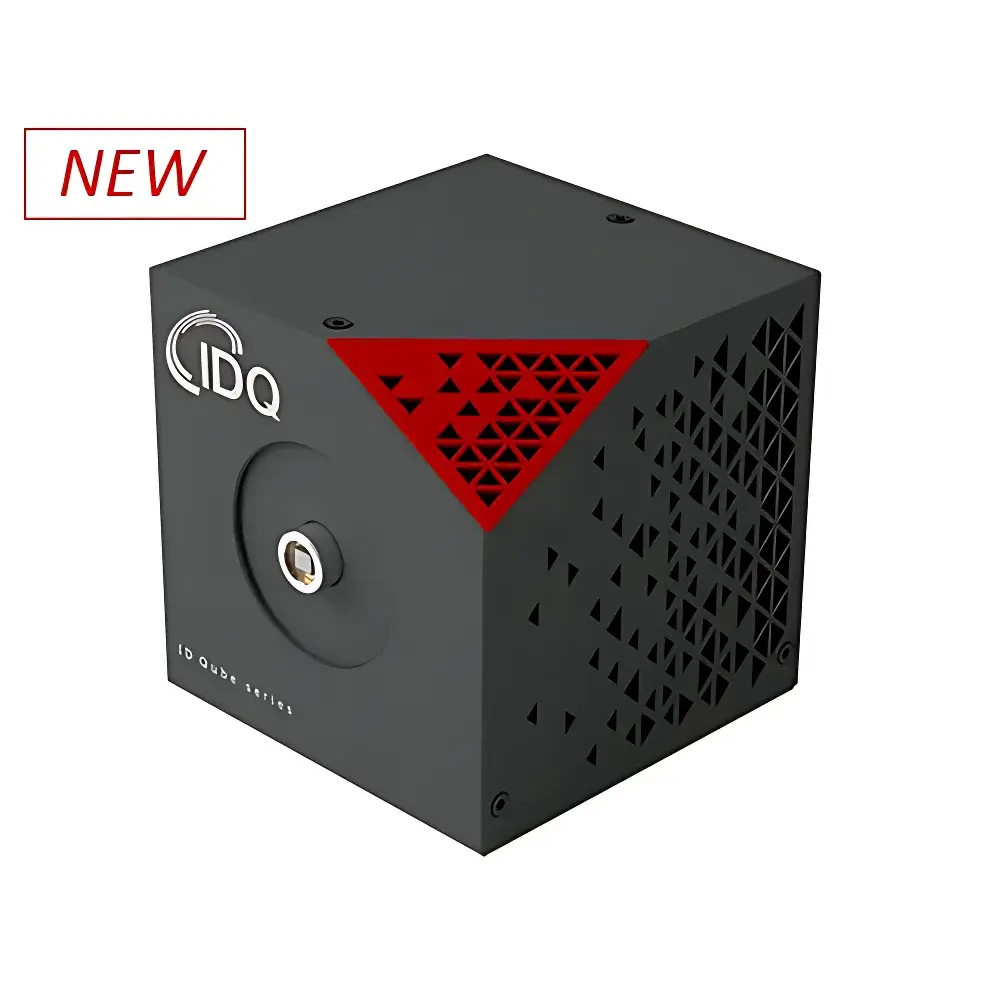
ID Quantique ID Qube NIR Gated Single-Photon Detector
| Brand | ID Quantique |
|---|---|
| Origin | Switzerland |
| Model | ID Qube NIR (Gated) |
| Detection Wavelength Range | 900–1700 nm |
| Gating Frequency | Up to 100 MHz |
| Dark Count Rate | <800 cps (at 10% detection efficiency) |
| Timing Resolution (Jitter) | 150 ps |
| Quantum Efficiency | up to 25% at 1550 nm |
| Cooling | Thermoelectric (TEC) |
| Coupling Options | Free-space, SMF-28, or multimode fiber |
| Operating Mode | Gated and free-running |
| Active Area | Standard InGaAs/InP APD |
Overview
The ID Quantique ID Qube NIR is a compact, thermoelectrically cooled gated single-photon detector engineered for high-fidelity photon counting in the near-infrared telecom band (900–1700 nm). Based on a custom-designed InGaAs/InP avalanche photodiode (APD) operated in Geiger mode, the detector leverages active quenching and fast gating circuitry to achieve low afterpulsing, sub-nanosecond timing precision, and robust suppression of dark counts. Its core architecture implements synchronous optical gating—where detection windows are precisely aligned with expected photon arrival times—enabling reliable operation in time-resolved quantum optical experiments without saturation from ambient background or laser leakage. Unlike continuously biased detectors, the ID Qube NIR’s gated architecture inherently rejects out-of-window events, significantly improving signal-to-noise ratio in pulsed quantum communication protocols such as BB84 and E91. The module is fully self-contained, requiring only DC power and TTL-compatible gate signals, making it suitable for integration into OEM quantum systems, field-deployable QKD terminals, and laboratory-grade time-of-flight instrumentation.
Key Features
- Telecom-band optimized detection: High quantum efficiency (up to 25% at 1550 nm) with spectral response covering O-, E-, S-, C-, and L-bands
- Gated operation with programmable window width and repetition rate up to 100 MHz, supporting ultrafast quantum synchronization
- Free-running mode available for continuous monitoring applications requiring flexibility in temporal structure
- Low timing jitter of ≤150 ps FWHM ensures precise photon arrival time stamping critical for time-correlated single-photon counting (TCSPC)
- Thermoelectric cooling maintains stable APD gain and dark count performance across ambient temperature variations (15–35 °C)
- Modular coupling options: factory-aligned free-space input, FC/PC-terminated single-mode fiber (SMF-28), or multimode fiber interfaces
- Integrated bias control, quenching, and digital output conditioning—no external electronics required for basic operation
Sample Compatibility & Compliance
The ID Qube NIR is compatible with standard telecom-grade optical components and aligns with common fiber-optic interfacing conventions (e.g., IEC 61300-3-35 for connector repeatability). It meets CE marking requirements for electromagnetic compatibility (EMC Directive 2014/30/EU) and low-voltage safety (LVD Directive 2014/35/EU). While not certified under FDA 21 CFR Part 11, its deterministic gate triggering, non-volatile configuration storage, and timestamped binary output format support audit-ready data acquisition in GLP-compliant quantum optics laboratories. The detector operates within ISO/IEC 17025-aligned environments when integrated with calibrated timing analyzers and NIST-traceable pulsed laser sources.
Software & Data Management
ID Quantique provides the QUBIT software suite (Windows/Linux/macOS) for real-time monitoring, gate parameter configuration (delay, width, frequency), and histogram-based timing analysis. Raw timestamps are output via LVDS or USB 2.0 in standardized binary formats (e.g., .ptu, compatible with PicoQuant’s SymPhoTime), enabling direct import into MATLAB, Python (using ptu_reader libraries), or commercial TCSPC platforms. All settings are stored in onboard EEPROM; no host dependency is required for autonomous deployment. For system integrators, a documented ASCII command protocol over RS-232 or USB CDC supports remote orchestration within LabVIEW, Python, or C++ control frameworks—facilitating compliance with automated test sequences in production-grade QKD hardware validation.
Applications
- Quantum key distribution (QKD) systems: Used as receiver modules in prepare-and-measure and entanglement-based protocols, especially where high clock rates and low quantum bit error rate (QBER) are essential
- Optical time-domain reflectometry (OTDR): Enables meter-scale spatial resolution in fiber fault localization via time-stamped backscatter photon detection
- Single-photon LiDAR: Supports direct time-of-flight ranging in atmospheric or indoor environments with picosecond-level depth resolution
- Fluorescence lifetime imaging (FLIM) and time-resolved spectroscopy: Delivers high temporal fidelity for decay curve reconstruction in NIR-emitting fluorophores (e.g., IR-26, cyanine derivatives)
- Fundamental quantum optics: Validated in Hong-Ou-Mandel interference, Bell-state measurements, and heralded single-photon source characterization
FAQ
What is the maximum achievable detection efficiency at 1550 nm?
The ID Qube NIR achieves up to 25% system detection efficiency (SDE) at 1550 nm under optimal gating conditions (10 ns gate width, 1 MHz repetition rate, −30 °C APD temperature).
Can the detector operate without external gating?
Yes—it supports free-running mode with adjustable hold-off time to mitigate afterpulsing; however, dark count rate increases relative to gated operation.
Is fiber coupling polarization-sensitive?
No—standard SMF-28 coupling is polarization-insensitive; optional polarization-maintaining (PM) fiber versions are available upon request.
Does the module include built-in timestamping capability?
No—timestamp generation requires an external time-to-digital converter (TDC) or time-correlated single-photon counting (TCSPC) board synchronized to the gate signal.
What maintenance is required during long-term operation?
None beyond periodic verification of TEC cooling performance and optical coupling alignment; the sealed APD package has no consumables or user-serviceable parts.





