
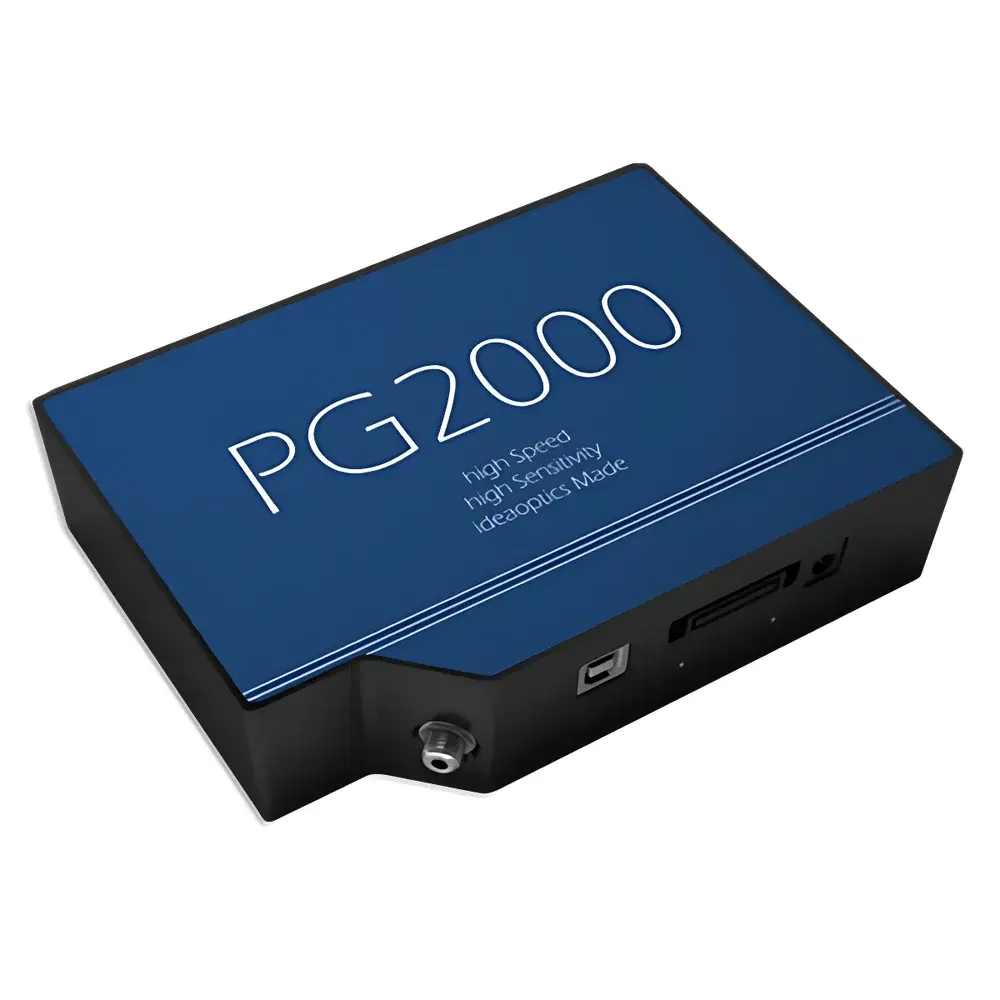
IdeaOptics PG2000 High-Speed High-Resolution Fiber Optic Spectrometer
| Brand | IdeaOptics |
|---|---|
| Origin | Shanghai, China |
| Manufacturer Type | Original Equipment Manufacturer (OEM) |
| Country of Origin | China |
| Model | PG2000 |
| Spectral Range | 200–1100 nm |
| Detector Type | CCD |
| Optical Resolution (FWHM) | 0.13–7.05 nm |
| Signal-to-Noise Ratio | 400:1 |
| Dynamic Range | 3000:1 |
| Stray Light | 0.1% @ 600 nm |
Overview
The IdeaOptics PG2000 is a high-performance fiber optic spectrometer engineered for applications demanding both temporal agility and spectral fidelity. Based on a Czerny-Turner optical architecture with optimized aberration correction, it employs a precision-aligned diffraction grating and thermally stabilized optical bench to maintain long-term wavelength calibration stability. The instrument operates on the principle of dispersed light detection: incoming polychromatic radiation—delivered via standard SMA905 fiber—is collimated, diffracted by a variable-blaze grating, and focused onto a linear CCD array. Its core design addresses two historically competing requirements in spectroscopic instrumentation: sub-millisecond acquisition latency and sub-nanometer spectral resolution. With a minimum integration time of 1 ms and optical resolution down to 0.13 nm (FWHM), the PG2000 enables time-resolved spectral monitoring of transient phenomena such as plasma decay kinetics, laser-induced breakdown spectroscopy (LIBS) pulse evolution, or rapid chemical reaction intermediates in flow cells.
Key Features
- Sub-millisecond reconfiguration: Full spectral acquisition cycle—including integration time update, detector readout, and data transfer—completed in ≤1 ms, enabling real-time feedback control loops in closed-loop optical systems.
- High-resolution optical platform: Optimized mechanical and thermal design ensures <±0.01 nm wavelength drift over 8 hours at constant ambient temperature (23 ± 1 °C), supporting quantitative multi-point calibration traceable to NIST-traceable emission line standards.
- Full-spectrum optimization: Integrated linear-variable order-sorting filter and variable-blaze grating jointly suppress higher-order diffraction across the entire 200–1100 nm range, achieving flat relative efficiency (<±15% variation) from UV-C through NIR-I without manual filter switching.
- Dedicated hardware triggering: TTL-compatible trigger input/output ports support external synchronization with pulsed lasers, shutter controllers, or motion stages—critical for pump-probe experiments and spatially resolved spectral mapping.
- Low-stray-light performance: Optical design and coated internal baffling limit stray light to ≤0.1% at 600 nm, ensuring accurate quantification of weak Raman bands adjacent to intense Rayleigh peaks or low-concentration absorption features near strong solvent cutoffs.
Sample Compatibility & Compliance
The PG2000 interfaces seamlessly with standard 400 µm or 600 µm core multimode silica fibers (NA = 0.22), accommodating both free-space coupling via optional focusing optics and direct immersion probes for liquid or gas-phase measurements. It complies with IEC 61326-1:2013 for electromagnetic compatibility in laboratory environments and meets RoHS 2011/65/EU material restrictions. While not certified for intrinsic safety, its low-power USB-powered operation (≤2.5 W) supports use in ISO 17025-accredited testing laboratories under documented risk assessment. Firmware and driver architecture support audit-ready operation per GLP and GMP guidelines when deployed with validated software environments.
Software & Data Management
The spectrometer ships with cross-platform SDKs (C/C++, Python, LabVIEW, MATLAB) supporting direct memory-mapped access to raw CCD frames and calibrated intensity arrays. All firmware operations—including grating positioning, integration time setting, and dark reference acquisition—are exposed via deterministic low-level API calls, enabling deterministic timing in custom automation sequences. Data output conforms to HDF5 v1.12 format with embedded metadata (wavelength calibration coefficients, temperature logs, integration parameters), facilitating FAIR (Findable, Accessible, Interoperable, Reusable) data practices. Optional SpectraSuite Pro software provides real-time spectral averaging, peak tracking, and batch processing compliant with FDA 21 CFR Part 11 requirements—including electronic signatures, audit trails, and role-based access control.
Applications
- Time-resolved photoluminescence decay analysis in semiconductor quantum dot characterization
- In-line process monitoring of pharmaceutical tablet coating uniformity via NIR reflectance spectroscopy
- Plasma diagnostics in industrial PECVD reactors using atomic line ratio thermometry
- UV-Vis kinetic assays in microfluidic enzymatic reactors with millisecond temporal resolution
- Multi-channel LIBS systems requiring synchronized spectral capture across multiple ablation events
- Calibration reference source validation against NIST SRM 2036 (mercury-argon lamp)
FAQ
What is the shortest achievable integration time?
The minimum hardware-limited integration time is 1 ms; effective dwell time may vary slightly depending on USB bandwidth and host system latency.
Can the PG2000 operate in continuous streaming mode?
Yes—when configured with appropriate buffer management and host-side DMA, sustained frame rates up to 500 Hz are achievable over USB 3.0.
Is wavelength calibration performed at the factory?
Each unit undergoes full spectral calibration using five primary NIST-traceable emission lines (Hg 253.65 nm, 365.01 nm, 404.66 nm, 435.83 nm, and Cd 643.85 nm), with coefficients stored in non-volatile memory.
Does the device support external triggering with jitter control?
Yes—the hardware trigger path has <100 ns jitter RMS and supports both rising-edge and falling-edge activation with programmable delay (0–100 ms, 1 µs resolution).
How is thermal drift compensated during extended measurements?
An integrated thermistor monitors optical bench temperature; calibration coefficients are interpolated in real time using a second-order polynomial model derived from factory thermal cycling tests (15–35 °C).




