
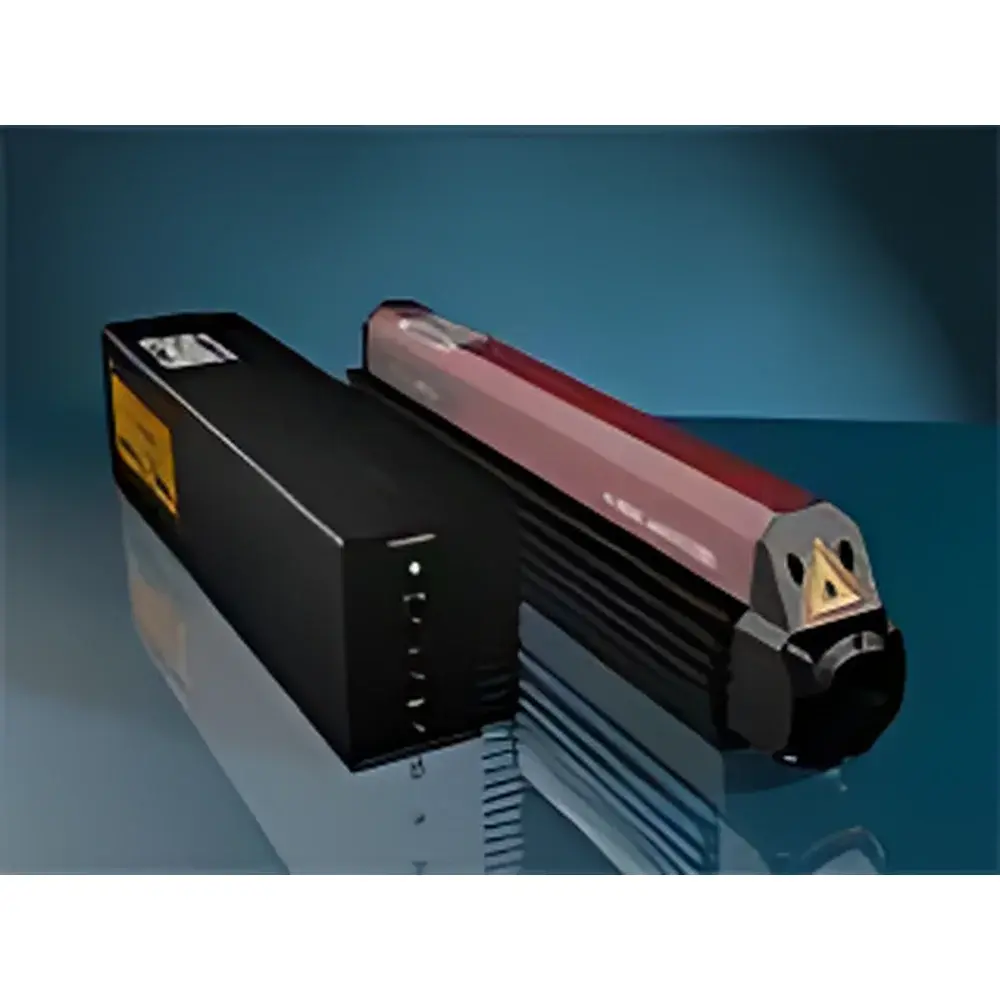
PLASMA LCD-3A CO₂ Laser System
| Brand | PLASMA |
|---|---|
| Origin | Russia |
| Type | Sealed Gas Discharge CO₂ Laser |
| Wavelength | 10.57–10.63 µm |
| Output Power | 3.0 W |
| Beam Mode | >90% TEM₀₀ |
| Polarization Ratio | 100:1 |
| Cooling | Air-Cooled |
| Configuration | Integrated RF-Excited Laser Head with Power Supply and Control Interface |
Overview
The PLASMA LCD-3A is a compact, RF-excited sealed-tube carbon dioxide (CO₂) laser system engineered for stable continuous-wave (CW) operation at the fundamental vibrational-rotational transition near 10.6 µm. Based on gas discharge physics within a CO₂–N₂–He mixture, the laser utilizes resonant energy transfer from nitrogen to CO₂ molecules, enabling high quantum efficiency and thermal stability. Its output is spectrally confined to the P-branch of the 00⁰1→10⁰0 transition, with typical linewidth <150 MHz (FWHM) under optimized cavity alignment. Designed for integration into OEM platforms and laboratory setups, the LCD-3A delivers consistent beam quality (M² < 1.1), low pointing instability (<5 µrad/°C), and long-term power stability (<±2% over 8 hours), making it suitable for applications demanding reproducible infrared irradiance in controlled environments.
Key Features
- RF-driven sealed discharge tube eliminates consumable electrodes and enables maintenance-free operation for >10,000 hours
- Integrated air-cooling architecture with thermally stabilized baseplate ensures passive thermal management without external chillers
- TEM₀₀-dominant output (>90% mode purity) with polarization extinction ratio ≥100:1, verified via calibrated Glan-Taylor prism analysis
- Low-noise analog modulation input (0–5 V, bandwidth up to 50 kHz) supports precise intensity control for process synchronization
- Compliant with IEC 60825-1:2014 Class 4 laser safety requirements; includes interlock-ready 24 V DC enable circuit and key-switched emission control
- Compact form factor (280 × 120 × 100 mm) with standardized kinematic mounting interface (M4 threaded holes on base)
Sample Compatibility & Compliance
The LCD-3A is compatible with standard ZnSe, Ge, and KRS-5 optics used in mid-infrared beam delivery systems. It interfaces directly with commercial IR spectrometers (e.g., FTIR benchtop units), laser processing stages, and medical dermatology platforms requiring calibrated 10.6 µm irradiation. The system conforms to electromagnetic compatibility standards per EN 61326-1:2013 (industrial environment) and meets mechanical safety requirements outlined in EN 60204-1:2018. While not certified for clinical use under ISO 13485 or FDA 21 CFR Part 820, its optical performance parameters are traceable to NIST-calibrated pyroelectric sensors and meet specification thresholds defined in ASTM F1980-20 (laser-based material interaction testing).
Software & Data Management
The LCD-3A operates as a standalone analog-controlled device but supports digital integration via optional RS-485 or USB-to-serial adapter (sold separately). A vendor-provided configuration utility (Windows/Linux) enables remote monitoring of discharge voltage, tube temperature, and output power history (sampled at 1 Hz). All operational logs include UTC timestamps and support CSV export for GLP-compliant documentation. Audit trails—required for GMP-aligned R&D workflows—are generated upon parameter changes and stored locally with write-protected retention. Firmware updates follow secure signed-binary protocols compliant with IEC 62443-3-3 SL2 requirements.
Applications
- Infrared spectroscopy: Source for absorption measurements of organic functional groups (C=O, C–O, N–H) in pharmaceutical excipients and polymer films
- Laser-assisted surface modification: Controlled ablation of copper-clad laminates during PCB micro-via drilling (spot size ≤150 µm, pulse repetition up to 5 kHz with external Q-switching)
- Medical device calibration: Reference emitter for validating thermal response of IR thermopile sensors used in contactless fever screening systems
- Materials processing research: Parameter studies on polyimide film carbonization thresholds and glass annealing kinetics under controlled fluence (0.1–5 J/cm²)
- Gas sensing validation: Tunable-line source for verifying detection limits of photoacoustic CO and CH₄ sensors operating near 10.6 µm
FAQ
What is the typical warm-up time to achieve rated power stability?
The LCD-3A reaches thermal equilibrium and maintains ±2% power stability within 15 minutes of cold start under ambient conditions of 20–25 °C.
Is water cooling required for continuous operation?
No — the LCD-3A is designed for forced-air cooling only; water-cooled variants (e.g., LCD-3AW) are available upon request for high-duty-cycle industrial integration.
Can the output wavelength be tuned across the CO₂ gain spectrum?
The standard LCD-3A operates fixed at 10.57–10.63 µm; tunable versions (e.g., LCD-3AG with grating feedback) support discrete line selection between 9.2–10.8 µm but require manual cavity realignment.
Does the system include beam collimation optics?
No — collimating and focusing optics must be selected separately based on application-specific M² and divergence requirements; recommended starting point: f = 50 mm ZnSe plano-convex lens.
What safety certifications does the LCD-3A hold?
It carries CE marking per Directive 2014/35/EU (LVD) and 2014/30/EU (EMC); full IEC 60825-1:2014 Class 4 classification report is available under NDA upon request.



