
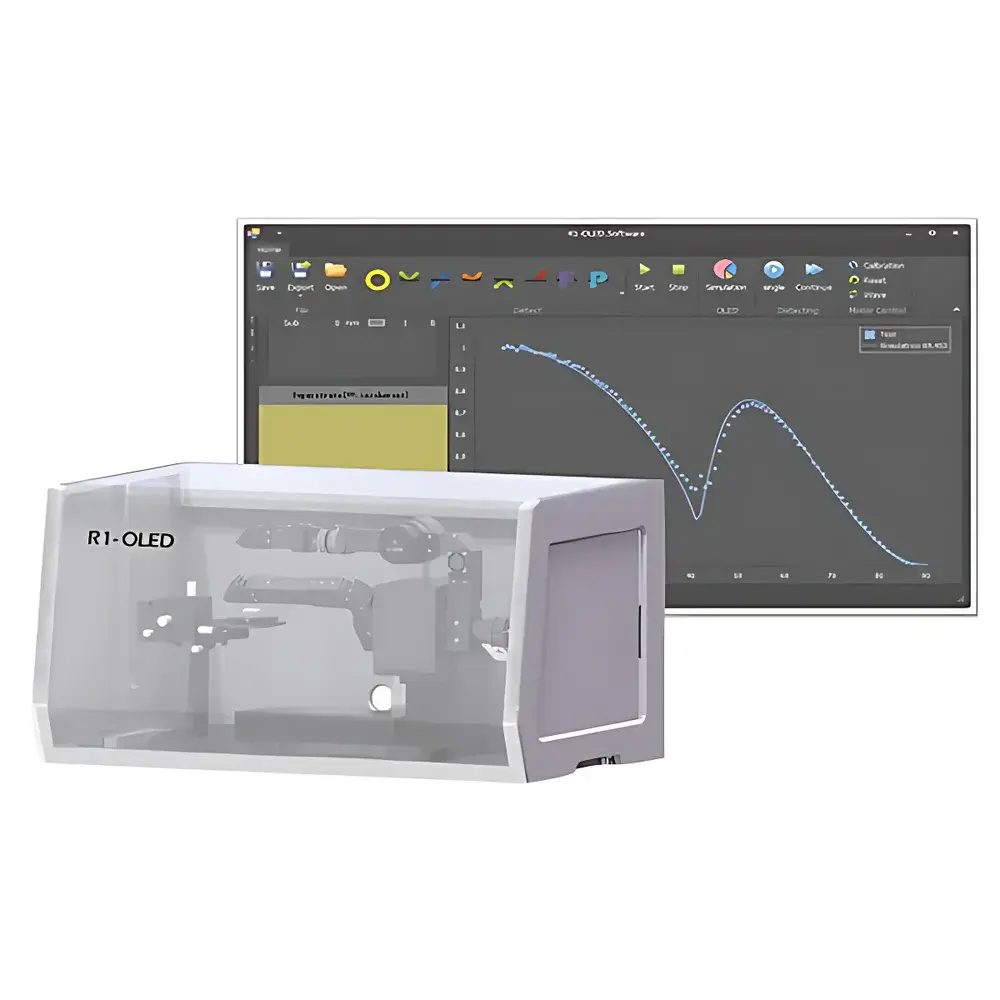
IdeaOptics R1-OLED Angular-Resolved Spectrometer for Organic Light-Emitting Materials
| Brand | IdeaOptics |
|---|---|
| Origin | Shanghai, China |
| Manufacturer Type | Original Equipment Manufacturer (OEM) |
| Country of Origin | China |
| Model | R1-OLED |
| Pricing | Upon Request |
Overview
The IdeaOptics R1-OLED Angular-Resolved Spectrometer is a purpose-built optical characterization platform engineered for quantitative, angle-resolved photoluminescence (PL) and electroluminescence (EL) spectroscopy of organic emissive materials. It operates on the principle of spatially resolved spectral detection across a full 0–360° azimuthal and polar angular range, enabling rigorous analysis of radiation pattern anisotropy, dipole orientation distribution, and outcoupling efficiency in thin-film optoelectronic systems. Designed specifically for R&D laboratories developing next-generation OLED emitters, TADF hosts, phosphorescent complexes, upconversion fluorophores, and organic photovoltaic (OPV) active layers, the system integrates high-precision rotational mechanics with broadband back-illuminated CCD detection to deliver spectrally and angularly resolved data essential for structure–property correlation and device physics modeling.
Key Features
- Full 0–360° continuous angular scanning capability enabled by dual high-resolution stepper motor stages with sub-0.1° positional repeatability and integrated optical encoder feedback.
- Broadband spectral coverage from 220 nm to 2500 nm, achieved via interchangeable gratings and optimized optical path design compatible with deep-UV excitation and NIR emission detection.
- Simultaneous PL and EL measurement modes supported through modular integration of calibrated light sources (e.g., deuterium lamps, tunable lasers, LED arrays) and source-measure units (SMUs) for bias-controlled electroluminescence.
- Back-illuminated, deep-depletion CCD spectrometer with high quantum efficiency (>90% at 600 nm) and low read noise (<3 e⁻ RMS), ensuring high signal-to-noise ratio across UV–Vis–NIR bands.
- Modular sample stage architecture accommodating substrates up to 100 mm × 100 mm, with vacuum-compatible and cryogenic-ready options available upon request.
Sample Compatibility & Compliance
The R1-OLED system supports planar and microstructured samples including spin-coated films, vapor-deposited multilayer OLED stacks, perovskite metasurfaces, and solution-processed nanostructured composites. Its mechanical and optical design conforms to ISO 14644-1 Class 5 cleanroom compatibility standards when operated under controlled environments. Data acquisition workflows support GLP-compliant documentation protocols, and software audit trails comply with FDA 21 CFR Part 11 requirements for electronic records and signatures when configured with user authentication and secure logging modules. Measurement traceability aligns with ISO/IEC 17025 guidelines for optical testing laboratories.
Software & Data Management
The proprietary AngularSpec™ software suite provides unified control of motorized stages, spectrometer acquisition, source triggering, and real-time spectral mapping. It includes built-in electromagnetic forward modeling tools based on rigorous coupled-wave analysis (RCWA) and dipole radiation theory, allowing users to fit experimental angular intensity distributions to theoretical models and extract quantitative molecular orientation parameters—including the order parameter
and horizontal dipole ratio (HDR). All raw and processed datasets are stored in HDF5 format with embedded metadata (wavelength calibration, angle timestamps, instrument configuration), ensuring FAIR (Findable, Accessible, Interoperable, Reusable) data principles. Export options include CSV, MATLAB .mat, and industry-standard JCAMP-DX for spectral interoperability.
Applications
- Quantification of horizontal dipole alignment in thermally activated delayed fluorescence (TADF) emitters to predict and optimize external quantum efficiency (EQE) in top-emitting OLED architectures.
- Angle-dependent outcoupling analysis of plasmonic and dielectric metasurfaces integrated with perovskite LEDs or organic nanocrystal films.
- Correlation of molecular packing symmetry (e.g., herringbone vs. π-stacked) with angular emission profiles in small-molecule and polymer-based emissive layers.
- In-situ monitoring of orientation evolution during thermal annealing or solvent-vapor treatment of solution-processed films.
- Validation of optical simulation outputs (e.g., FDTD, RCWA) against experimentally measured far-field radiation patterns for photonic crystal OLED designs.
FAQ
What spectral resolution can be achieved across the 220–2500 nm range?
Spectral resolution is grating-dependent and ranges from 0.15 nm (UV–Vis, 1200 g/mm grating) to 2.5 nm (NIR, 150 g/mm grating), with pixel-limited resolving power validated per NIST SRM 2034 and ISO 13694 standards.
Can the system perform time-resolved angular-resolved measurements?
Yes—when coupled with pulsed excitation sources (e.g., picosecond diode lasers) and time-correlated single-photon counting (TCSPC) modules, the platform supports transient angular PL/EL mapping with temporal resolution down to 50 ps.
Is the software capable of exporting orientation parameters directly to TCAD or optical simulation packages?
Yes—AngularSpec™ exports fitted dipole orientation tensors and angular intensity matrices in ASCII and JSON formats compatible with Synopsys Sentaurus, Lumerical DEVICE, and COMSOL Multiphysics optical modules.
Does the system meet CE or FCC regulatory requirements for laboratory instrumentation?
Yes—the R1-OLED platform carries CE marking (2014/30/EU EMC Directive and 2014/35/EU Low Voltage Directive) and complies with FCC Part 15 Subpart B Class A emission limits for industrial scientific equipment.




