
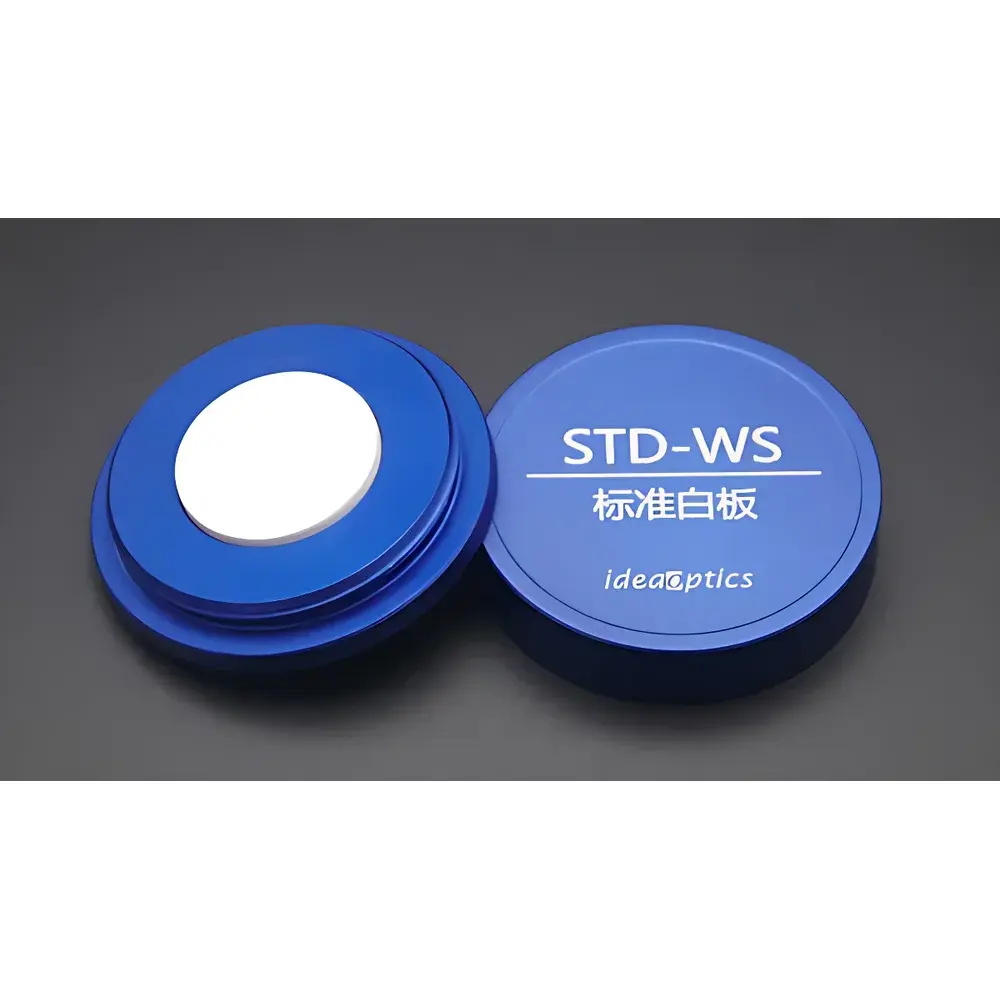
IdeaOptics STD-WS High-Reflectance Diffuse Standard White Reflectance Tile
| Brand | IdeaOptics |
|---|---|
| Model | STD-WS |
| Material | Sintered PTFE (Polytetrafluoroethylene) |
| Spectral Range | 200–2500 nm |
| Average Diffuse Reflectance | ≥98% (250–1500 nm), ≥95% (250–2200 nm) |
| Housing | Anodized Aluminum with Threaded Sealing Cap |
| Compliance | ISO 13655:2017 (Spectral Measurement of Reflectance), ASTM E259–21 (Standard Practice for Preparation and Use of Reflectance Standards), NIST-traceable calibration available upon request |
| Component Type | Optical Reference Standard |
Overview
The IdeaOptics STD-WS High-Reflectance Diffuse Standard White Reflectance Tile is a precision-engineered optical reference standard designed for quantitative diffuse reflectance spectroscopy across the ultraviolet, visible, and near-infrared (UV-VIS-NIR) spectral regions. Based on sintered polytetrafluoroethylene (PTFE), the STD-WS tile exhibits Lambertian scattering behavior and exceptional spectral stability, enabling accurate normalization of spectrometer system response and reliable quantification of sample reflectance. Its operational range spans 200–2500 nm, with ≥98% average diffuse reflectance between 250–1500 nm and ≥95% from 250–2200 nm—meeting stringent requirements for radiometric and photometric calibration in laboratory and industrial settings. Unlike painted or ceramic-based standards, the PTFE matrix offers inherent chemical inertness, low fluorescence, minimal photodegradation, and negligible batch-to-batch variability—critical attributes for long-term measurement repeatability and inter-laboratory comparability.
Key Features
- Ultra-high diffuse reflectance: ≥98% (250–1500 nm), maintained over extended exposure to UV radiation and ambient humidity
- Full-spectrum compatibility: Validated performance from deep UV (200 nm) through short-wave NIR (2500 nm)
- Robust mechanical architecture: Precision-machined sintered PTFE core mounted within a CNC-milled anodized aluminum housing with threaded sealing cap—providing IP54-level dust and moisture resistance
- Traceable calibration support: Optional NIST-traceable reflectance certification available per ISO/IEC 17025-accredited procedures
- Low angular dependence: Maintains consistent BRDF (Bidirectional Reflectance Distribution Function) characteristics across ±10° incidence angles, ensuring compatibility with fiber-optic probe geometries common in portable and benchtop systems
- No binder or pigment additives: Pure PTFE composition eliminates spectral artifacts associated with organic binders or metal oxide pigments
Sample Compatibility & Compliance
The STD-WS is engineered for use with integrating spheres, bifurcated fiber-optic probes, and collimated beam configurations typical in UV-VIS-NIR spectrophotometry. It serves as a primary reference for calibrating reflectance measurements of optically rough, non-Lambertian surfaces—including ceramics, matte plastics, textured coatings, paper, textiles, and biological tissues. The tile complies with key international standards governing spectral reflectance metrology, including ISO 13655:2017 (spectral measurement of reflectance), ASTM E259–21 (preparation and use of reflectance standards), and supports GLP-compliant workflows when paired with audit-trail-enabled spectrometer software. Its thermal stability (−10 °C to +60 °C operating range) and resistance to condensation ensure reliability in controlled environment laboratories and field-deployable instrumentation.
Software & Data Management
While the STD-WS is a passive optical component, it integrates seamlessly into data acquisition pipelines used with IdeaOptics’ FX series spectrometers and third-party platforms (e.g., Ocean Insight, Avantes, Hamamatsu). When used with compliant software, the tile enables automated dark-current subtraction, intensity normalization, and spectral correction routines. For regulated environments, its use aligns with FDA 21 CFR Part 11 requirements when deployed alongside electronic records systems that enforce user authentication, version control, and immutable audit trails for calibration events. Reflectance validation reports—including spectral deviation plots and uncertainty budgets—can be generated using standard spectral analysis toolkits (e.g., MATLAB, Python SciPy, or commercial packages such as Thermo Fisher OMNIC).
Applications
- Calibration of UV-VIS-NIR spectrophotometers and hyperspectral imaging systems
- Quantitative reflectance characterization of architectural coatings, automotive paints, and additive-manufactured surface finishes
- Quality control of diffuse-transmission materials (e.g., opal glass, frosted polymers)
- Benchmarking of BRDF models in computer graphics and remote sensing simulation
- In-process monitoring of pigment dispersion uniformity in ink and paint manufacturing
- Validation of solar reflectance indices (SRI) per ASTM E1980 for cool roof materials
FAQ
What spectral range is the STD-WS certified for?
The STD-WS is characterized and validated from 200 nm to 2500 nm, with reflectance ≥98% between 250–1500 nm and ≥95% between 250–2200 nm.
Can the STD-WS be used in humid or outdoor environments?
Yes—the anodized aluminum housing with threaded sealing cap provides protection against incidental moisture and particulate ingress (IP54 rating); however, prolonged immersion or condensation inside the housing is not recommended.
Is the reflectance value NIST-traceable?
NIST-traceable calibration certificates are available as an optional service, issued by an ISO/IEC 17025-accredited laboratory with uncertainty budgets reported per ISO/IEC Guide 98-3 (GUM).
How often should the STD-WS be recalibrated?
Under normal laboratory handling and storage conditions (clean, dry, protected from direct UV exposure), annual verification is recommended; more frequent checks are advised in high-use or harsh-environment applications.
Does the STD-WS require special cleaning procedures?
No solvents or abrasives should be used. Light contamination may be removed with compressed air or gentle wiping using lint-free tissue slightly dampened with deionized water—followed immediately by thorough drying.




