
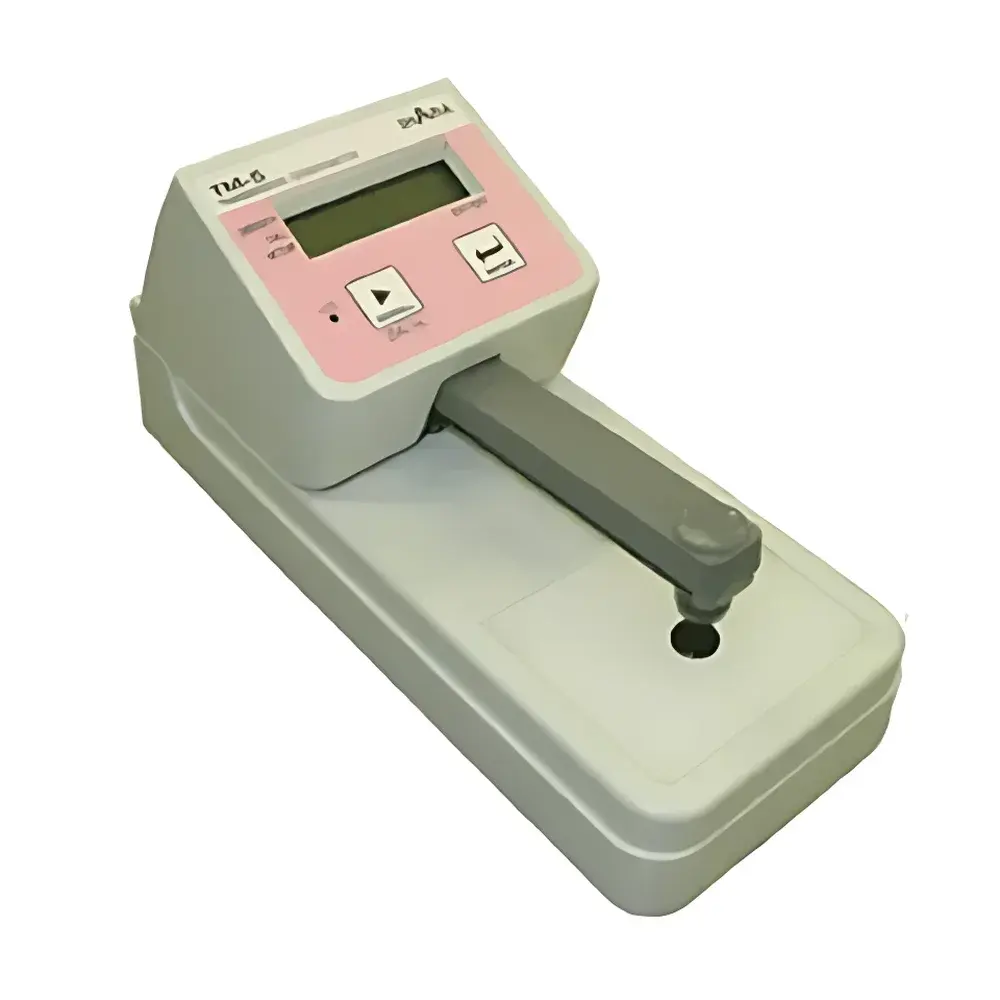
Ihara Electronic TM-5 Densitometer for Black-and-White Film Transmission Density Measurement
| Brand | Ihara Electronic |
|---|---|
| Origin | Japan |
| Model | TM-5 |
| Measurement Principle | Optical Transmission Densitometry (ANSI PH2.19 compliant) |
| Measuring Apertures | φ3 mm, φ2 mm, φ1 mm |
| Density Range | 0.0–6.0 D |
| Repeatability | ±0.01 D (0–5.0 D) |
| Instrumental Accuracy | ±0.02 D (0–4.0 D), ±0.03 D (4.0–5.0 D) |
| Operating Temperature | 5–40 °C |
| Light Source | Halogen Lamp |
| Detector | Filtered Photodiode Assembly |
| Output Interface | RS-232C |
| Data Storage Capacity | 100 measurements |
| Included Accessories | Calibration Films (Glossy, φ3/φ2/φ1 mm), AC Adapter (9 V, 500 mA), Instruction Manual |
| Optional | Communication Cable, Replacement Case |
Overview
The Ihara Electronic TM-5 Densitometer is a precision optical instrument engineered for high-accuracy transmission density measurement of black-and-white radiographic film. Designed in strict compliance with ANSI PH2.19 standards for densitometric performance and spectral response, the TM-5 employs a calibrated halogen light source and a spectrally matched photodiode detector assembly to deliver traceable, reproducible optical density (D) values across an extended range of 0.0 to 6.0 D. Its optical architecture incorporates a defined measurement geometry based on specular reflection compensation, ensuring minimal influence from surface finish variations—critical when evaluating glossy medical film substrates. The device is optimized for quality assurance workflows in diagnostic imaging departments, where quantitative control of film optical density directly correlates with image contrast, dynamic range, and low-contrast detectability. Unlike general-purpose densitometers limited to ≤4.0 D, the TM-5 maintains metrological integrity up to 6.0 D—an essential capability for verifying high-density regions in mammography, computed radiography (CR), and digital radiography (DR) quality control protocols.
Key Features
- Extended density range up to 6.0 D—validated for high-density radiographic film evaluation in clinical and industrial QA environments.
- Triple-aperture selection (φ1 mm, φ2 mm, φ3 mm) enables localized density assessment aligned with ISO 11699-1 and ASTM E1815 test patterns.
- High repeatability of ±0.01 D within 0–5.0 D range, supported by temperature-compensated analog signal conditioning and stable thermal management.
- Integrated calibration verification: supplied with certified glossy reference films for routine accuracy checks per ISO/IEC 17025 traceability guidelines.
- Ergonomic single-action measurement arm—press-to-measure operation minimizes operator-induced variability and accelerates throughput in high-volume QC labs.
- RS-232C serial interface supports bidirectional communication with PCs or printers; compatible with custom LIMS integration and automated report generation.
- Onboard memory stores up to 100 measurement records with timestamp and aperture identification—enabling audit-ready data capture without external hardware.
Sample Compatibility & Compliance
The TM-5 is validated for use with standard black-and-white silver-halide radiographic films—including Kodak, Agfa, Fuji, and Konica-Minolta medical-grade emulsions—as well as industrial NDT films meeting ASTM E999 and ISO 11699-2 specifications. Its optical design conforms to ANSI PH2.19 requirements for spectral sensitivity (visual-weighted photopic response), eliminating systematic bias caused by non-standard illuminants. The instrument meets electromagnetic compatibility (EMC) Class B criteria per IEC 61326-1 and operates reliably within ambient conditions of 5–40 °C and ≤80% RH (non-condensing). While not FDA-cleared as a medical device, its metrological performance aligns with FDA guidance for film processor monitoring under 21 CFR Part 1020.30 and supports GLP/GMP documentation requirements through secure data export and calibration log retention.
Software & Data Management
The TM-5 operates autonomously but integrates seamlessly into regulated environments via its RS-232C port. Raw density values, aperture selection, and measurement timestamps are transmitted in ASCII format, enabling direct ingestion into Excel-based QA logs or validated laboratory information management systems (LIMS). No proprietary software is required; users may implement simple terminal emulation (e.g., PuTTY, Tera Term) or develop custom scripts using Python’s pySerial library for batch validation reporting. All stored measurements remain accessible until overwritten—no volatile memory or battery-backed RAM is used, ensuring data persistence during power cycles. Audit trails can be reconstructed from printed output or exported CSV files, satisfying basic 21 CFR Part 11 record-keeping expectations when paired with procedural controls.
Applications
- Radiographic film processor performance verification—daily, weekly, and monthly density uniformity testing per AAPM Report No. 18 and JIS Z 3062.
- Baseline characterization of new film batches prior to clinical deployment.
- Quantitative assessment of developer chemistry exhaustion and replenishment efficacy.
- Validation of automatic film processing systems against established density targets (e.g., 2.2 ± 0.15 D for chest radiographs).
- Supporting accreditation audits (e.g., ACR, JCIA, ISO 9001) with documented, repeatable densitometric evidence.
- Industrial non-destructive testing (NDT) film QC in aerospace, power generation, and welding certification programs.
FAQ
What standards does the TM-5 comply with for densitometric accuracy?
The TM-5 adheres to ANSI PH2.19 for spectral response and geometric configuration, and its measurement uncertainty budget is consistent with ISO 11699-1 Annex A for radiographic film densitometry.
Can the TM-5 measure reflective density?
No—the TM-5 is exclusively configured for transmission density measurement of transparent media; it does not support reflective or diffuse reflectance modes.
Is calibration traceable to national standards?
Yes—certified reference films provided with the instrument are calibrated against NIST-traceable densitometry standards, and full calibration certificates are available upon request.
How often should the built-in calibration films be replaced?
Reference films should be replaced annually or after 500 measurements, whichever occurs first, to maintain measurement integrity under ISO/IEC 17025 Clause 6.4.10.
Does the TM-5 require annual recalibration by the manufacturer?
While not mandatory, Ihara Electronic recommends biennial factory recalibration with full metrological verification report issuance to sustain long-term accuracy confidence.




