
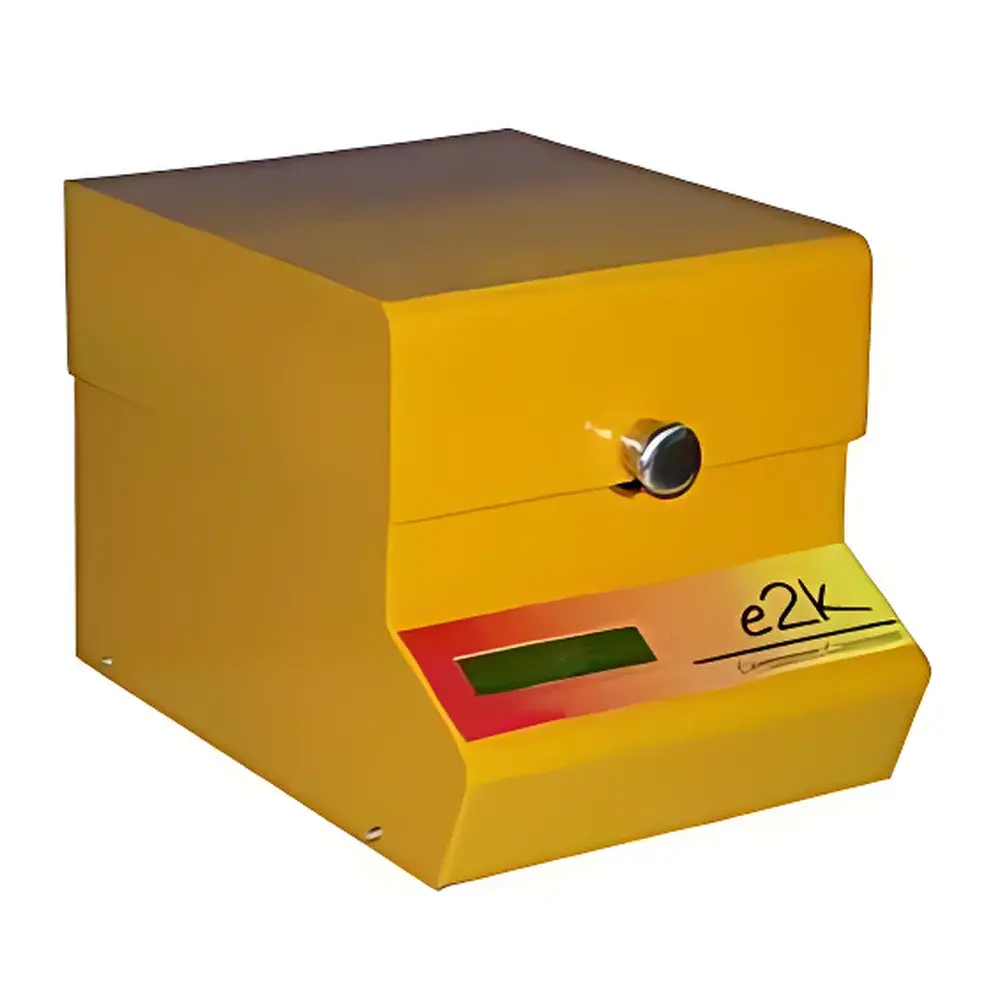
IKA E2K Advanced Automatic Bomb Calorimeter
| Origin | Imported |
|---|---|
| Manufacturer Type | Authorized Distributor |
| Model | E2K |
| Operating Temperature Range | 0–60 °C |
| Temperature Repeatability | ≤0.1% RSD |
| Temperature Resolution | 1 µK |
| Gross Calorific Value Resolution | 0.001 MJ/kg |
| Calibration | 10 stored calibration curves per smart bomb vessel, automatic standard deviation correction, integrated calibration sensors per vessel |
| Sample Throughput | Up to 10 samples/hour (standard configuration) |
| Measurement Time | 1.5–3 min per test |
| Dimensions (W×D×H) | 280×400×290 mm |
| Weight | 9 kg |
| Data Storage Capacity | >1000 test records with full metadata (operator ID, ambient conditions, calibration traceability) |
| Connectivity | Ethernet-enabled for multi-unit network (up to 7 units) |
| Ignition Control | Adjustable ignition energy, programmable high/low sample mass limits, customizable test cycle parameters |
Overview
The IKA E2K Advanced Automatic Bomb Calorimeter is a precision-engineered isoperibolic (constant-temperature jacket) combustion calorimeter designed for the accurate determination of gross calorific value (GCV) in solid and liquid fuels and organic materials. It operates on the fundamental principle of adiabatic or near-isothermal oxygen bomb combustion—where a precisely weighed sample is ignited under high-pressure oxygen (typically 30 bar) inside a stainless-steel bomb vessel, and the resulting temperature rise in a thermally stabilized water bath is measured via ultra-high-resolution platinum resistance thermometry (1 µK resolution). The system computes GCV using standardized thermodynamic corrections for nitric acid formation, sulfuric acid formation, and fuse wire/cotton ignition energy—fully compliant with ASTM D240, D5865, D4809, ISO 1928, DIN 51900-2, and BS 4791:1985. Its patented dry-bomb architecture eliminates reliance on water-filled jackets, overflow troughs, or manual leveling—reducing maintenance, eliminating thermal lag artifacts, and improving inter-laboratory reproducibility.
Key Features
- Smart bomb vessels with embedded microprocessors and self-diagnostic capability—each stores up to 10 user-defined calibration curves and performs real-time sensor validation.
- Integrated calibration sensors per vessel ensure traceable, in-situ correction for ignition energy (fuse wire, cotton), blank contributions, and thermal inertia—no external reference runs required between samples.
- Automated mass input via RS232/USB interface to analytical balances or manual keyboard entry; supports operator ID tagging and GLP-compliant audit trails.
- Configurable test cycles—including adjustable ignition energy, programmable upper/lower mass limits, and variable oxygen pressurization sequences—to accommodate diverse sample matrices (e.g., low-energy animal feed vs. high-energy explosives).
- Networked operation: Up to seven E2K units can be synchronized and centrally monitored via Ethernet, enabling shared method libraries, consolidated reporting, and load-balanced throughput in high-volume QC labs.
- Onboard memory retains >1000 complete test records—including raw thermograms, calibration coefficients, environmental logs (ambient T/RH), and operator metadata—exportable as CSV or XML for LIMS integration.
- Multi-language UI (English, German, Chinese, Korean) with context-sensitive help and guided calibration workflows compliant with ISO/IEC 17025 documentation requirements.
Sample Compatibility & Compliance
The E2K accommodates heterogeneous, high-ash, or volatile-rich matrices including coal, coke, biomass pellets, animal feed, cement clinker, industrial oils, propellants, and explosive formulations. Its robust bomb design meets UN transport safety standards for energetic materials handling. All measurement protocols adhere strictly to ISO/IEC 17025 clause 5.4.2 (method validation), ASTM E144 (calorimeter calibration), and USP (calorimetric assay validation). Calibration traceability is maintained through NIST-traceable benzoic acid reference materials (SRM 39j), with automatic uncertainty propagation per GUM (JCGM 100:2008). The system supports 21 CFR Part 11-compliant electronic signatures when deployed with validated third-party LIMS or ELN platforms.
Software & Data Management
The embedded firmware provides real-time thermogram visualization, automatic baseline drift compensation, and outlier detection based on ASTM D5865 Annex A4 criteria. Raw data files (.cal) include digital signatures, timestamped operator actions, and cryptographic hash verification to prevent post-acquisition tampering. Export formats include ASTM E2500-compliant PDF reports (with embedded calibration certificates), CSV for statistical process control (SPC), and XML for automated ingestion into enterprise quality management systems (QMS). Audit trails record all parameter changes, calibration events, and user logins—retained for ≥15 years per internal retention policy aligned with FDA and EU Annex 11 expectations.
Applications
Primary use cases span fuel certification (ASTM D5865 for coal, D4809 for liquid fuels), regulatory compliance (EU Directive 2009/28/EC for biomass sustainability), R&D formulation optimization (food calorie labeling per FDA 21 CFR 101.9, pet food metabolizable energy modeling), and defense sector energetic material characterization (DoD MIL-STD-810G thermal stability screening). Secondary applications include cement kiln fuel substitution studies, waste-derived fuel (RDF/SRF) acceptance testing, and academic research in thermochemistry and reaction enthalpy quantification.
FAQ
Does the E2K require water bath maintenance or leveling?
No—the intelligent bomb vessel operates in a dry, thermostatically controlled metal jacket; no water filling, overflow management, or manual leveling is necessary.
How is calibration traceability documented per ISO/IEC 17025?
Each calibration event generates a digitally signed certificate referencing NIST SRM 39j batch numbers, uncertainty budgets, and environmental conditions—automatically archived with test records.
Can the system integrate with our existing LIMS?
Yes—via configurable RESTful API or HL7-compliant middleware; validated interfaces available for Thermo Fisher SampleManager, LabVantage, and STARLIMS.
What safety certifications apply to the oxygen bomb assembly?
All bomb vessels conform to PED 2014/68/EU Category IV pressure equipment requirements and carry CE marking with EN ISO 13849-1 functional safety validation.
Is remote diagnostics supported?
Yes—embedded SSH access (disabled by default) and encrypted remote firmware updates are available under controlled IT security protocols approved for GxP environments.



