
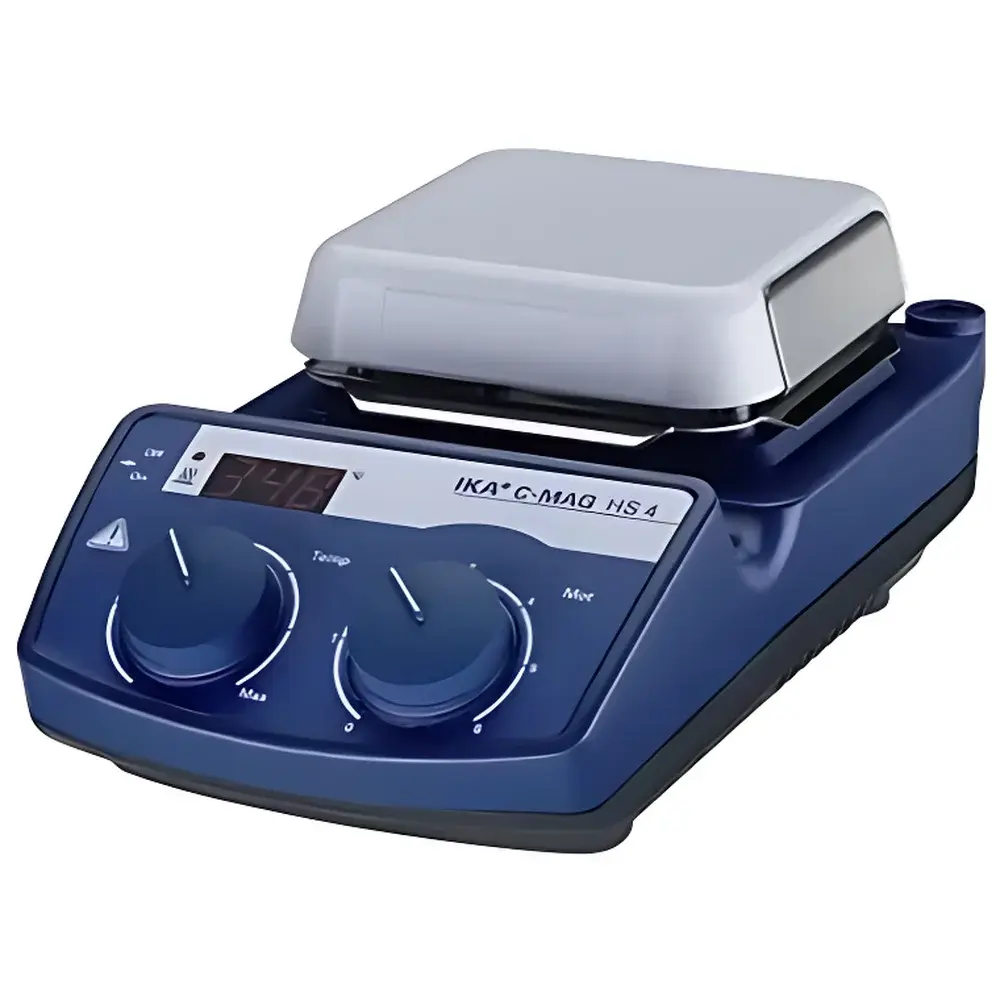
IKA C-MAG HS4 IKAMAG® Magnetic Stirrer with Heating
| Brand | IKA |
|---|---|
| Origin | Germany |
| Model | HS4 |
| Instrument Type | Magnetic Stirrer |
| Max. Stirring Volume | 5 L (H₂O) |
| Speed Range | 100–1500 rpm |
| Heating Temperature Range | 50–500 °C |
| Heating Power | 250 W |
| Motor Output Power | 1.5 W |
| Plate Material | Ceramic |
| Plate Dimensions | 100 × 100 mm |
| Safety Overtemperature Cut-off | 550 °C |
| IP Rating | IP21 |
| Input Voltage | 230 V, 50/60 Hz |
| Weight | 3 kg |
Overview
The IKA C-MAG HS4 IKAMAG® is a compact, single-position magnetic stirrer with integrated ceramic heating plate, engineered for precision temperature-controlled mixing in academic, pharmaceutical, and industrial laboratory environments. It operates on the principle of magnetic coupling—rotating a PTFE- or glass-coated stir bar via a rotating magnetic field generated beneath a non-magnetic ceramic surface—enabling contactless agitation without mechanical shaft penetration. The device combines robust thermal performance (50–500 °C range, ±10 K control accuracy) with digitally referenced speed regulation (100–1500 rpm), making it suitable for applications requiring simultaneous heating and homogeneous dispersion of low-to-medium viscosity samples up to 5 L (water-equivalent). Its sealed ceramic top plate resists chemical corrosion and thermal shock, while the elevated control panel minimizes liquid ingress risk during routine operation.
Key Features
- Ceramic heating plate (100 × 100 mm) with high thermal stability and resistance to acids, alkalis, and organic solvents
- Digital LED display for real-time monitoring of set and actual heating temperature
- Fixed safety overtemperature cut-off at 550 °C, compliant with DIN EN 60529 (IP21) for protection against vertically falling solids
- Elevated control interface reduces exposure to splashes and improves ergonomics during extended use
- Integrated error-code diagnostics displayed numerically for rapid troubleshooting (e.g., sensor fault, overheating, motor stall)
- Low-noise brushless DC motor delivering consistent torque across the full speed range (100–1500 rpm)
- Energy-efficient design: 250 W heating output with 2.5 K/min ramp rate in 1 L water (measured in H15 vessel)
Sample Compatibility & Compliance
The C-MAG HS4 supports standard laboratory vessels—including borosilicate glass beakers, Erlenmeyer flasks, and stainless-steel containers—up to 5 L volume when using appropriately sized stir bars (recommended length: 40–60 mm). Its ceramic surface tolerates brief exposure to temperatures exceeding 500 °C, ensuring compatibility with high-boiling-point solvents (e.g., ethylene glycol, silicone oils) and post-reaction residue cleaning protocols. The unit conforms to IEC 61010-1 for electrical safety in laboratory equipment and meets CE marking requirements for EMC and low-voltage directives. While not certified for GLP/GMP production environments, its repeatable thermal and rotational behavior supports method development aligned with ASTM E2917 (Standard Practice for Calibration of Laboratory Equipment) and ISO/IEC 17025 traceability frameworks when used with NIST-traceable thermometers and tachometers.
Software & Data Management
The C-MAG HS4 is a stand-alone analog-digital hybrid instrument with no onboard data logging or PC connectivity. All operational parameters—including target temperature, current plate temperature, and speed setting—are displayed locally via dual LED indicators. No software drivers, firmware updates, or cloud integration are required or supported. For laboratories implementing 21 CFR Part 11-compliant workflows, external validation documentation (e.g., IQ/OQ protocols) must be developed independently; the device provides no audit trail, electronic signatures, or user-access controls. However, its mechanical simplicity ensures long-term reliability and minimal calibration drift—key advantages for QC labs maintaining legacy instrumentation fleets.
Applications
- Precipitation and crystallization studies requiring controlled nucleation kinetics
- Solution preparation for spectroscopic standards (UV-Vis, ICP-OES) where homogeneity and temperature consistency impact absorbance linearity
- Buffer equilibration and pH adjustment in molecular biology workflows
- Preparation of polymer solutions and colloidal dispersions prior to rheological or particle size analysis
- Heating-stirring steps in ASTM D86 (distillation) or ISO 3104 (kinematic viscosity) sample conditioning protocols
- Small-scale synthesis reactions under reflux conditions using air-cooled condensers
FAQ
What is the maximum recommended vessel diameter for optimal stirring performance?
For uniform vortex formation and efficient heat transfer, vessels with diameters ≤90 mm are recommended when operating near 1500 rpm. Larger beakers (e.g., 1000 mL) may require lower speeds or longer stabilization times.
Can the C-MAG HS4 be used with metal stir bars?
No. Only PTFE- or glass-coated magnetic stir bars should be used to prevent scratching the ceramic surface and ensure consistent magnetic coupling.
Is the heating plate surface resistant to HF or molten NaOH?
While the ceramic plate exhibits broad chemical inertness, prolonged exposure to hydrofluoric acid or concentrated molten alkalis will degrade the glaze. Routine cleaning with mild detergent and deionized water is advised.
Does the unit support external temperature probe input for PID feedback control?
No. Temperature regulation is based solely on the built-in ceramic plate sensor; no external probe port or RTD input is provided.
What maintenance is required to ensure long-term accuracy?
Annual verification of temperature accuracy using a calibrated immersion thermometer and speed verification with an optical tachometer are recommended per ISO/IEC 17025 Clause 6.4.1. No internal lubrication or recalibration is user-serviceable.



