
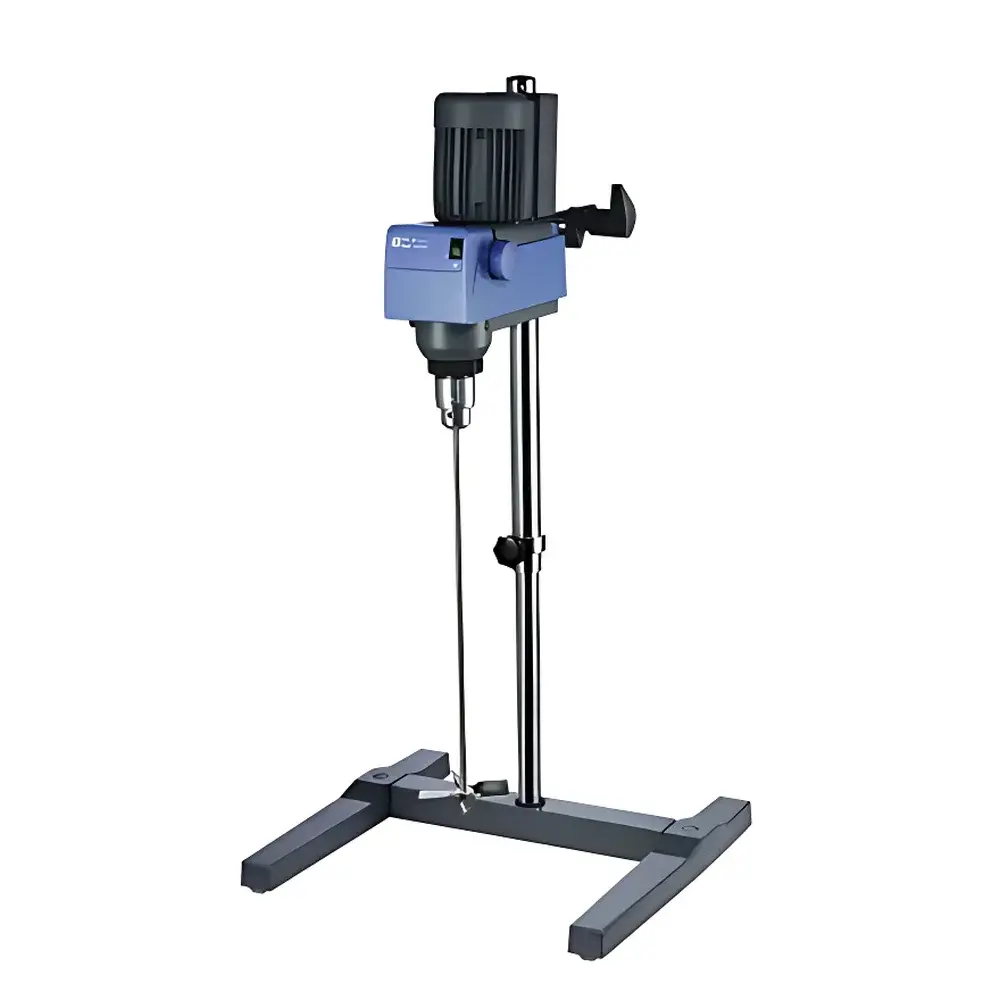
IKA RW28 Basic Mechanical Stirrer
| Brand | IKA |
|---|---|
| Origin | Germany |
| Model | RW28 Basic |
| Max. Viscosity | 50,000 mPa·s |
| Speed Range | 60–1400 rpm (two ranges, continuously adjustable) |
| Max. Volume (H₂O) | 80 L |
| Motor Output Power | 90 W |
| Max. Torque | 900 N·cm (at 100 rpm), 1144 N·cm (overload at 60 rpm) |
| Shaft Output Power | 90 W |
| Duty Cycle | 100% continuous operation |
| Clamp Range | 1–10 mm |
| Hollow Shaft ID | 10.5 mm |
| IP Rating | IP42 |
| Dimensions (W×H×D) | 123 × 364 × 252 mm |
| Weight | 7.4 kg |
| Ambient Operating Conditions | 5–40 °C, ≤80% RH |
| Voltage | 100–240 V, 50/60 Hz |
| Input Power | 220 W |
| Shaft Fixation | Chuck |
| Support | Adjustable extension arm (Ø16 mm, 145 mm length) |
| Display | Analog speed scale |
| Compliance | DIN EN 60529 |
Overview
The IKA RW28 Basic Mechanical Stirrer is a robust, continuously operable laboratory stirrer engineered for reproducible mixing and dispersion tasks across research labs, quality control environments, and pilot-scale production settings. Designed around a high-torque, brush-type DC motor architecture, the RW28 Basic delivers stable rotational energy transfer under variable load conditions—particularly critical when processing non-Newtonian or highly viscous media. Its mechanical drive system operates on the principle of direct-coupled torque transmission via a precision-machined chuck and hollow stainless-steel shaft, enabling both standard overhead stirring and in-line probe integration (e.g., temperature sensors or pH electrodes through the 10.5 mm internal bore). With a maximum water-equivalent volume capacity of 80 L and rated torque output up to 900 N·cm at low speeds, the unit supports scalable process development—from benchtop formulation to pre-production batch validation—while maintaining consistent shear profiles across viscosity ranges from 1 mPa·s to 50,000 mPa·s.
Key Features
- Two-speed operational ranges (60–400 rpm and 240–1400 rpm at 50 Hz; extended to 72–480 rpm and 288–1680 rpm at 60 Hz) with infinitely variable adjustment via analog dial control
- Hollow stainless-steel stirring shaft (10.5 mm inner diameter) permitting real-time inline instrumentation insertion during operation
- High-strength chuck mechanism accommodating stirring elements from 1 mm to 10 mm in diameter—compatible with standard IKA impellers, anchor paddles, and custom-designed dispersers
- Full 100% duty cycle rating ensures uninterrupted operation under sustained high-load conditions, validated per DIN EN 60529 for IP42 ingress protection against solid objects >1 mm and vertically falling water droplets
- Modular support configuration with 145 mm extendable arm (16 mm diameter) and universal clamp interface for seamless integration into fume hoods, reactor stands, or custom-built rigs
- Thermally stabilized motor housing and optimized heat dissipation design maintain consistent torque delivery across ambient temperatures from 5 °C to 40 °C and relative humidity up to 80%
Sample Compatibility & Compliance
The RW28 Basic is routinely deployed for mixing aqueous suspensions, polymer solutions, ceramic slurries, pharmaceutical suspensions, and food-grade emulsions. Its mechanical architecture avoids electromagnetic interference, making it suitable for use alongside sensitive analytical instrumentation such as balances, spectrophotometers, or electrochemical workstations. The device conforms to DIN EN 60529 (IP42), ensuring operational safety in typical laboratory environments. While not equipped with digital communication interfaces (e.g., RS232 or analog output), its analog speed scale and mechanical reliability support GLP-aligned documentation practices when paired with external logging systems. It is not certified for hazardous area use (ATEX/IECEx) or sterile processing (ISO 13485), and users must validate suitability for GMP-relevant applications per internal SOPs.
Software & Data Management
The RW28 Basic operates as a standalone analog instrument without embedded firmware, network connectivity, or software-driven calibration routines. Speed selection is performed manually using the front-panel dial, with rotational velocity indicated via a calibrated analog scale—eliminating dependency on power-up sequences, firmware updates, or cybersecurity protocols. This architecture enhances long-term operational stability and reduces failure modes associated with digital electronics in chemically aggressive or vibration-prone environments. For laboratories requiring traceable speed records, integration with external data acquisition systems (e.g., USB-connected tachometers or vision-based RPM analyzers) is feasible via third-party hardware. No FDA 21 CFR Part 11 compliance features are present; manual logbook entries remain the primary audit trail method.
Applications
- Homogenization of high-viscosity polymer melts and thermoplastic composites prior to rheological or thermal analysis
- Dispersion of nanomaterials (e.g., graphene oxide, metal oxides) in solvent-based matrices for coating formulation
- Preparation of uniform suspensions for particle size distribution studies (e.g., laser diffraction or sedimentation analysis)
- Stirring of culture media and buffer solutions in bioprocess development workflows
- Mixing of catalyst slurries in heterogeneous reaction screening under inert atmosphere gloveboxes
- Batch-wise dilution and reconstitution of reference standards in analytical chemistry laboratories
FAQ
Is the RW28 Basic suitable for explosive or flammable solvent environments?
No. The unit lacks ATEX or IECEx certification and contains brushed motor components that may generate sparks. It must be operated only in non-hazardous locations.
Can the stirring shaft accommodate custom-designed impellers?
Yes—provided the shank diameter falls within the 1–10 mm chuck range and the total mass and moment of inertia remain within the motor’s dynamic load specifications.
Does the hollow shaft allow simultaneous temperature monitoring during stirring?
Yes. Standard PT100 probes or thermocouples with outer diameters ≤10 mm can be inserted through the shaft bore while maintaining rotation integrity.
What maintenance is required for long-term reliability?
Periodic inspection of chuck jaw integrity, lubrication of extension arm pivot points (if used with oscillating motion), and verification of motor ventilation grilles for dust accumulation.
Is voltage auto-sensing supported?
No. Input voltage must be manually configured via internal jumper settings per local supply (100 V, 115 V, or 220–240 V), as specified in the technical manual.



