
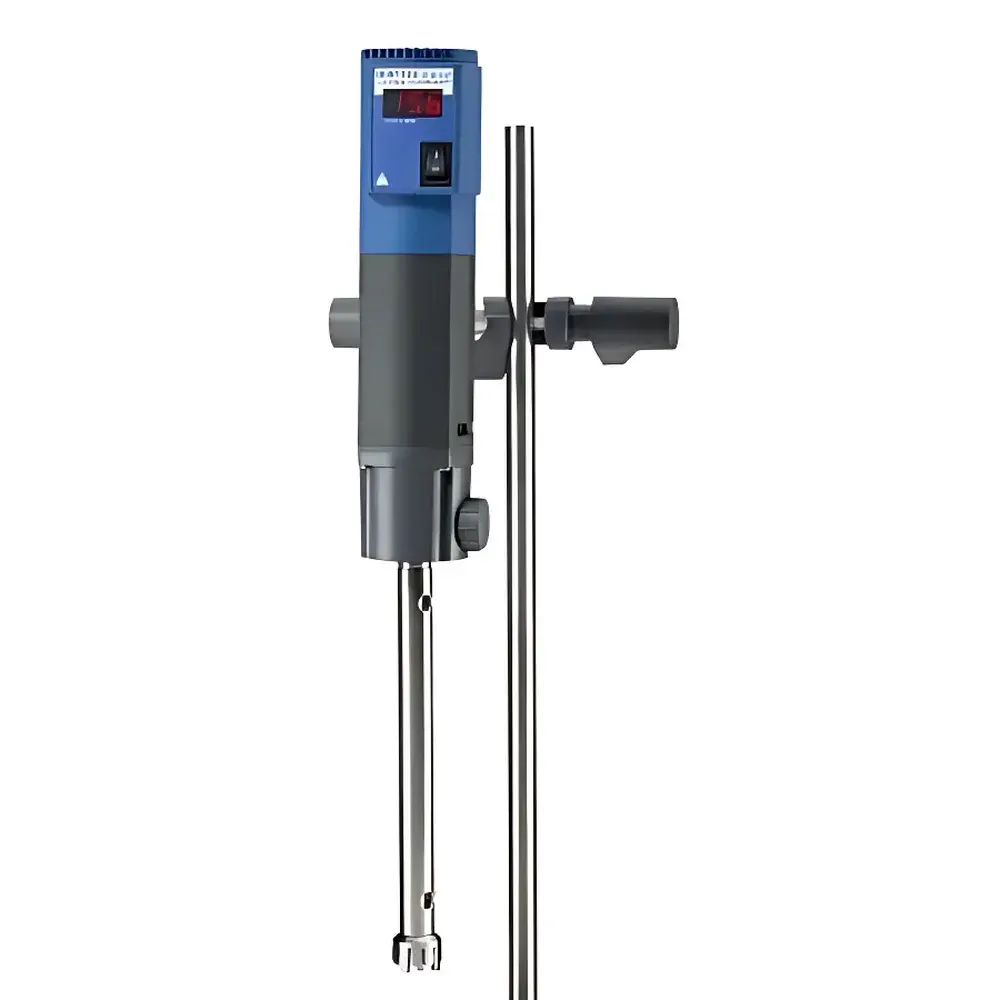
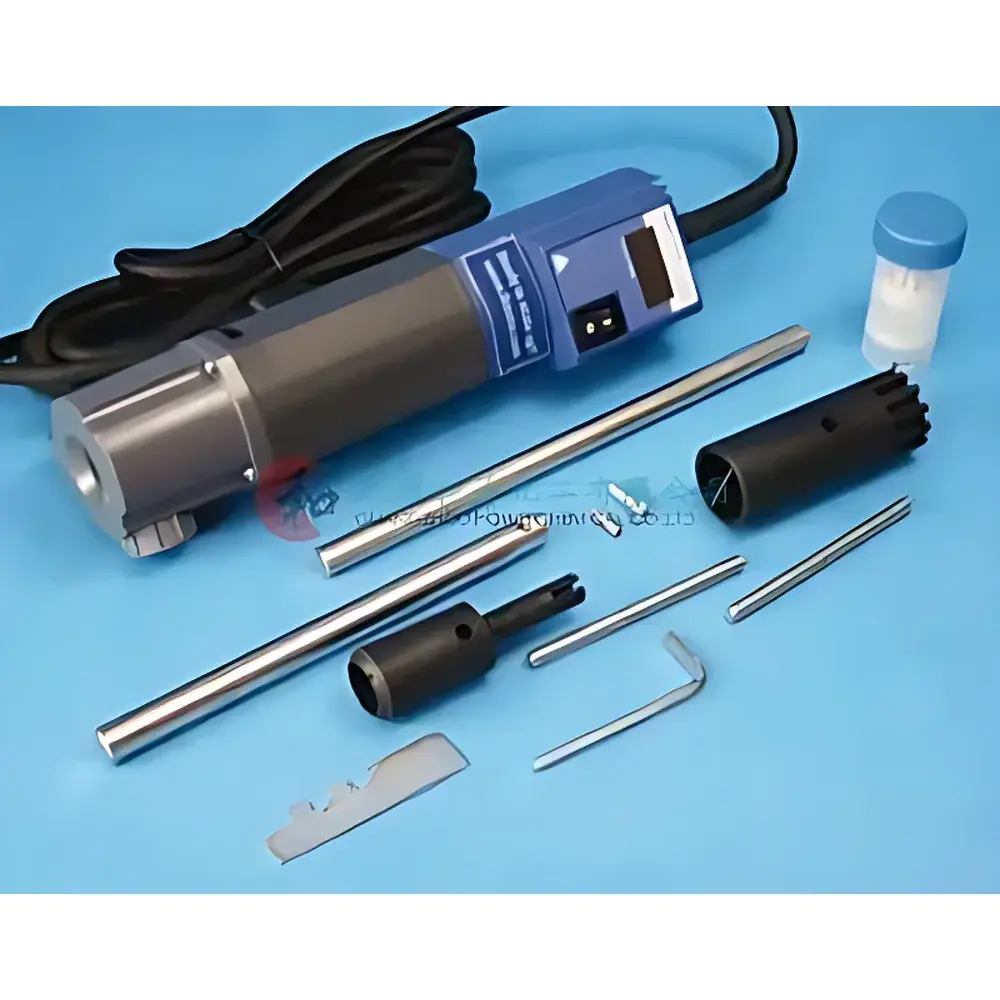
IKA T25 Digital Display High-Speed Disperser
| Brand | IKA |
|---|---|
| Origin | Germany |
| Manufacturer Type | Authorized Distributor |
| Origin Category | Imported |
| Model | T25 |
| Motor Input/Output Power | 500 / 300 W |
| Volume Range (H₂O) | 1–2,000 mL |
| Max. Viscosity | 5,000 mPa·s |
| Speed Range | 3,500–24,000 rpm |
| Speed Control | Continuous Variable |
| Speed Display | Digital |
| No-Load Noise Level | 73 dB(A) |
| Overload Protection | Yes |
| Rotor-Stator Tip Diameter/Length | 13 mm / 175 mm |
| Dimensions (W×D×H) | 65 × 80 × 240 mm |
| Weight | 1.6 kg |
| Ambient Temperature Range | 5–40 °C |
| Relative Humidity Limit | ≤80 % |
| Ingress Protection Rating | IP20 |
Overview
The IKA T25 Digital Display High-Speed Disperser is a precision-engineered laboratory dispersing system designed for reproducible homogenization, emulsification, and cell disruption across diverse sample matrices. Operating on the principle of high-shear rotor-stator mechanics, the T25 generates intense hydrodynamic forces through controlled rotation of a precisely balanced rotor within a fixed stator—inducing cavitation, turbulent flow, and mechanical shearing at the tip interface. This mechanism enables efficient particle size reduction, uniform dispersion of insoluble phases, and rapid breakdown of biological aggregates. Its robust 300 W output motor delivers consistent torque across the full speed range (3,500–24,000 rpm), making it suitable for applications ranging from low-viscosity aqueous suspensions to moderately viscous formulations up to 5,000 mPa·s. The device complies with DIN EN 60529 (IP20) for electrical safety in standard laboratory environments and is engineered for continuous duty under controlled ambient conditions (5–40 °C, ≤80 % RH).
Key Features
- Digital speed display with real-time rpm readout ensures precise operational control and method documentation traceability.
- Three-point bearing support system enhances mechanical stability and extends service life under prolonged high-speed operation.
- Continuous variable speed regulation allows fine-tuned optimization for sensitive samples—critical for avoiding thermal degradation or excessive foaming.
- Integrated overload protection safeguards motor integrity during transient viscosity spikes or accidental stalling.
- Modular design supports interchangeable rotor-stator assemblies; all dispersing tools are ISO-standardized for interchangeability and long-term availability.
- Compact footprint (65 × 80 × 240 mm) and lightweight construction (1.6 kg) facilitate integration into fume hoods, glove boxes, or reactor workstations.
Sample Compatibility & Compliance
The T25 accommodates volumes from 1 mL to 2,000 mL in standard cylindrical or conical glass or plastic vessels. It is routinely deployed in environmental analysis (e.g., wastewater sludge homogenization per ASTM D5907), pharmaceutical pre-formulation (API dispersion in excipient matrices), clinical diagnostics (blood/tissue lysate preparation compliant with CLSI H20-A2), and academic research (nanoparticle suspension stabilization). All contact materials meet USP Class VI biocompatibility requirements. While the base unit does not include integrated data logging, its analog tachometer output interface (0–10 V) permits connection to external recorders or SCADA systems for GLP/GMP-aligned process validation.
Software & Data Management
The T25 operates as a standalone instrument without embedded firmware or proprietary software. However, its analog speed output signal (0–10 V, proportional to rpm) is compatible with third-party data acquisition systems—including LabVIEW, MATLAB, or industrial PLC platforms—for time-stamped speed monitoring and audit trail generation. When used in regulated environments, users may implement manual logbooks or electronic lab notebooks (ELNs) to document operating parameters, dispersing tool identification, and batch-specific settings—supporting alignment with FDA 21 CFR Part 11 requirements where electronic signatures and audit trails are mandated.
Applications
- Preparation of homogeneous suspensions for particle size analysis (e.g., laser diffraction or dynamic light scattering).
- Routine homogenization of biological tissues and cultured cells prior to nucleic acid or protein extraction.
- Emulsification of oil-in-water or water-in-oil systems in food science and cosmetic formulation development.
- Dispersion of nanomaterials (e.g., carbon nanotubes, metal oxides) into polymer matrices or solvent carriers.
- Slurry conditioning for environmental sediment analysis and heavy metal leaching studies.
- In-line integration with jacketed reactors for temperature-controlled dispersion under vacuum or inert atmosphere.
FAQ
Is the T25 suitable for sterile processing?
The base unit is not autoclavable; however, all stainless-steel dispersing tools (e.g., S25N-13G) can be sterilized via dry heat (160 °C, 2 h) or ethylene oxide—provided compatibility with the specific tool geometry and coating is verified.
Can the T25 be operated inside a glove box?
Yes—its compact dimensions, low power draw, and absence of internal ventilation fans make it compatible with nitrogen- or argon-purged glove boxes; ensure proper cable feedthrough sealing and static grounding.
What maintenance intervals are recommended?
IKA recommends visual inspection of rotor-stator clearance and bearing play every 500 operating hours; lubrication is not required—the sealed bearings are lifetime-maintained.
Does the T25 comply with electromagnetic compatibility (EMC) standards?
Yes—it conforms to EN 61326-1:2013 for laboratory equipment, ensuring minimal interference with adjacent analytical instruments such as HPLC detectors or mass spectrometers.
Are calibration certificates available for the digital speed display?
Traceable calibration reports (per ISO/IEC 17025) can be issued by authorized IKA service centers upon request, covering speed accuracy verification against NIST-traceable tachometers.



