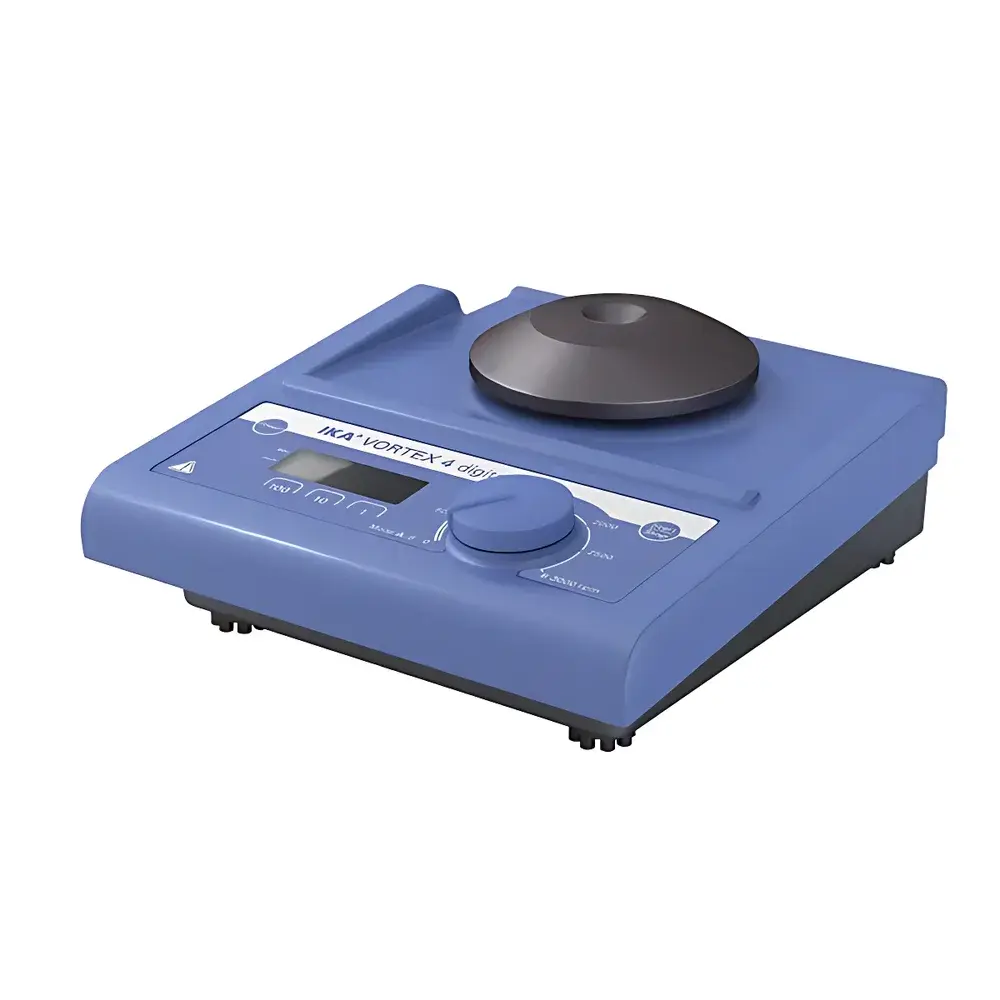
IKA Vortex 4 Digital Vortex Mixer
| Brand | IKA |
|---|---|
| Origin | Germany |
| Model | Vortex 4 digital |
| Timer Range | 1/60–999 min |
| Platform Quantity | 1 |
| Orbit Diameter | 4.5 mm |
| Speed Range | 0–3000 rpm |
| Minimum Adjustable Speed | 200 rpm |
| Max Load (incl. fixture) | 0.5 kg |
| Input Power | 10 W |
| Output Power | 8 W |
| Continuous Duty Cycle | 100% |
| Operating Temperature | 5–40 °C |
| Relative Humidity Limit | 80% |
| Protection Rating | IP21 (DIN EN 60529) |
| Voltage | 100–240 V AC, 50/60 Hz |
| DC Supply | 24 V, 800 mA |
| Dimensions (W×H×D) | 176 × 190 × 63 mm |
| Weight | 3 kg |
| Display | LED timer & analog speed scale |
| Timer Type | Countdown, programmable |
| Operating Modes | Continuous, Pulse (Touch), Auto-detect mode (Mode A) / Universal mode (Mode B) |
| Compatibility | Microtubes, PCR tubes, Eppendorf tubes, 96-well microplates (with optional plate adapter) |
Overview
The IKA Vortex 4 Digital is a compact, benchtop vortex mixer engineered for precision and reliability in routine life science laboratories. It operates on the principle of orbital shaking—generating controlled circular motion with a fixed 4.5 mm orbit diameter—to ensure homogeneous suspension, resuspension, or mixing of low-volume liquid samples in tubes and microplates. Designed for high reproducibility across variable sample formats, it delivers stable rotational output from 200 to 3000 rpm, with real-time analog speed indication and digital countdown timing. Its zinc alloy housing provides mechanical robustness and thermal stability during extended operation, while its universal voltage input (100–240 V AC) ensures compatibility with global laboratory power infrastructure. The device meets DIN EN 60529 IP21 ingress protection requirements, confirming resistance to vertically falling drips and limited finger contact—making it suitable for standard biosafety level 1 (BSL-1) environments.
Key Features
- Two intelligent operating modes: Mode A (auto-detection) automatically identifies standard IKA vortex pads and limits speed to 3000 rpm only when certified accessories are mounted; Mode B bypasses pad detection to enable full 3000 rpm output with any compatible platform.
- Dual-function timer with LED display supports both continuous operation and precise pulse (touch) activation—ideal for intermittent mixing of sensitive biological samples such as enzyme reactions or cell suspensions.
- Integrated safety logic prevents unintended high-speed operation: when non-standard pads are detected in Mode A, maximum speed is restricted to 1300 rpm to maintain mechanical integrity and sample containment.
- Compact footprint (176 × 63 × 190 mm) and lightweight design (3 kg) facilitate placement in biosafety cabinets, cold rooms, or crowded benchtop configurations without compromising accessibility.
- Energy-efficient brushless motor delivers 8 W mechanical output from 10 W electrical input, enabling 100% duty cycle operation without thermal derating under ambient conditions (5–40 °C, ≤80% RH).
Sample Compatibility & Compliance
The Vortex 4 Digital accommodates a broad range of common labware—including 0.2–50 mL conical tubes, PCR strips, Eppendorf-style microcentrifuge tubes, and single 96-well microplates (when fitted with an optional plate holder). Its 0.5 kg load capacity includes fixture mass, ensuring secure retention during vigorous agitation. The instrument complies with IEC/EN 61010-1 for electrical safety in laboratory equipment and conforms to electromagnetic compatibility standards per EN 61326-1. While not inherently GLP/GMP-certified, its repeatable speed control, traceable timer function, and absence of analog signal outputs make it suitable for use in quality-controlled workflows where manual process documentation is maintained per ISO/IEC 17025 or internal SOPs.
Software & Data Management
The Vortex 4 Digital operates as a standalone instrument with no embedded firmware, network interface, or data logging capability. All settings—including timer duration (programmable from 1 second to 999 minutes in 1/60-minute increments) and speed selection—are configured manually via front-panel controls. The LED timer provides visual countdown feedback, while the analog speed scale enables rapid verification of rotational state without digital dependency. This architecture eliminates cybersecurity risks associated with connected devices and aligns with institutional policies restricting networked peripherals in regulated environments. For audit-trail purposes, users may record operational parameters (e.g., speed, time, mode) alongside sample IDs in electronic lab notebooks (ELNs) compliant with 21 CFR Part 11 when used within validated processes.
Applications
- Routine homogenization of bacterial cultures, protein solutions, and nucleic acid preparations prior to centrifugation or downstream analysis.
- Resuspension of lyophilized reagents, pellet washing steps in DNA/RNA extraction protocols, and buffer equilibration in chromatography workflows.
- Pre-analytical mixing in clinical microbiology labs—ensuring uniform distribution of blood culture specimens or sputum homogenates before plating or automated detection.
- Supporting qPCR assay setup by facilitating consistent mixing of master mixes and template dilutions in low-volume reaction tubes.
- Integration into automated liquid handling systems via external footswitch or relay control (using optional IKA accessory modules), enabling synchronized agitation during robotic pipetting cycles.
FAQ
Does the Vortex 4 Digital support RS232 or USB connectivity for remote control?
No. It is a manually operated device with no serial, USB, or Ethernet interfaces.
Can it be used inside a refrigerated chamber or cold room?
Yes—provided ambient temperature remains between 5 °C and 40 °C and relative humidity does not exceed 80% (non-condensing).
Is calibration required or supported by IKA?
The unit is factory-calibrated for speed and timer accuracy. IKA does not provide user-accessible recalibration routines; periodic verification using an external tachometer or stopwatch is recommended per lab quality procedures.
What safety certifications does it carry?
It complies with EN 61010-1 (Safety Requirements for Electrical Equipment for Measurement, Control, and Laboratory Use) and EN 61326-1 (EMC for Laboratory Equipment).
How is compatibility ensured with non-IKA adapters or custom platforms?
Only in Mode B (no pad detection); however, mechanical stability and sample containment must be independently verified by the end user for any third-party accessory.