
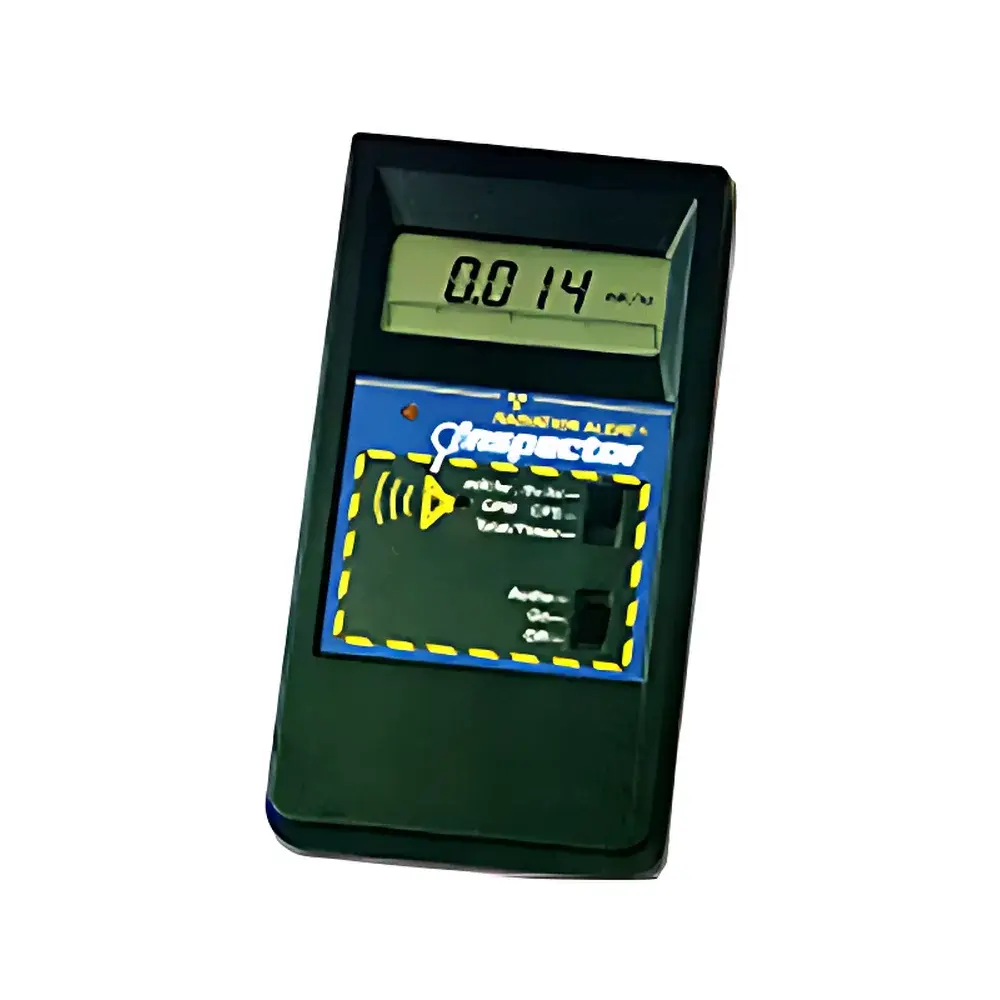
IMI Medcom Inspector Multi-Function Radiation Survey Meter
| Brand | IMI Medcom |
|---|---|
| Origin | USA |
| Model | Inspector |
| Detection Principle | Geiger-Müller (GM) Tube with Mica End-Window |
| Radiation Types | Alpha (α), Beta (β), Gamma (γ), and X-ray |
| Display | Digital LCD |
| Detector | Internal GM tube (45 mm effective mica window diameter) |
| Power Supply | One 9V alkaline battery (typical life: 200 hours) |
| Timer | Adjustable built-in timer |
| Calibration | External calibration port |
| Compliance | Designed for field-deployable radiation safety surveys per ANSI N42.33, IEC 60846, and ISO 4037-3 guidelines |
Overview
The IMI Medcom Inspector Multi-Function Radiation Survey Meter is a compact, handheld, microprocessor-controlled radiation detection instrument engineered for reliable, real-time measurement of low-level ionizing radiation in field and laboratory environments. It operates on the proven Geiger-Müller (GM) counting principle, utilizing a thin-window (1.5–2.0 mg/cm²) mica-end GM tube optimized for detection of alpha, beta, gamma, and X-ray emissions across a broad energy range (≥25 keV for γ/X-rays; ≥0.3 MeV for β; surface-sensitive α detection down to ~3.5 MeV). The instrument delivers direct digital readout in standard units—counts per minute (CPM), counts per second (CPS), and dose rate equivalents (mR/h or µSv/h)—with automatic range scaling and background subtraction capability. Its robust mechanical design, low-power architecture, and intuitive front-panel interface make it suitable for routine radiation safety monitoring, environmental screening, and emergency response applications where portability, rapid deployment, and operational simplicity are critical.
Key Features
- High-sensitivity mica-end GM detector with 45 mm effective window diameter—enabling efficient detection of low-penetrating alpha and beta particles alongside gamma and X-ray photons.
- Dual-mode operation: internal detector configuration (INSPECTOR) for general survey use; external probe option (INSPECTOR EXP) for remote or hard-to-access measurements without repositioning the main unit.
- Microprocessor-based signal processing with auto-zeroing, pulse discrimination logic, and configurable alarm thresholds (audible and visual).
- Adjustable integrated timer supporting timed count modes (e.g., 10 s, 60 s, 300 s) to improve statistical accuracy during low-activity measurements.
- External calibration port compliant with traceable NIST-traceable reference sources—facilitating routine performance verification per ISO/IEC 17025-accredited QA/QC protocols.
- Low-power consumption design powered by a single 9V alkaline battery (200-hour typical runtime under continuous operation), with low-battery indicator and auto-shutdown to preserve data integrity.
Sample Compatibility & Compliance
The Inspector is validated for direct surface contamination assessment of solid materials—including concrete, metal, ceramics, and building finishes—as well as qualitative screening of airborne particulates (via swipe tests) and low-energy radionuclides such as 222Rn progeny, 14C, 3H (via indirect methods), and 241Am. It meets functional requirements outlined in ANSI N42.33 (Portable Radiation Detection Instrumentation), IEC 60846-1:2014 (Radiation protection instrumentation — Ambient and/or directional dose equivalent [rate] meters and/or monitors for beta, X and gamma radiation), and ISO 4037-3:2019 (X and gamma reference radiations). While not intended for primary dosimetry certification, its response characteristics support ALARA-based exposure assessments aligned with OSHA 1910.120 and IAEA Safety Standards Series No. RS-G-1.7.
Software & Data Management
The Inspector operates as a standalone instrument with no proprietary software dependency. All measurement data—including time-stamped CPM/CPS readings, accumulated counts, and dose rate history—are retained in non-volatile memory for manual transcription. Optional analog output (0–1 V) and TTL pulse output enable integration with external data loggers or SCADA systems for continuous environmental monitoring networks. For laboratories operating under GLP or 21 CFR Part 11 requirements, external validation documentation—including calibration certificates, uncertainty budgets, and instrument-specific SOPs—is supported through IMI Medcom’s technical service portal and third-party accredited calibration providers.
Applications
- Routine contamination surveys in nuclear medicine departments, radiopharmaceutical manufacturing facilities, and decommissioning sites.
- Environmental baseline studies and post-incident radiological mapping following transportation accidents or facility breaches.
- Screening of construction materials (e.g., granite, fly ash, recycled aggregate) for natural radionuclide content (U-238 series, Th-232, K-40) per ASTM C1176 and EU Council Directive 2013/59/Euratom.
- Educational demonstrations of radiation interaction principles, decay statistics, and shielding effectiveness in university physics and health physics labs.
- First-responder readiness kits for HAZMAT teams requiring immediate, ruggedized detection capability without reliance on network infrastructure.
FAQ
What radiation types does the Inspector detect?
It detects alpha, beta, gamma, and X-ray radiation using its mica-window GM tube—optimized for sensitivity to low-energy emissions while maintaining adequate gamma response.
Can the Inspector be used for radon gas measurement?
No—it does not directly measure gaseous 222Rn; however, it can quantify alpha-emitting radon progeny deposited on surfaces or filter media via swipe or air sampling protocols.
Is the instrument suitable for regulatory compliance reporting?
It supports preliminary screening and trend analysis but is not certified as a primary reference instrument; final compliance reporting requires traceable calibration and documented uncertainty per ISO/IEC 17025.
How often should the Inspector be calibrated?
Annual calibration is recommended; additionally, user-performed functional checks with a check source (e.g., 137Cs or 241Am) should be conducted before each shift or survey session.
Does the Inspector meet FDA or EPA regulatory requirements?
It complies with applicable performance standards referenced in EPA guidance documents (e.g., EPA 402-R-08-001) and supports practices consistent with FDA’s radiation safety recommendations for diagnostic imaging facilities.
Related Products







