
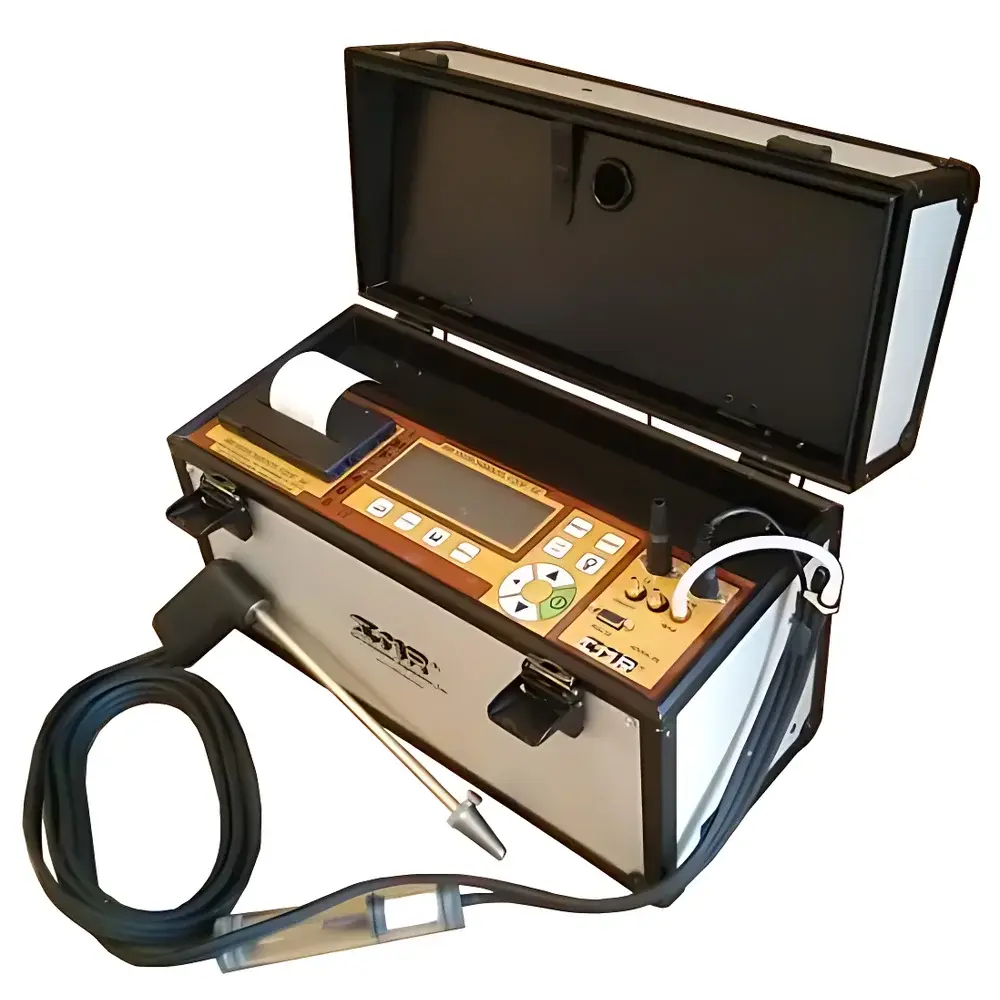
IMR IMR1400C Portable Flue Gas Analyzer
| Brand | IMR |
|---|---|
| Origin | USA |
| Model | IMR1400C |
| Instrument Type | Portable Flue Gas Analyzer |
| Measurement Accuracy | <2% FS |
| Repeatability | <2% FS |
| Response Time | 1 s |
| Stability | <2% FS over 8 h |
| Measurable Gases | O₂, NO, NO₂, CO, SO₂, HC/CH₄ |
| Optional Sensors | HCl, N₂O, Cl₂, H₂, NH₃, H₂S, CO₂ (IR) |
| Operating Temperature Range | –20 °C to +1200 °C (flue gas), –20 °C to +120 °C (ambient) |
| Dimensions | 305 × 228.6 × 117 mm |
| Weight | 2.9 kg |
| Battery Life | Up to 6 h (rechargeable Li-ion) |
| Communication Interfaces | RS232, USB |
| Compliance | Certified for official emissions monitoring per German TA-Luft and EU EN 15267-3 |
Overview
The IMR IMR1400C Portable Flue Gas Analyzer is an engineered solution for real-time, field-deployable combustion emission assessment in industrial and regulatory environments. Based on electrochemical sensing for O₂, CO, NO, NO₂, and SO₂ — complemented by optional infrared (CO₂) and catalytic bead (CxHy) detection — the instrument delivers trace-level quantification under dynamic flue conditions. Its architecture adheres to fundamental principles of parametric combustion analysis: simultaneous multi-gas measurement enables stoichiometric calculation of excess air (λ), combustion efficiency, flue gas loss, and theoretical CO₂ concentration via ASME PTC 4.1–derived algorithms. Designed for compliance-grade data acquisition, the IMR1400C meets functional requirements for periodic stack testing, boiler optimization, and continuous process validation across power generation, metallurgical, petrochemical, and R&D facilities.
Key Features
- Simultaneous real-time display of up to four parameters on backlit LCD: O₂, NO, NO₂, CO, SO₂, HC/CH₄, flue gas temperature (TG), and ambient temperature (TA)
- Integrated ASME-compliant combustion parameter engine: calculates λ (excess air ratio), qA (air heat loss), CO₂ (theoretical and measured), and NOx (NO + NO₂) without external software
- Selectable output units per gas: ppm, mg/m³, mg/m³ @ reference O₂ (5%, 3%, or user-defined), and mg/kWh for energy-normalized reporting
- Seven pre-programmed fuel types (e.g., natural gas, light oil, bituminous coal) with five customizable fuel profiles supporting bespoke HHV/LHV and stoichiometric coefficients
- Onboard statistical processing: automatic mean, standard deviation, and min/max tracking across sequential measurements
- Dual thermal management: TG measured via K-type thermocouple (–20–1200 °C); TA via semiconductor sensor (–20–120 °C), both with ±2 °C accuracy
- Modular probe interface: standardized 6-mm OD sampling port accepts 250 mm, 750 mm, 1500 mm, or 2500 mm stainless steel probes; optional CO protection valve prevents sensor saturation during high-CO events
- Self-diagnostic firmware with automated zero calibration, sensor health monitoring, and fault logging compliant with IEC 61508 SIL 2 functional safety principles
Sample Compatibility & Compliance
The IMR1400C is validated for use with dry or conditioned flue streams containing particulate loadings ≤50 mg/m³ (filter paper-based soot measurement included). It operates within a certified measurement range of 0–20.9 vol.% O₂ (±0.2 vol.%), 0–4000 ppm CO (1 ppm resolution), 0–2000 ppm NO (1 ppm), 0–100 ppm NO₂ (1 ppm), 0–4000 ppm SO₂ (1 ppm), and 0–100% CxHy (0.01% resolution). All electrochemical sensors meet EN 50379-1:2012 stability and cross-sensitivity thresholds. The analyzer carries official type approval under German TA-Luft Annex 4 and is referenced in VDI 3862 for stationary source monitoring. It satisfies data integrity prerequisites for GLP-aligned reporting and supports audit-ready documentation when paired with optional built-in thermal printer (EN 15267-3 certified print format).
Software & Data Management
Data export occurs via RS232 (ASCII protocol) or USB (virtual COM port), enabling direct integration with laboratory information management systems (LIMS) and SCADA interfaces. Raw measurement logs include timestamp, sensor ID, calibration status, ambient pressure (optional barometer module), and operator ID fields. Firmware supports FDA 21 CFR Part 11–compliant audit trails when used with password-protected user roles (admin/operator) and electronic signature prompts for calibration events. No proprietary software is required: exported .csv files contain structured columns for gas concentration, temperature, calculated efficiency metrics, and uncertainty flags. Firmware updates are performed via USB using signed binary packages verified against IMR’s public key infrastructure.
Applications
- Regulatory stack testing at coal-fired and gas-fired power plants per EPA Performance Specification 2 and EN 14181
- Combustion optimization in industrial boilers, kilns, and incinerators to minimize NOx and CO while maximizing thermal efficiency
- R&D validation of low-emission burner designs and alternative fuel blends (e.g., biomass co-firing, hydrogen-enriched natural gas)
- QA/QC verification of continuous emission monitoring systems (CEMS) during relative accuracy test audits (RATA)
- Field diagnostics of furnace draft imbalance, air leakage, and incomplete combustion in refinery heaters and coke ovens
FAQ
Does the IMR1400C meet EPA Method 6C and Method 7E requirements for NOx and SO2?
Yes — when configured with certified electrochemical sensors and operated within specified temperature and moisture limits, it fulfills the performance criteria for portable reference analyzers under both methods.
Can the instrument calculate CO2 without an IR sensor?
Yes — CO2 is computed stoichiometrically from O2 depletion and selected fuel composition; optional IR-based direct CO2 measurement provides cross-validation.
Is the battery pack replaceable in the field?
Yes — the rechargeable Li-ion battery module is user-serviceable with standard Torx tools and retains full capacity for ≥300 charge cycles.
What calibration gases are required for daily verification?
A two-point span check using certified zero air and a multi-component span gas (e.g., 10% O2, 500 ppm CO, 100 ppm NO, 50 ppm SO2) is recommended before each measurement campaign.
How does the CO protection valve function during high-concentration sampling?
The solenoid-actuated valve diverts sample flow away from the CO sensor when inlet concentration exceeds 1500 ppm, preventing electrolyte saturation and extending sensor life without interrupting other channel measurements.







