
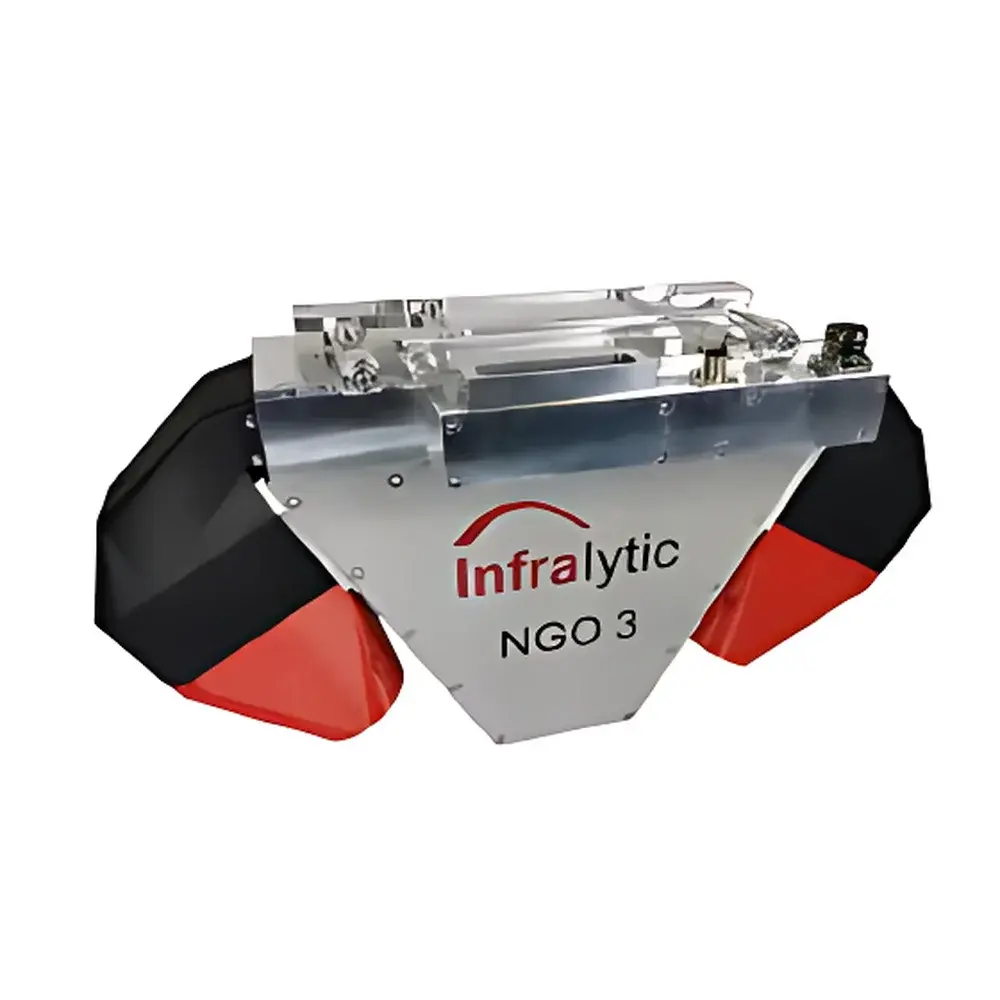
Infralytic NGO3-W Online Non-Contact Water & Oil Film Thickness Gauge
| Brand | Infralytic |
|---|---|
| Origin | Germany |
| Model | NGO3-W |
| Measurement Principle | Near-Infrared (NIR) Absorption Spectroscopy |
| Measuring Distance | 200 mm |
| Measurement Range | Water & Emulsion Residue (0.1–500 mg/m²) |
| Accuracy | ±5% of reading (typical, dependent on surface uniformity and substrate emissivity) |
| Repeatability | <±2 mg/m² |
| Sampling Frequency | Up to 120 Hz |
| Standoff Tolerance | ±20 mm vertical deviation |
| Operating Temperature | 0 °C to +55 °C |
| Enclosure Rating | IP65 |
| Dimensions (L×W×H) | 519 × 264 × 100 mm |
| Weight | 8 kg |
| Substrate Compatibility | Ferrous & non-ferrous metals, ceramic-coated strips |
| Output Interface | Analog 4–20 mA, RS-485, Ethernet (Modbus TCP / optional OPC UA) |
| Compliance | CE, RoHS, EN 61326-1 (EMC), EN 61000-6-2/6-4 |
Overview
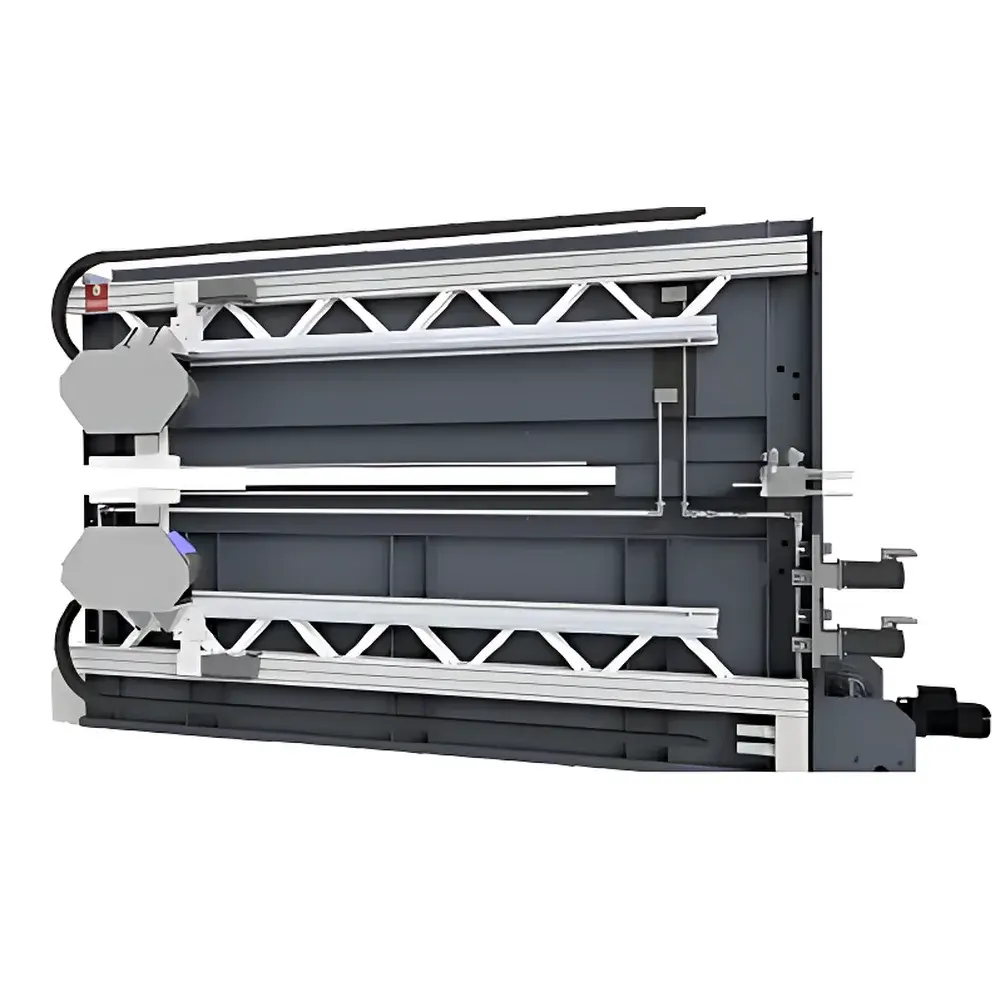
The Infralytic NGO3-W is a high-precision, industrial-grade online thickness gauge engineered for real-time, non-contact quantification of residual water and rolling emulsion films on moving metal strip surfaces during hot and cold rolling, pickling, and coiling operations. Unlike conventional capacitive or beta-gauge systems, the NGO3-W employs calibrated near-infrared (NIR) absorption spectroscopy—specifically targeting vibrational overtones of O–H bonds in water and C–H bonds in hydrocarbon-based lubricants—to deliver simultaneous, decoupled measurement of both water (mg/m²) and oil/emulsion (g/m²) mass loading. Its optical architecture is optimized for dynamic process environments: it operates at standoff distances up to 200 mm, tolerates vertical strip position deviations of ±20 mm, and delivers stable readings independent of strip speed (0–25 m/s) and mechanical vibration. Designed for integration into continuous production lines—including heavy plate mills, hot strip mills, and continuous casting finishing stands—the NGO3-W enables closed-loop drying optimization by feeding live residue data directly to PLCs or DCS systems.
Key Features
- True dual-parameter output: Simultaneous, mathematically deconvoluted measurement of water content (0.1–500 mg/m²) and emulsion/oil film mass (0.01–20 g/m²) using multi-wavelength NIR spectral analysis.
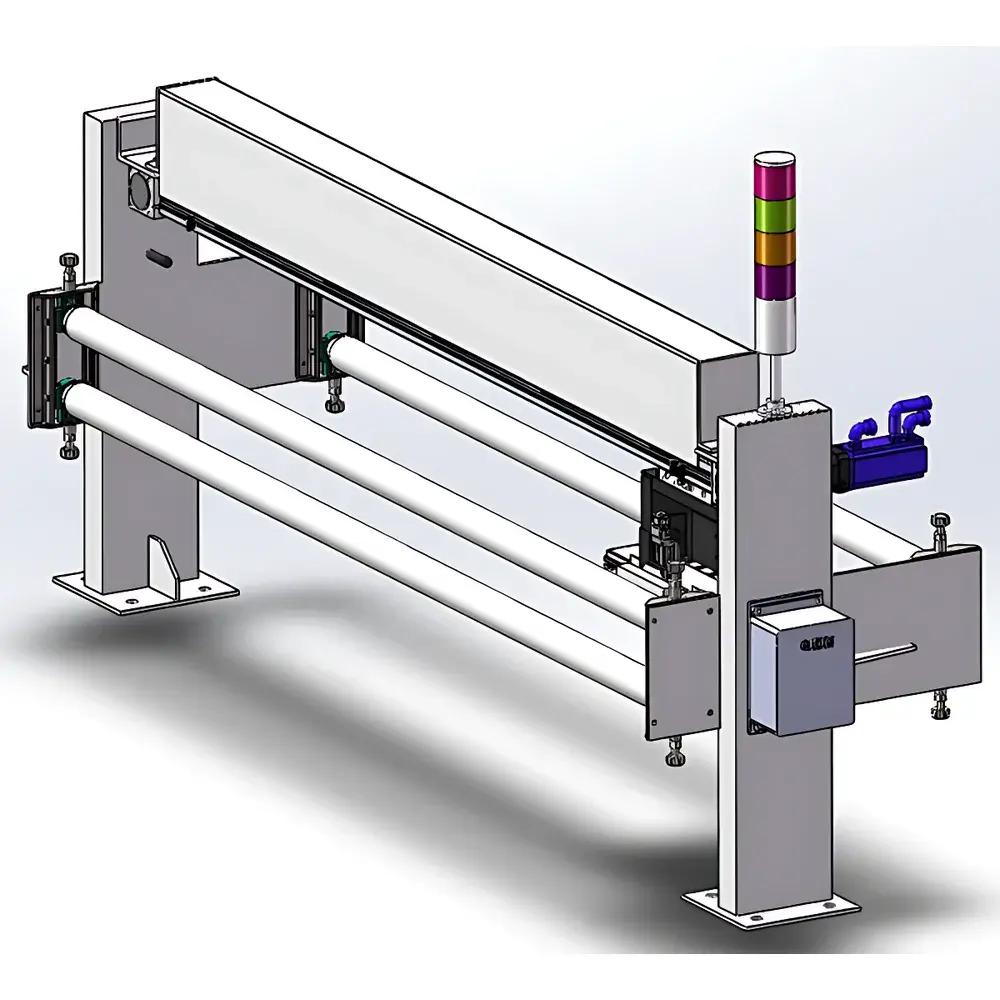
- Non-contact operation with 200 mm working distance: Eliminates risk of contamination, wear, or thermal interference; compatible with installation between final support roll and coiler entry.
- Real-time compensation for strip vibration and lateral runout: Adaptive optical path stabilization ensures measurement integrity under typical mill vibration spectra (up to 1 kHz).
- Self-validating optical system: Internal reference channel continuously monitors LED intensity, detector responsivity, and ambient IR background—triggering diagnostic alerts if drift exceeds ISO 17025 traceability thresholds.
- Industrial-grade ruggedization: IP65-rated aluminum housing, operating temperature range from 0 °C to +55 °C, and shock resistance compliant with IEC 60068-2-27 (25 g, 11 ms half-sine pulse).
- Process-ready connectivity: Standard analog 4–20 mA outputs for water and oil channels, plus digital interfaces including RS-485 (Modbus RTU) and Ethernet (Modbus TCP); optional OPC UA server for MES integration.
Sample Compatibility & Compliance
The NGO3-W is validated for use on all electrically conductive and non-conductive strip substrates encountered in primary metal processing—including low-carbon steel, stainless steel, aluminum alloys, and ceramic-coated hot bands. Its NIR methodology is insensitive to electrical conductivity, surface roughness (Ra ≤ 15 µm), or moderate oxide layer formation. Calibration is performed per ASTM E1421 (Standard Practice for Calibration of Near-Infrared Spectrometers) and traceable to NIST SRM 2036 (Near-Infrared Reflectance Standard). The instrument meets electromagnetic compatibility requirements per EN 61326-1 (industrial environment), safety standards per EN 61010-1, and conforms to RoHS Directive 2011/65/EU. For regulated manufacturing environments (e.g., automotive or aerospace supply chains), raw measurement logs include embedded timestamps, operator ID fields, and audit-trail metadata compliant with FDA 21 CFR Part 11 Annex 11 principles when paired with Infralytic’s optional TraceLog software.
Software & Data Management
The NGO3-W integrates seamlessly with Infralytic’s proprietary ThicknessView™ software suite (Windows-based, .NET 6 runtime), which provides real-time visualization, statistical process control (SPC) charting (X̄-R, Cpk), and automated report generation (PDF/CSV). Historical data is stored in SQLite or SQL Server databases with configurable retention policies (default: 90 days, extendable to 2 years). All measurements are time-stamped with microsecond resolution and synchronized via NTP or PTP (IEEE 1588) when connected to plant Ethernet. The software supports GLP-compliant electronic signatures, change history logging, and export of raw spectral data (.csv) for third-party chemometric modeling (e.g., partial least squares regression). Optional cloud gateway modules enable secure MQTT-based telemetry to AWS IoT Core or Azure IoT Hub for predictive maintenance analytics.
Applications
- Hot strip mill coiling lines: Quantify residual emulsion after high-pressure descaling and before coiling to prevent interlayer staining and hydrogen embrittlement risks.
- Heavy plate mills: Monitor water carryover post-pickle line to optimize rinse tank chemistry and reduce acid consumption.
- Continuous casting finishing stands: Control coolant film thickness on slab surfaces to stabilize thermal gradients and minimize edge cracking.
- Galvanizing and annealing lines: Verify cleaning efficiency prior to zinc coating or hydrogen atmosphere entry—critical for adhesion and surface defect prevention.
- Energy management systems: Correlate measured residue load with dryer energy consumption (kWh/t) to identify optimal blow-off pressure and radiant heater setpoints.
FAQ
Does the NGO3-W require periodic recalibration in situ?
No—its internal reference channel performs continuous photometric self-validation. Full factory recalibration is recommended every 12 months or after physical impact, per ISO/IEC 17025 procedures.
Can it distinguish between free water and emulsified oil-water mixtures?
Yes—spectral deconvolution algorithms separate absorption contributions from bound OH (water) and CH₂/CH₃ (hydrocarbons), enabling independent quantification even in complex emulsion layers.
Is the sensor affected by ambient lighting or furnace radiation?
No—the optical head incorporates narrowband interference filters (FWHM < 10 nm) and active background subtraction, rendering it immune to broadband IR sources up to 1200 °C blackbody emission.
What strip speeds are supported?
From standstill (0 m/s) up to 25 m/s—measurement frequency remains constant at ≤120 Hz across the full range, with no speed-dependent latency.
How is alignment verified during commissioning?
A built-in laser alignment aid projects a visible crosshair onto the strip surface; combined with live spectral signal-to-noise ratio (SNR) feedback in ThicknessView™, alignment tolerance is confirmed within ±1 mm lateral offset.



