
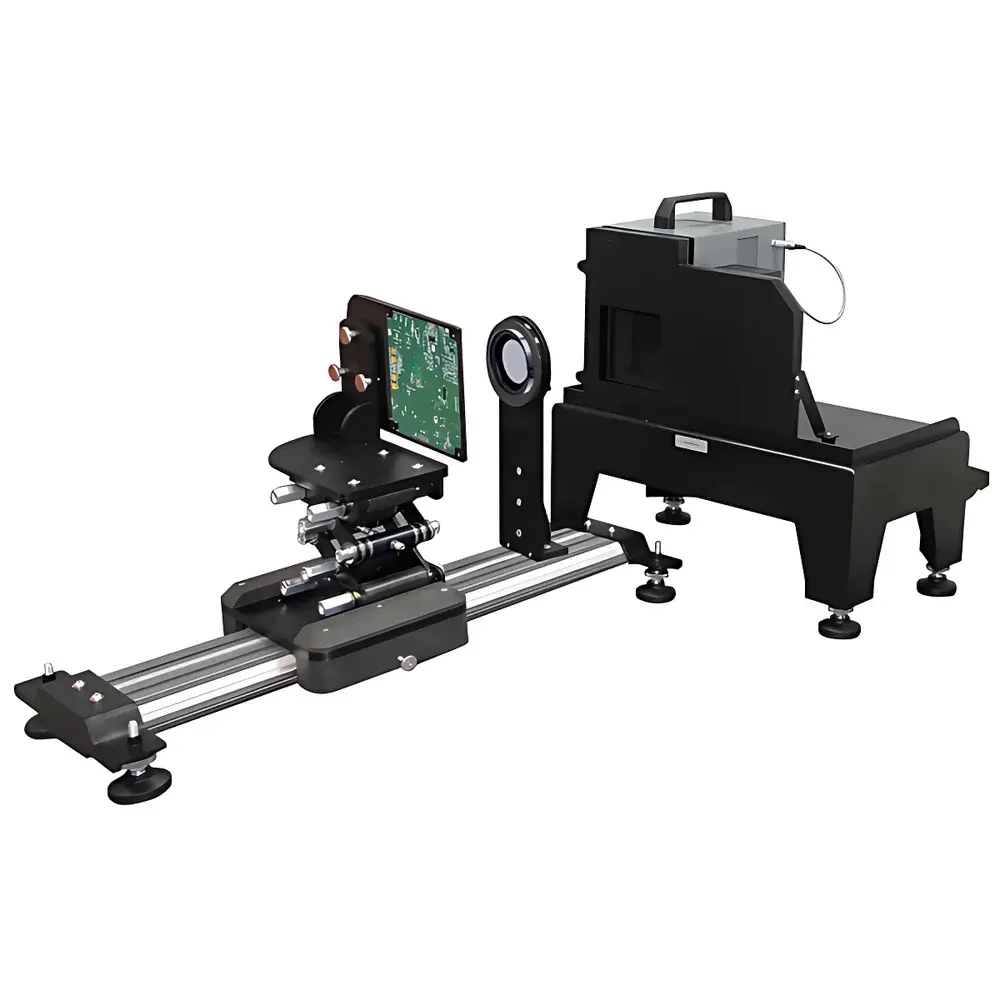
Inframet FT Series IR FPA Characterization & Core Testing System
| Brand | Inframet |
|---|---|
| Origin | Poland |
| Model | FT Series (Configurable: FT-N / FT-I / FT-S) |
| Application | R&D and QA of IR focal plane arrays (cooled & uncooled) and thermal imaging cores (LWIR/MWIR) |
| Compliance | Designed for ISO/IEC 17025-compliant calibration workflows, supports traceable measurement protocols per ASTM E1213, E1543, and MIL-STD-810G thermal test environments |
Overview
The Inframet FT Series IR FPA Characterization & Core Testing System is a modular, laboratory-grade platform engineered for comprehensive performance evaluation of infrared focal plane arrays (FPAs) and thermal imaging cores. Based on calibrated blackbody-driven radiometric stimulation and synchronized digital signal acquisition, the system implements standardized radiometric, spatial, and spectral measurement principles aligned with the physics of infrared detection—namely, photon flux integration, thermal noise modeling, and modulation transfer function (MTF) analysis in the LWIR (8–14 µm) and MWIR (3–5 µm) bands. Unlike generic thermal camera testers, the FT system operates as a metrology-grade reference platform: it delivers spatiotemporally controlled infrared irradiance onto the DUT’s input pupil using programmable blackbody sources, precision apertures, and collimated optical paths—enabling repeatable, quantitative characterization under conditions replicating real-world optical train interfaces. Its architecture supports both detector-level validation (bare FPAs) and subsystem-level verification (fully assembled thermal cores), making it essential for R&D labs, foundry qualification teams, and third-party calibration facilities engaged in infrared sensor development and production release testing.
Key Features
- Modular workstation configuration: Three semi-autonomous functional units—FT-N (Noise & Responsivity), FT-I (Imaging Quality), and FT-S (Spectral Response)—can be deployed individually or integrated into a unified test environment.
- Full-parameter coverage across three orthogonal domains: radiometric (NETD, FPN, non-uniformity, D*, dynamic range, linearity, saturation level), spatial (MTF via slanted-edge method, PVF, crosstalk), and spectral (relative spectral responsivity, bandpass deviation, signal correlation across wavelength bins).
- Support for both cooled (MCT, InSb) and uncooled (VOx, a-Si) FPAs; compatible with LWIR and MWIR spectral bands via interchangeable blackbody and filter modules.
- Automated pixel-level defect mapping with sub-pixel localization accuracy; bad pixel identification includes classification by type (dead, noisy, responsive outlier) and spatial clustering analysis.
- 3D noise modeling capability including temporal, spatial, and spatiotemporal components; optional NPSD (Noise Power Spectral Density) and 1/f noise extraction with user-defined integration time inputs.
- Traceable radiometric calibration chain compliant with NIST-traceable blackbody references; all measurements adhere to uncertainty budgets documented per ISO/IEC Guide 98-3 (GUM).
Sample Compatibility & Compliance
The FT system accommodates FPAs and thermal cores with formats up to 1280×1024 pixels and pixel pitches from 10 µm to 30 µm. It accepts both windowed and dewar-integrated packages, with mechanical interface adaptability for standard cold finger mounts and vacuum feedthroughs. Optical input is configurable for f/1.0–f/4.0 systems via adjustable collimation optics. All measurement procedures are structured to support GLP/GMP audit readiness: full electronic record retention, user authentication, audit trail logging, and 21 CFR Part 11–compliant electronic signatures available through optional software licensing. Test reports include metadata on environmental conditions (ambient temperature, humidity, chamber stability), equipment calibration status, and uncertainty propagation per ISO/IEC 17025 Annex A.5.
Software & Data Management
The FT Control Suite is a Windows-based application built on a deterministic real-time acquisition engine. It provides scriptable test sequences, batch processing for multi-DUT campaigns, and export of raw data in HDF5 format for external analysis. Measurement results are stored in a relational database with hierarchical tagging (DUT ID, test date, operator, configuration ID). The software includes built-in compliance reporting templates aligned with ASTM E1213 (NETD), E1543 (MTF), and IEC 62676-5 (thermal imaging core verification). Raw frame capture supports 16-bit linear output with timestamp synchronization to ±100 ns. Optional API access enables integration with enterprise LIMS and PLM systems via RESTful endpoints and OPC UA protocol support.
Applications
- Front-end FPA qualification at wafer and die levels prior to hybridization
- Thermal core acceptance testing for OEM camera module suppliers
- Failure analysis of anomalous response patterns (e.g., column drift, row noise, thermal hysteresis)
- Verification of spectral filter alignment and cut-on/cut-off characteristics in multispectral IR systems
- Development and validation of non-uniformity correction (NUC) algorithms
- Reference-grade inter-laboratory comparison studies under EURAMET and BIPM frameworks
FAQ
What blackbody temperature stability is required for NETD measurement?
Stability of ±0.01 °C over 30 minutes is recommended for high-accuracy NETD determination; the FT system includes active thermal regulation and drift compensation algorithms.
Can the FT-S module measure absolute spectral responsivity?
No—it measures relative spectral responsivity normalized to peak response; absolute calibration requires external NIST-traceable reference detectors.
Is vacuum compatibility supported for cryogenic FPAs?
Yes—optional vacuum chamber integration with electrical feedthroughs and thermal anchoring is available for operation down to 77 K.
Does the system support automated MTF measurement per ISO 12233?
Yes—slanted-edge MTF analysis follows ISO 12233:2017 Annex D methodology, with edge orientation tolerance < ±0.5° and oversampling factor ≥4×.
How is traceability maintained across firmware and software updates?
Each software version is digitally signed and linked to a validated calibration certificate; version-controlled configuration files ensure reproducible test setups across instrument lifecycles.




