
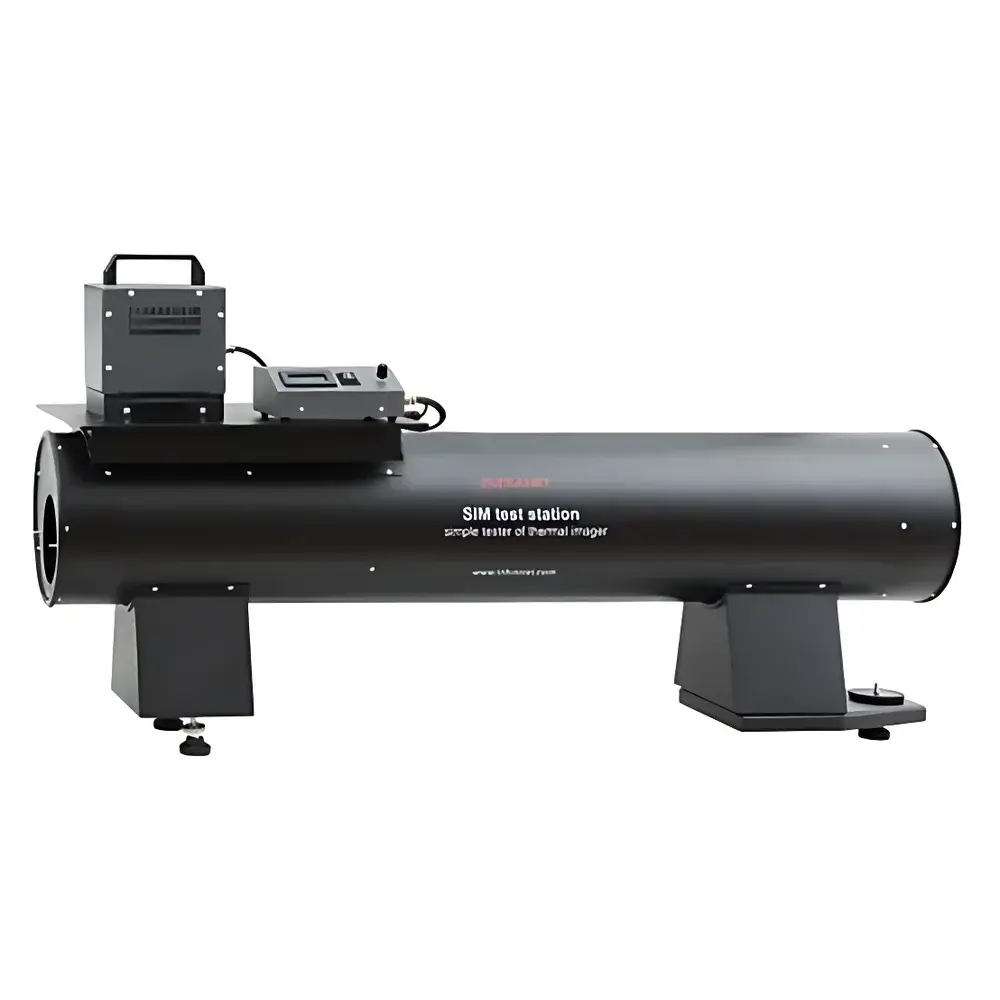
Inframet SIM Simple Thermal Imager Test System
| Brand | Inframet |
|---|---|
| Origin | Poland |
| Model | SIM |
| Optical Tube Type | Off-axis reflective collimator |
| Aperture | 60–250 mm (model-dependent) |
| Focal Length | 600–2500 mm |
| Spectral Range | 0.4–15 µm |
| Spatial Resolution | ≥30 mrad (CDT660SR & CDT11100SR), ≥50 mrad (larger models) |
| Mirror Surface Accuracy | λ/3 @ 630 nm |
| Coating | Protected aluminum |
| FOV | 2.7° |
| Blackbody Type | NSB40, non-stabilized |
| Radiating Area | 40 × 40 mm |
| Emissivity | ≥0.96 |
| ΔT Range | ≥−10 °C to +10 °C |
| Target Types | Crosshair (7–14 mm line width) & USAF 1951 (1.00–14.30 lp/mm) |
| Power Supply | 110/220 VAC, 50/60 Hz |
| Operating Temperature | 10–35 °C |
| Weight | 7–60 kg (system-dependent) |
| Dimensions | 610×140×210 mm to 2610×350×400 mm |
Overview
The Inframet SIM Simple Thermal Imager Test System is a manually operated, cost-optimized optical projection platform engineered for laboratory-grade evaluation and functional verification of thermal imaging systems. It operates on the principle of collimated infrared target projection—using an off-axis reflective collimator to generate near-parallel infrared radiation from calibrated thermal targets, enabling spatial resolution, modulation transfer function (MTF), and contrast sensitivity assessment of uncooled and cooled IR imagers across the 0.4–15 µm spectral band. Unlike automated or high-stability test benches, the SIM system prioritizes repeatability and accessibility for routine QA/QC, R&D screening, and calibration lab pre-screening tasks—particularly where absolute radiometric accuracy is secondary to relative thermal contrast analysis.
Key Features
- Modular architecture comprising five core components: off-axis reflective collimator (CDT-series), NSB40 non-stabilized blackbody source, CNSB temperature controller, TP2 target wheel, and interchangeable IR targets—including dual-format crosshair patterns (7 mm and 14 mm line widths) and USAF 1951 resolution charts (1.00–14.30 lp/mm).
- Five scalable collimator variants (SIM60 to SIM250) with apertures from 60 mm to 250 mm and focal lengths from 600 mm to 2500 mm—each optimized for specific imager aperture and working distance requirements.
- High-fidelity optical design: λ/3 surface accuracy at 630 nm, protected aluminum coating for broadband reflectance (0.4–15 µm), and consistent 2.7° field of view across all models.
- NSB40 blackbody provides adjustable thermal contrast via CNSB controller; though not radiometrically stable or traceably calibrated, it delivers reproducible ΔT steps over −10 °C to +10 °C range—sufficient for qualitative MTF, dead pixel mapping, and focus validation.
- Robust mechanical construction with CNC-machined aluminum housings, designed for long-term stability in controlled lab environments (10–35 °C ambient).
Sample Compatibility & Compliance
The SIM system supports evaluation of microbolometer-based and photon-detecting thermal imagers—including cooled InSb, MCT, and quantum well IR photodetector (QWIP) systems—provided their entrance pupil aligns with the collimator’s effective aperture and focal plane position. Target projection geometry adheres to ISO 12233:2017 Annex D (for resolution chart usage) and ASTM E1213-20 (Standard Test Method for Minimum Resolvable Temperature Difference). While the NSB40 blackbody lacks NIST-traceable calibration, the system conforms to internal lab protocols for comparative testing under GLP-aligned documentation practices. All electrical components meet CE marking requirements per EN 61000-6-3 (EMC) and EN 61000-6-1 (immunity).
Software & Data Management
The SIM system operates without proprietary software—it relies on manual target selection, physical blackbody temperature adjustment via CNSB front-panel controls, and independent acquisition by the device under test (DUT). This architecture eliminates software licensing, driver dependencies, or cybersecurity overhead—making it suitable for air-gapped labs, defense contractors requiring ITAR-compliant workflows, and educational institutions with limited IT support. For auditability, users are advised to log controller setpoints, ambient conditions, and DUT acquisition parameters in accordance with ISO/IEC 17025 Clause 7.5 (technical records) and FDA 21 CFR Part 11 (if used in regulated medical device validation).
Applications
- Functional verification of thermal camera focus, alignment, and boresight stability prior to field deployment.
- Qualitative assessment of minimum resolvable temperature difference (MRTD) using variable-contrast crosshair and USAF 1951 patterns.
- Dead/hot pixel mapping and uniformity screening during production QA cycles.
- Training and demonstration platforms in IR optics courses, military technician schools, and OEM service centers.
- Pre-calibration screening before full radiometric characterization using higher-tier systems (e.g., Inframet TIRIS or SBIR-certified blackbodies).
FAQ
Is the NSB40 blackbody NIST-traceable?
No—the NSB40 is intentionally designed as a non-stabilized, relative-temperature source. It provides repeatable thermal contrast steps but does not support absolute radiometric calibration. For traceable measurements, integration with external calibrated blackbodies (e.g., CI Systems CB-1500 or Mikron M390) is recommended.
Can the SIM system be used for long-wave infrared (LWIR) imagers?
Yes—its 0.4–15 µm spectral coverage fully encompasses MWIR (3–5 µm) and LWIR (8–14 µm) bands. Mirror coating and collimator design ensure >85% average reflectance across both ranges.
What is the maximum usable distance between the SIM collimator and the DUT?
The effective working distance depends on collimator model and DUT entrance pupil size. As a rule of thumb, maintain DUT-to-collimator distance ≤10× focal length (e.g., ≤2 m for SIM200) to preserve collimation fidelity and minimize wavefront error.
Are custom target patterns supported?
Yes—TP2 target wheel accepts user-supplied masks up to 50 mm diameter with standard mounting interface. Custom USAF subsets, slanted-edge targets, or multi-contrast step wedges can be integrated subject to mechanical compatibility review.
Does Inframet provide installation or training support?
Inframet offers optional on-site commissioning and operator training packages—covering optical alignment verification, CNSB controller operation, target interchange procedures, and documentation best practices aligned with ISO/IEC 17025.






