
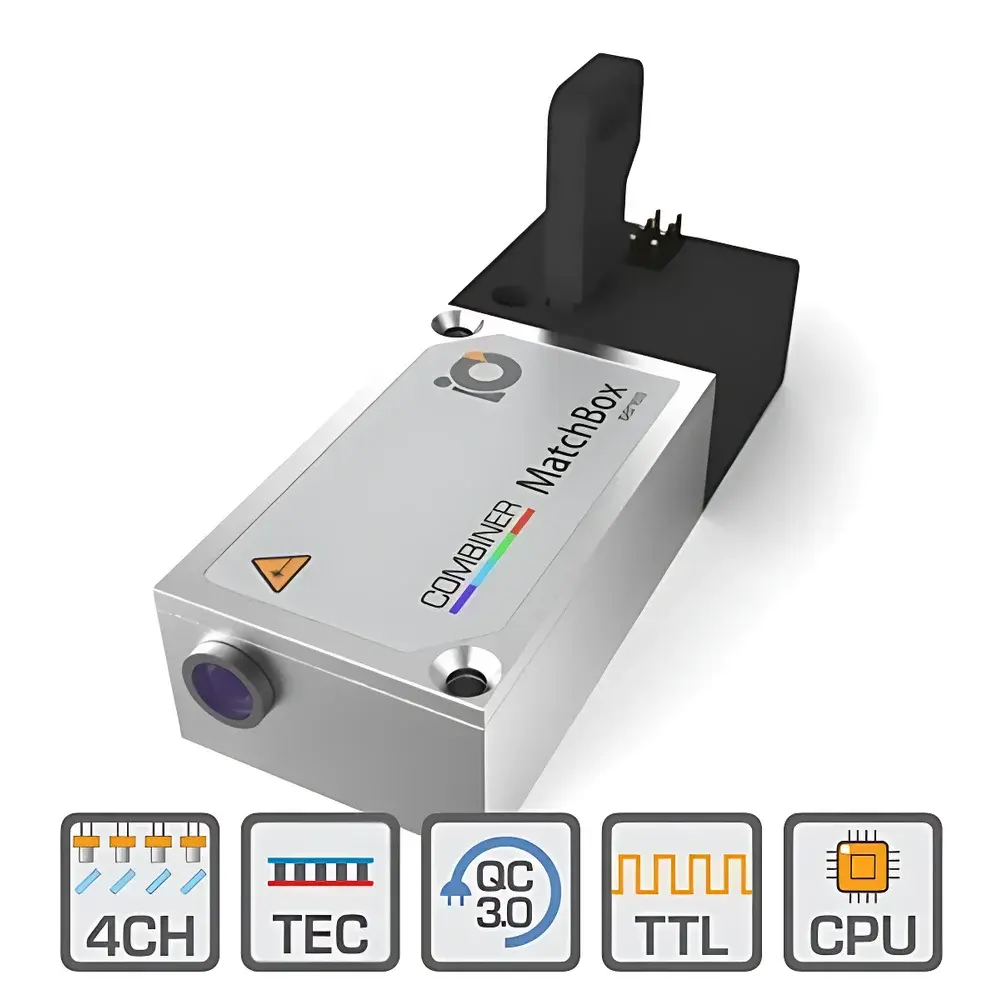
Integrated Optics MatchBox2 4-Channel Wavelength Combiner Laser Module
| Brand | Integrated Optics |
|---|---|
| Model | 40A-48A-XXY-64A-11 |
| Dimensions | 50 × 30 × 18 mm |
| Output Options | Free-space or multimode fiber-coupled (105/200/400 µm core) |
| Wavelength Channels | Up to 4 (e.g., 405/488/520/638 nm) |
| Power Stability | <1% RMS (8 h) |
| Intensity Noise | <2% RMS (20 Hz–20 MHz) |
| Spectral Bandwidth | <1.5 nm (FWHM) |
| Spatial Mode | TEM₀₀ or top-hat-like multimode |
| Cooling | Integrated TEC |
| Control Interface | Digital & analog modulation, 5 V DC supply |
| Compliance | RoHS, CE |
Overview
The Integrated Optics MatchBox2 4-Channel Wavelength Combiner is a compact, OEM-optimized laser module engineered for precise multi-wavelength excitation in demanding optical instrumentation. Based on dichroic beam combining architecture, it integrates up to four independently controlled semiconductor laser diodes—each with discrete current and temperature regulation—into a single 50 × 30 × 18 mm package. Unlike conventional stacked or fiber-pigtailed combiners, this module employs high-efficiency dielectric interference filters to spatially superimpose collimated beams with minimal wavefront distortion and polarization crosstalk. The result is a stable, alignment-free output suitable for applications requiring simultaneous or time-gated multi-spectral illumination, including fluorescence lifetime imaging (FLIM), Förster resonance energy transfer (FRET) assays, and multi-parameter flow cytometry. Its monolithic mechanical design, combined with integrated thermoelectric cooling (TEC) and automatic power control (APC), ensures thermal and intensity stability under varying ambient conditions—critical for long-duration measurements in regulated environments.
Key Features
- Ultra-compact footprint (50 × 30 × 18 mm) enabling integration into space-constrained platforms such as portable analyzers, point-of-care devices, and miniaturized microscopes
- Four independently addressable laser channels with digital TTL/analog modulation support (0–5 V), permitting synchronized pulsing, intensity ramping, or channel gating
- Integrated TEC-based thermal management with closed-loop temperature control (±0.1 °C stability), minimizing wavelength drift and mode hopping
- Low-noise operation: intensity noise <2% RMS (20 Hz–20 MHz); power stability <1% RMS over 8 hours
- Flexible output configuration: free-space collimated beam (TEM₀₀ or top-hat profile) or multimode fiber coupling via SMA905 connector (105/200/400 µm core options)
- Standard 5 V DC input with <2 W typical power consumption—compatible with battery-powered and embedded systems
- Interchangeable mechanical and electrical interface: identical form factor and pinout across MatchBox2 product family for seamless module replacement
- Factory-aligned optics with no user-serviceable adjustments; designed for drop-in integration without recalibration
Sample Compatibility & Compliance
The MatchBox2 Wavelength Combiner supports excitation of common fluorophores (e.g., DAPI, FITC, PE, APC, Cy5) and Raman-active samples across its 405–785 nm operating range. Its spectral accuracy (±5 nm wavelength tolerance) and narrow bandwidth (<1.5 nm FWHM) ensure minimal spectral overlap between adjacent channels—essential for quantitative multicolor detection. The module complies with IEC 60825-1:2014 (laser safety Class 3B/4 depending on configuration), RoHS Directive 2011/65/EU, and CE marking requirements for electromagnetic compatibility (EMC Directive 2014/30/EU). For regulated life science applications, the device supports audit-ready operation when paired with compliant host controllers—enabling traceability of laser activation timestamps, power settings, and thermal logs in accordance with GLP and FDA 21 CFR Part 11 data integrity principles.
Software & Data Management
Integrated Optics provides a vendor-neutral USB-C interface and ASCII command protocol compatible with LabVIEW, Python (PySerial), MATLAB, and C/C++ environments. Firmware supports real-time monitoring of diode current, TEC voltage, case temperature, and photodiode feedback—enabling closed-loop power stabilization and predictive thermal diagnostics. Optional SDK includes timestamped logging, batch configuration profiles, and error-code mapping for automated system validation. No proprietary drivers are required; all communication occurs over standard CDC ACM serial emulation. For GxP-compliant deployments, the module’s deterministic response latency (<100 µs for TTL-triggered on/off) and non-volatile parameter storage support electronic record integrity per ALCOA+ principles.
Applications
- Confocal and widefield fluorescence microscopy: FLIM, FRAP, FLIP, and multiplexed FRET experiments requiring simultaneous multi-wavelength excitation
- High-throughput flow cytometry: four-color cell sorting and phenotyping with reduced optical path complexity and cross-talk
- Raman spectroscopy: multi-line excitation for resonance enhancement and background suppression in pharmaceutical and material analysis
- Environmental and food safety monitoring: rapid classification of microbial contaminants or adulterants using spectral fingerprinting
- Particle sizing and zeta potential analysis: multi-angle light scattering (MALS) with coherent multi-wavelength sources
- OEM instrumentation: embedded laser engines for portable DNA sequencers, handheld spectrometers, and clinical diagnostic cartridges
FAQ
Can the wavelengths be customized beyond the standard 405/488/520/638 nm set?
Yes—Integrated Optics offers custom configurations including 445 nm, 450 nm, 532 nm (DPSS), 785 nm, and other wavelengths within 405–1550 nm range, subject to diode availability and thermal design constraints.
Is fiber coupling polarization-maintaining (PM) available?
PM fiber coupling is supported on select models (e.g., -PT suffix variants); however, dichroic combining inherently introduces polarization-dependent loss—PM performance must be verified per channel using external waveplates if orthogonal polarization states are required.
What is the warm-up time to achieve full power stability?
Typical thermal stabilization time is ≤60 seconds from cold start; power settles to <0.5% deviation within 90 seconds under active APC and TEC control.
Does the module support analog modulation at frequencies above 1 MHz?
Analog modulation bandwidth is DC–500 kHz (−3 dB); for higher-frequency modulation (e.g., >1 MHz), digital TTL triggering is recommended.
How is calibration traceability maintained for regulatory submissions?
Each unit ships with a factory calibration certificate referencing NIST-traceable photodiode standards; spectral and power data are logged during final test and archived for 10 years per ISO/IEC 17025 requirements.




