
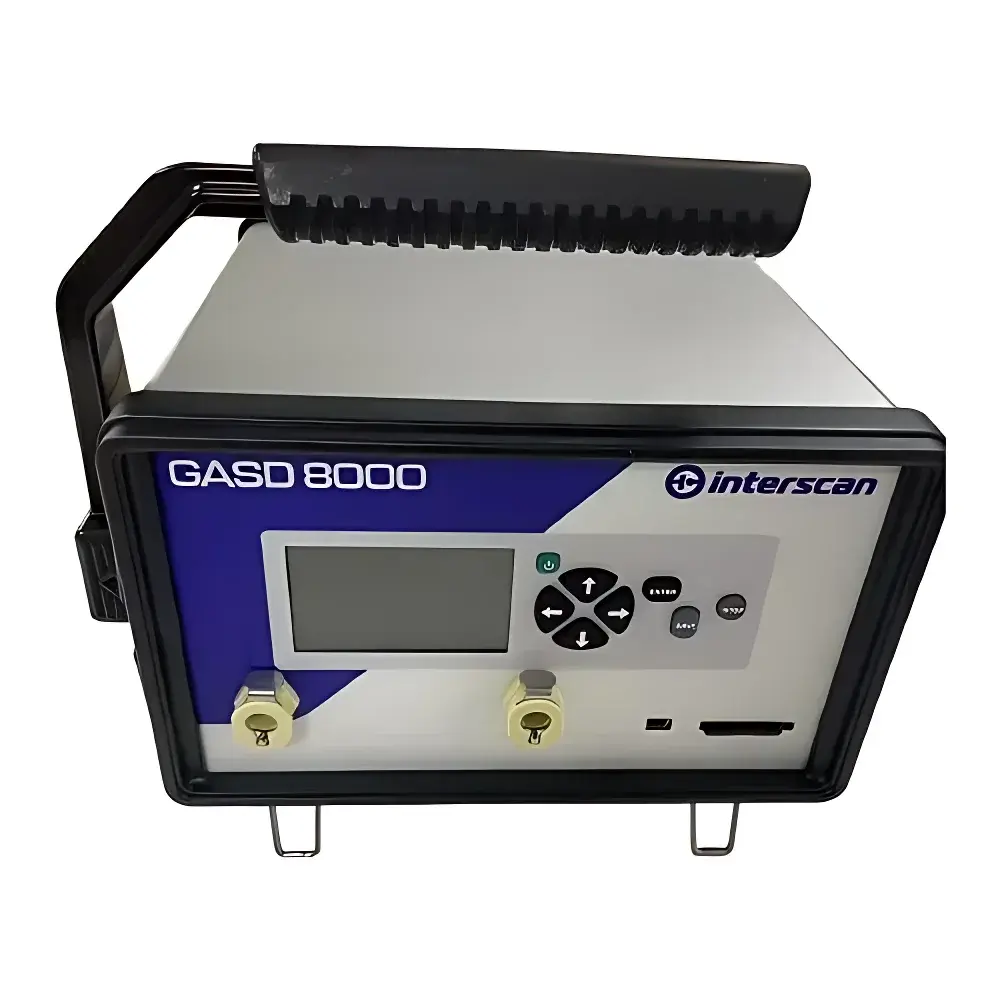
Interscan 8160 Portable Formaldehyde Analyzer
| Brand | Interscan |
|---|---|
| Origin | USA |
| Model | 8160 |
| Detection Principle | Electrochemical Sensor |
| Measurement Range | 0–20.00 ppm (0–2000 ppb) |
| Resolution | 0.01 ppm / 1 ppb |
| Repeatability | ±0.5% of reading |
| Accuracy | ±2% Rd + 0.01 ppm |
| Response Time | <60 s |
| Linearity Error | ±1.0% (24 h) |
| Zero Drift | ±1.0% (24 h) |
| Span Drift | ≤±2.0% (24 h) |
| Sampling Method | Continuous pump-suction |
| Display | LCD with real-time graphing and data logging |
| Analog Outputs | 4–20 mA and 0–2.5 V |
| Battery Life | Up to 8 h (rechargeable Li-ion) |
| Operating Environment | 0–45 °C, 0–90% RH |
| Dimensions | 140 × 210 × 254 mm |
| Weight | 2.95 kg |
| Enclosure | Anodized aluminum housing |
Overview
The Interscan 8160 Portable Formaldehyde Analyzer is a field-deployable, battery-powered gas detection instrument engineered for quantitative, real-time measurement of formaldehyde (HCHO) in ambient air. It employs a diffusion-controlled electrochemical sensing principle—where formaldehyde selectively oxidizes at the working electrode surface, generating a current linearly proportional to gas concentration. This transduction mechanism ensures high selectivity against common interferents (e.g., CO, NO₂, ethanol), validated per ASTM D5197–22 and ISO 16000-23 protocols for indoor air quality (IAQ) monitoring. Designed for compliance-critical environments—including occupational health assessments, post-renovation verification, and building commissioning—the 8160 delivers direct-reading capability without consumables or calibration gases during routine operation. Its integrated micro-pump enables active sampling under variable airflow conditions, eliminating passive diffusion bias and ensuring representative time-weighted average (TWA) exposure data per OSHA 29 CFR 1910.1200 and ACGIH TLV® requirements.
Key Features
- Long-life electrochemical sensor with proven stability (>24 months typical service life under normal IAQ conditions)
- Onboard rechargeable lithium-ion battery supporting continuous 8-hour operation with pump enabled
- Real-time graphical display showing concentration trend, peak hold, and statistical summary (min/max/avg)
- Dual analog outputs (4–20 mA and 0–2.5 V) compatible with industrial SCADA, BMS, and data acquisition systems
- Internal data logger storing up to 32,000 timestamped readings (configurable sampling interval: 1 s to 60 min)
- Rugged anodized aluminum enclosure (IP54-rated) meeting MIL-STD-810G shock/vibration specifications
- Calibration traceable to NIST-traceable formaldehyde standards; supports user-initiated zero/span verification
Sample Compatibility & Compliance
The 8160 is optimized for gaseous formaldehyde detection in non-condensing air matrices across indoor, occupational, and environmental settings. It complies with key regulatory frameworks governing formaldehyde exposure assessment: US EPA Method TO-11A (for sorbent tube validation), ISO 16000-23 (indoor air—determination of formaldehyde), and EN 16516 (construction products emission testing). Its electrochemical architecture avoids cross-sensitivity to acetaldehyde, methanol, and VOCs below 50 ppm—validated via independent third-party interference testing (per IEC 62941). The device supports GLP-compliant operation through audit-trail-enabled firmware (calibration logs, alarm events, battery status), aligning with FDA 21 CFR Part 11 data integrity expectations when used in pharmaceutical cleanroom qualification.
Software & Data Management
Data export is facilitated via USB-C interface using Interscan’s proprietary PC application (Windows 10/11 compatible), which enables full dataset visualization, statistical analysis (e.g., TWA, STEL, ceiling limits), and PDF report generation compliant with ISO/IEC 17025 documentation requirements. Firmware updates are delivered via signed binary packages to ensure cryptographic integrity. All logged data include embedded metadata: UTC timestamps, sensor temperature/humidity compensation values, pump status, and battery voltage—enabling retrospective uncertainty budgeting per GUM (JCGM 100:2008). No cloud dependency or subscription model is required; raw .csv files are fully interoperable with LIMS and Excel-based QA workflows.
Applications
- Occupational hygiene surveys in furniture manufacturing, plywood mills, and textile finishing facilities
- Post-construction IAQ verification in schools, hospitals, and residential buildings per ASHRAE Standard 62.1
- Regulatory compliance monitoring for formaldehyde emissions from composite wood products (CARB ATCM Phase II, EPA TSCA Title VI)
- Field validation of air purification system performance (e.g., photocatalytic oxidation units)
- Research-grade exposure assessment in toxicology and epidemiological cohort studies
- Emergency response screening following fire damage or chemical spill incidents
FAQ
What is the recommended calibration frequency for the 8160 in routine monitoring?
Calibration verification (zero and span) is advised before each daily use or after exposure to concentrations >10 ppm; full two-point calibration every 30 days or per internal QA protocol.
Can the 8160 be used in high-humidity environments such as greenhouses or humidified laboratories?
Yes—its integrated humidity compensation algorithm corrects for signal drift up to 90% RH; however, condensation must be avoided via inlet hydrophobic filter (optional accessory).
Does the device meet explosion-proof certification for use in petrochemical facilities?
No—the 8160 is rated for general-purpose use (Class I, Division 2 not certified); for hazardous locations, consult Interscan’s intrinsically safe IS-8160 variant (UL 913 listed).
Is sensor replacement a user-serviceable procedure?
Yes—field-replaceable sensor cartridges ship pre-calibrated; replacement requires no tools and takes <90 seconds, with automatic firmware recognition.
How is measurement uncertainty quantified for regulatory reporting?
Total expanded uncertainty (k=2) is ±3.2% at 1 ppm (coverage includes accuracy, repeatability, temperature/humidity effects, and calibration standard uncertainty), documented in the Certificate of Conformance supplied with each unit.
Related Products







