
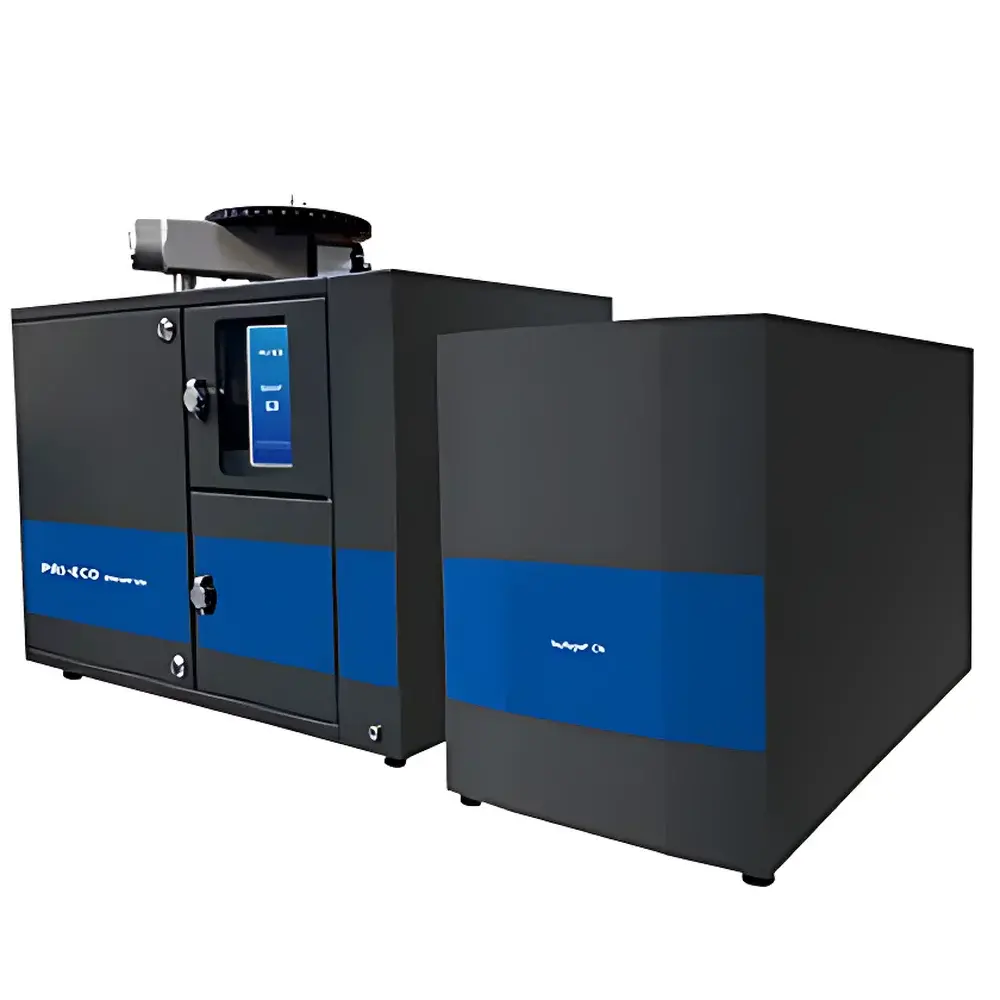
Isotope5 CNS Isotope Ratio Mass Spectrometer
| (brand | Pri-eco |
|---|---|
| origin | Beijing, China |
| manufacturer | Pri-eco |
| type | benchtop isotope ratio mass spectrometer |
| model | Isotope5 CNS |
| measurement range | δ¹³C, δ¹⁵N, δ³⁴S, δ³²S |
| resolution | >75 at m/z 29) |
Overview
The Isotope5 CNS Isotope Ratio Mass Spectrometer is a compact, high-precision benchtop IRMS engineered for stable isotope ratio analysis of carbon (¹³C/¹²C), nitrogen (¹⁵N/¹⁴N), and sulfur (³⁴S/³²S) in solid, liquid, and gaseous samples. Developed by Pri-eco in collaboration with Compact Science Systems (UK), the instrument employs magnetic sector mass spectrometry with a 14 cm radius-of-curvature (RAD), 90° geometry analyzer and permanent high-stability magnet—ensuring long-term mass calibration stability without electromagnet drift or active temperature control. Ion detection utilizes a triple Faraday cup collector array optimized for simultaneous or sequential measurement of adjacent masses (e.g., m/z 44/45/46 for CO₂; m/z 28/29/30 for N₂; m/z 32/33/34 for SO₂), enabling high-precision delta-value calculation via internal normalization. Designed for routine laboratory environments, the Isotope5 CNS operates without cryogenic cooling or high-vacuum oil pumps, relying instead on an integrated low-power turbomolecular vacuum system and helium carrier gas—reducing infrastructure dependency while maintaining analytical rigor required for climate science, biogeochemistry, food authenticity, and clinical diagnostics.
Key Features
- Benchtop footprint (70 × 30 × 47 cm; 45 kg) — installs on standard lab benches without dedicated floor space or reinforced flooring
- Permanent magnet architecture — eliminates thermal drift and power fluctuations affecting mass stability; no warm-up stabilization time required
- Triple Faraday collector configuration — supports multi-ion beam detection with real-time background subtraction and electronic gain matching
- Low operational gas consumption — helium usage ≤3–5 bar at <10 mL/min during analysis; built-in standby mode reduces flow to <1 mL/min during idle periods
- Integrated vacuum system — single-stage turbomolecular pump with active pressure regulation; ultimate vacuum <5 × 10⁻⁷ mbar
- Full diagnostic firmware — real-time ion beam monitoring, automatic leak detection, filament emission profiling, and vacuum integrity logging
- Plug-and-play interface — RS-485 and Ethernet connectivity for synchronized operation with elemental analyzers (EA), gas chromatographs (GC), or liquid chromatographs (LC)
Sample Compatibility & Compliance
The Isotope5 CNS is fully compatible with EA-IRMS, GC-IRMS, and LC-IRMS configurations. When coupled with the Element5 EA (CNS/O mode), it accepts CO₂, N₂, and SO₂ gases generated from combustion of solid or liquid samples in tin or silver capsules (0.1–500 mg; up to 1000 mg for soils). For volatile organic compound (VOC) analysis, GC-IRMS integration enables compound-specific δ¹³C measurement using capillary columns and high-sensitivity TCD detection. LC-IRMS compatibility supports online oxidation of eluted organics into CO₂ prior to IRMS inlet. All configurations comply with ISO 11290-2 (microbial identification), ASTM D7653 (petroleum hydrocarbon fingerprinting), USP (method validation), and support audit-ready data handling per FDA 21 CFR Part 11 when used with validated software workflows. Instrument design meets IEC 61010-1 safety standards for laboratory electrical equipment.
Software & Data Management
The Isotope5 CNS ships with a full-featured software suite supporting instrument control, sequence definition, real-time data acquisition, offline peak integration, and delta-value calculation using standardized reference materials (IAEA-CH-6, USGS24, IAEA-N-1, IAEA-S-1). The software implements dual-ratio referencing (e.g., ⁴⁵/⁴⁴ and ⁴⁶/⁴⁴ for CO₂), non-linear correction algorithms, and mass-dependent fractionation modeling. All raw signal files (.raw), processed results (.csv), and system logs are timestamped and digitally signed. Audit trail functionality records user actions, parameter changes, calibration events, and QC sample injections—fully traceable for GLP/GMP compliance. Data export supports LIMS integration via ASTM E1467-compliant XML schema and direct SQL database push.
Applications
- Climatology & Biogeochemistry: Quantifying carbon sequestration pathways via δ¹³C in soil organic matter; tracing nitrogen cycling in wetlands using δ¹⁵N in NO₃⁻ and NH₄⁺
- Food Authenticity: Detecting honey adulteration (C₄ sugar syrups) via δ¹³C discrimination; verifying geographical origin of wines and dairy products
- Clinical Diagnostics: Urea breath test for Helicobacter pylori infection using ¹³C-labeled urea and real-time δ¹³C tracking
- Petroleum Geochemistry: Sulfur isotopic fingerprinting (δ³⁴S) of crude oils and bitumens for reservoir correlation and migration studies
- Forensic Science: Isotopic profiling of explosives residues, illicit drugs, and human remains for provenance reconstruction
- Agricultural Research: Nitrogen use efficiency assessment in crops via δ¹⁵N labeling experiments and fertilizer source tracking
FAQ
What sample types can be analyzed directly on the Isotope5 CNS?
The Isotope5 CNS does not accept raw samples directly. It requires pre-processed gaseous analytes—CO₂, N₂, or SO₂—from elemental analyzers; or compound-separated CO₂ from GC/LC interfaces. Solid/liquid samples must first undergo combustion, pyrolysis, or chemical conversion.
Does the Isotope5 CNS require liquid nitrogen or other cryogens?
No. The instrument uses ambient-temperature Faraday detectors and a permanently magnetized sector analyzer—eliminating need for LN₂, liquid helium, or thermoelectric cooling.
Can the Isotope5 CNS measure oxygen isotopes (δ¹⁸O)?
Not natively. Oxygen isotope analysis requires conversion to CO or CO₂ under controlled fluorination conditions and separate inlet configuration. Integration with specialized OEA modules (e.g., TC/EA) is possible but not part of standard CNS configuration.
What is the typical measurement precision for δ¹³C in routine operation?
Internal precision is ±0.10‰ (1σ) for CO₂ reference gas at m/z 44 (20 nA beam intensity); sample precision for 100 µg C urea standards is ±0.20‰ (1σ), consistent with ISO 13877 requirements for environmental isotope testing.
Is remote monitoring and troubleshooting supported?
Yes. The embedded web server enables secure HTTPS access for live vacuum status, ion beam currents, detector voltages, and error logs. Firmware updates and diagnostic scripts can be deployed over LAN without physical access.
Related Products




