
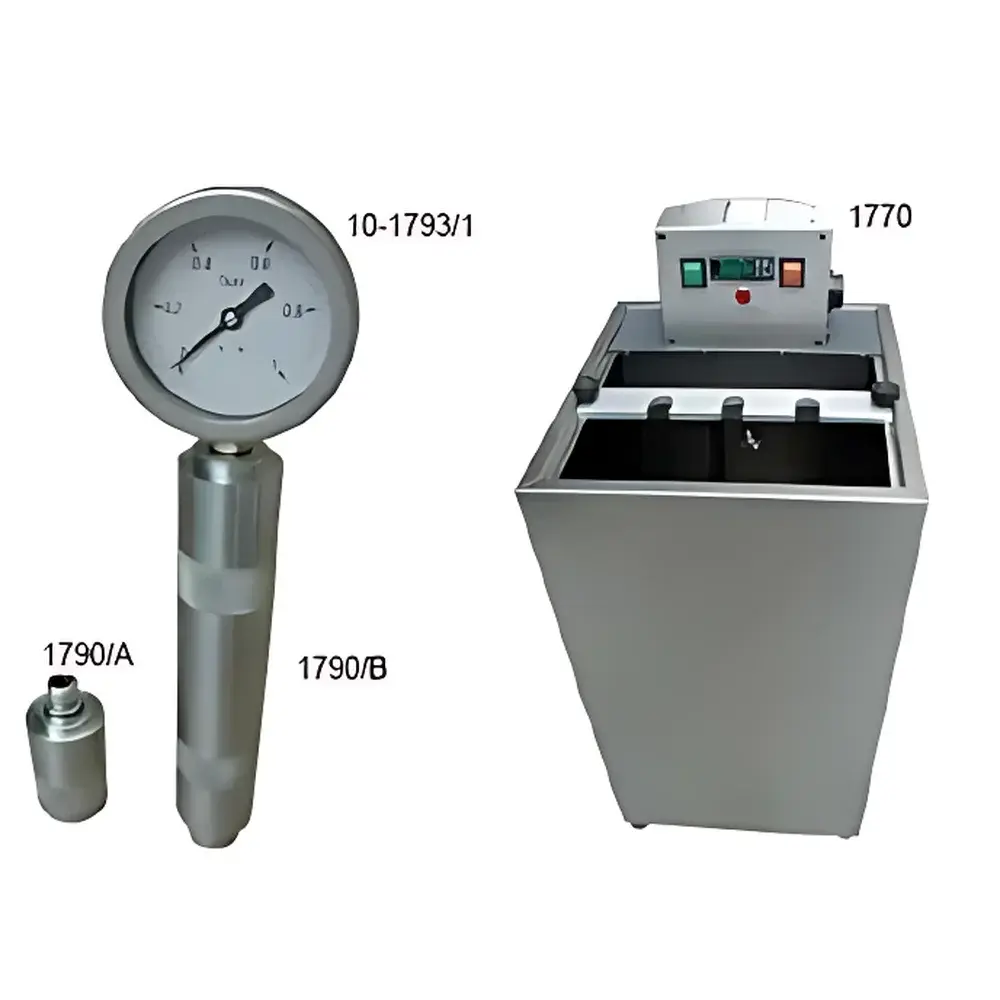
Italian-made D323 Reid Vapor Pressure Tester
| (Origin | Italy |
|---|---|
| Manufacturer Type | Authorized Distributor |
| Origin Category | Imported |
| Model | D323 |
| Pricing | Available Upon Request) |
Overview
The Italian-made D323 Reid Vapor Pressure Tester is a precision-engineered laboratory instrument designed for the standardized determination of Reid Vapor Pressure (RVP) of volatile petroleum products in strict accordance with ASTM D323, IP 69, ISO 3007, and related international test methods. RVP is a critical quality control parameter that quantifies the vapor pressure exerted by a liquid petroleum sample at 37.8°C (100°F) under specified equilibrium conditions—specifically, a 4:1 vapor-to-liquid volume ratio in a sealed, calibrated test chamber. This measurement directly informs safety during storage and transport, volatility behavior during engine cold-start performance, and regulatory compliance for gasoline, reformulated fuels, naphthas, and light distillates. The D323 implements the classical Reid method using a robust, thermostatically controlled water bath system with dual-wall stainless-steel construction, ensuring thermal stability and long-term repeatability required for routine QC laboratories operating under GLP or refinery QA protocols.
Key Features
- Triple-position thermostatic bath engineered for simultaneous or sequential RVP testing per ASTM D323 Procedure A, B, C, and D—supporting diverse sample classes including gasoline, volatile crude oils, aviation turbine fuels (e.g., Jet A-1), and high-volatility distillates.
- Precision microprocessor-based PID temperature control delivering ±0.1°C stability at the standard test temperature of 37.8°C (100°F), with independent overtemperature protection circuitry to prevent thermal excursion.
- Dual LED display showing both setpoint and real-time bath temperature, enabling immediate verification of thermal equilibration prior to sample immersion.
- Stainless-steel bath tank with insulated double-wall architecture minimizing ambient heat exchange and reducing energy consumption during extended operation.
- Integrated depth-specific sample holder fixtures ensuring consistent immersion of the RVP test chamber (bomb) to the exact depth mandated by ASTM D323—critical for accurate vapor-phase volume calibration.
- Modular pressure transducer compatibility: supports interchangeable analog pressure gauges spanning 0–0.4 bar (0–5.8 psi) up to 0–10 bar (0–145 psi), enabling method-specific range selection without hardware modification.
Sample Compatibility & Compliance
The D323 is validated for use with gasoline, motor fuel blends (excluding oxygenated fuels containing ethanol or TAME), volatile crude oils, naphtha, and aviation turbine fuels meeting specification limits defined in ASTM D323 Annexes. Method A applies to samples with RVP ≤ 180 kPa (26 psi); Method C extends capability to higher-pressure samples up to 690 kPa (100 psi); Method D is optimized for aviation fuels exhibiting RVP near 50 kPa (7 psi). It is explicitly not intended for liquefied petroleum gas (LPG), methanol-blended fuels, or samples containing significant concentrations of dissolved gases or non-condensable vapors. All operational procedures align with ISO/IEC 17025 competency requirements, and the system supports audit-ready documentation when integrated with compliant laboratory information management systems (LIMS).
Software & Data Management
While the base D323 operates as a standalone analog-controlled instrument, optional digital interfaces—including RS-232 or USB output modules—are available for integration into automated data acquisition workflows. When paired with validated third-party software, the system can generate timestamped RVP reports with embedded metadata (operator ID, sample ID, ambient barometric correction, bath temperature log), satisfying traceability requirements under FDA 21 CFR Part 11 and EU Annex 11 for regulated environments. Calibration logs, maintenance records, and pressure gauge verification certificates may be archived in accordance with internal SOPs and external accreditation body expectations (e.g., UKAS, A2LA).
Applications
- Refinery process control: Real-time RVP monitoring of gasoline blending streams to ensure compliance with seasonal volatility specifications (e.g., EPA Tier 3 RVP limits).
- Fuel certification labs: Generation of legally defensible RVP data for product release against ASTM D439, D4814, or EN 228.
- Research & development: Evaluation of volatility impact from alternative blendstocks (e.g., bio-isobutanol, alkylates) under standardized test conditions.
- Contract testing facilities: High-throughput RVP analysis supporting API RP 2540, ISO 4259 reproducibility criteria.
- Aviation fuel quality assurance: Verification of Jet A/A-1 volatility per ASTM D1655 Annex A1 and DEF STAN 91-91.
FAQ
Which ASTM methods does the D323 support?
ASTM D323 Procedures A, B, C, and D—with appropriate pressure gauge selection and operator-defined test parameters.
Can the D323 be used for ethanol-gasoline blends (E10, E15)?
No—ASTM D323 explicitly excludes oxygenated fuels containing ethanol or TAME; use ASTM D5191 (Mini-Method) or D6377 instead.
Is the bath temperature verified independently?
Yes—calibrated NIST-traceable thermometers or digital temperature probes can be used for periodic verification per ASTM E77 or ISO 17025 internal calibration procedures.
What maintenance is required for long-term accuracy?
Monthly cleaning of the stainless-steel bath, quarterly verification of pressure gauge linearity, and annual recalibration of the PID controller’s temperature sensor are recommended.
Does the D323 meet environmental safety standards?
The unit complies with IEC 61010-1 for electrical safety and features enclosed heating elements with thermal cutoff—no open flame or hazardous exhaust generation.






