
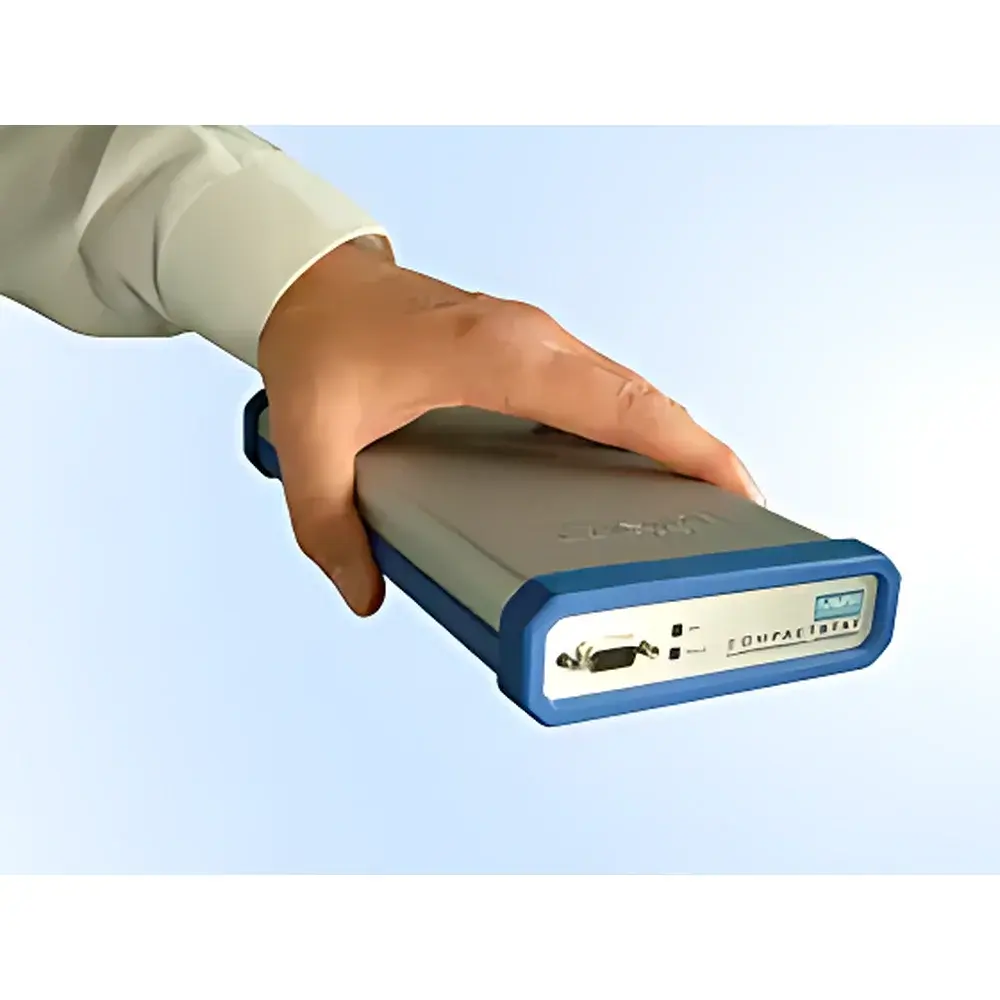
Ivium CompactStat.h Portable Electrochemical Workstation
| Brand | Ivium |
|---|---|
| Origin | Netherlands |
| Model | CompactStat.h |
| Instrument Type | Portable Electrochemical Workstation |
| Channel Count | Single-Channel |
| Current Range | ±1 pA to ±10 mA (12 ranges: 1 pA, 10 pA, 100 pA, 1 nA, 10 nA, 100 nA, 1 µA, 10 µA, 100 µA, 1 mA, 10 mA) |
| Current Accuracy | ±0.2% of reading |
| Potential Accuracy | ±0.2% of reading |
| Potentiostatic Range | −10 V to +10 V |
| EIS Frequency Range | 10 µHz to 3 MHz |
| Current Resolution | down to 0.6 aA (at selected range) |
| Potential Resolution | down to 0.07 nV (at selected range) |
| Applied Signal Resolution | 0.00013% |
| Measurement Resolution (current) | 0.00006% of selected range |
Overview
The Ivium CompactStat.h is a high-performance, USB-powered portable electrochemical workstation engineered for precision potentiostatic, galvanostatic, and electrochemical impedance spectroscopy (EIS) measurements. Designed and manufactured in the Netherlands, it integrates laboratory-grade performance into a compact, field-deployable form factor—enabling rigorous electrochemical characterization without compromising resolution, stability, or compliance readiness. Its core architecture implements a true four-electrode potentiostat/galvanostat with analog feedback control, supporting both floating and grounded configurations to accommodate diverse cell geometries and grounding requirements (e.g., corrosion cells, battery half-cells, photoelectrochemical devices). The system operates on standard USB 2.0 power (5 V DC), eliminating the need for external power supplies while maintaining low-noise signal integrity across its full dynamic range—from sub-picoampere currents to ±30 mA maximum output.
Key Features
- Ultra-low current detection capability: 12 programmable current ranges spanning ±1 pA to ±10 mA, with resolution as fine as 0.6 aA (attoampere) at the 1 pA range.
- Broad EIS bandwidth: 10 µHz to 3 MHz frequency coverage—enabling characterization of interfacial processes from slow diffusion-controlled reactions to fast charge-transfer kinetics and double-layer relaxation.
- Mixed-mode measurement capability: Simultaneous application of up to five independent stimuli (e.g., potential step, current step, linear sweep, open-circuit potential, and AC perturbation) within a single automated sequence; supports in-situ EIS acquisition during transient events.
- High-resolution potential control: ±10 V compliance range with 0.07 nV minimum potential resolution and ±0.2% accuracy across all ranges.
- Integrated electrochemical noise analysis suite: Time-domain metrics (corrosion current density icorr, pitting index, localized corrosion resistance Rp) and frequency-domain tools including FFT-based spectral analysis and Maximum Entropy Method (MEM) for enhanced spectral resolution.
- Photoelectrochemical extension support: Built-in I–V curve acquisition, photocurrent quantification, and parameter extraction (fill factor, maximum power point, incident photon-to-current efficiency IPCE, and solar-to-hydrogen conversion efficiency).
Sample Compatibility & Compliance
The CompactStat.h is compatible with standard three-electrode (working, reference, counter) and two-electrode electrochemical cells, including rotating disk electrodes (RDE), microelectrodes, screen-printed electrodes (SPEs), and custom-designed flow cells. It supports both aqueous and non-aqueous electrolytes and is routinely deployed in corrosion monitoring, battery material screening, biosensor development, and photoelectrocatalysis studies. From a regulatory perspective, the instrument’s deterministic timing, audit-trail-capable software logging, and traceable calibration protocols align with GLP and GMP documentation expectations. While not pre-certified for FDA 21 CFR Part 11, its data export formats (CSV, TXT, binary .mpt) and metadata-rich file structure facilitate integration into validated laboratory information management systems (LIMS) and electronic lab notebooks (ELN).
Software & Data Management
Controlled via IviumSoft—a Windows-based application offering intuitive experiment setup, real-time visualization, and post-acquisition analysis—the CompactStat.h provides native support for EIS modeling (equivalent circuit fitting using nonlinear least-squares regression), Tafel analysis, cyclic voltammetry deconvolution, and chronoamperometric diffusion modeling. All raw and processed data are stored with full metadata (timestamp, instrument ID, operator, method parameters, environmental conditions if logged externally). Export options include ASCII-compatible formats for third-party analysis (e.g., MATLAB, Python SciPy, OriginLab) and direct import into statistical process control (SPC) platforms. Firmware updates are delivered through Ivium’s secure web portal, ensuring long-term compatibility with evolving analytical standards.
Applications
- Corrosion science: Polarization resistance (Rp), electrochemical noise analysis (ENA), and localized corrosion mapping under realistic environmental conditions.
- Battery R&D: Half-cell and full-cell testing—including voltage-capacity profiling, SEI formation analysis, and impedance evolution during cycling.
- Electrocatalysis: Kinetic evaluation of HER/OER/ORR catalysts via Tafel slopes, exchange current densities, and EIS-derived charge-transfer resistances.
- Photoelectrochemistry: Quantitative assessment of semiconductor photoanodes/cathodes under simulated AM1.5G illumination, including incident-photon-to-current-efficiency (IPCE) scans.
- Sensor development: Amperometric and impedimetric biosensor calibration, limit-of-detection (LOD) validation, and stability assessment over extended periods.
FAQ
Is the CompactStat.h suitable for regulated quality control environments?
Yes—while not pre-validated for 21 CFR Part 11, its deterministic operation, timestamped data files, and configurable user access controls support internal validation per ISO/IEC 17025 and ASTM E2500 guidelines.
Can it perform simultaneous EIS during potentiostatic holds or sweeps?
Yes—its Mixed Mode functionality enables superimposed small-amplitude AC signals (e.g., 10 mV RMS) on DC bias steps or linear sweeps, allowing time-resolved impedance acquisition at defined potentials.
What electrode configurations does it support?
Three-electrode (WE/RE/CE), two-electrode, and pseudo-reference setups; optional floating mode eliminates ground-loop interference in shielded or isolated systems.
Does it require external power or batteries?
No—it draws stable 5 V DC power directly from a USB 2.0 port, making it fully portable without auxiliary power sources.
How is calibration performed?
Factory calibration is traceable to NIST standards; users may perform verification using certified resistor-capacitor test kits (e.g., Ivium RC-Test Box) and documented procedures included in the instrument manual.







