
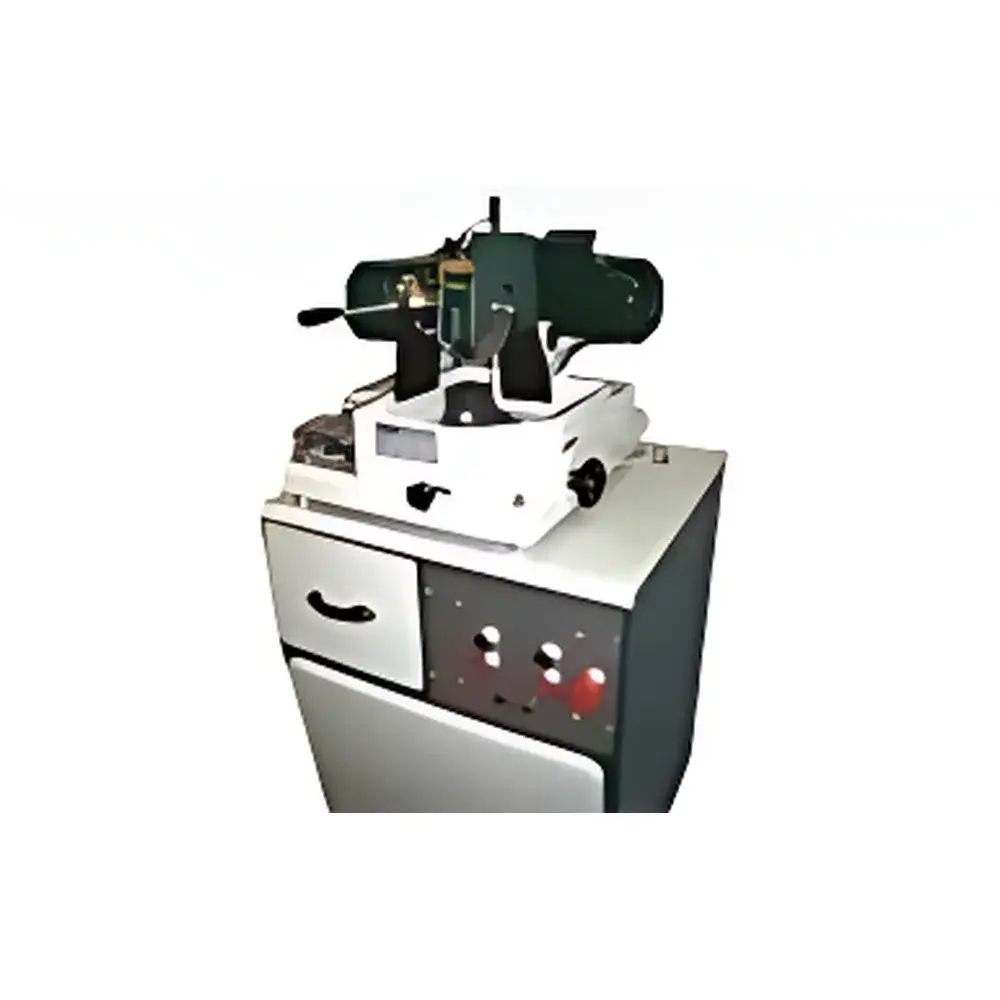
J0215 Vertical Rock Slice Machine
| Origin | France |
|---|---|
| Manufacturer Type | Authorized Distributor |
| Origin Category | Imported |
| Model | J0215 |
| Pricing | Upon Request |
| Cooling Capacity | 30 L |
| Blade Diameter | 175 mm |
| Motor | 3-Phase, 1 kW |
| Sample Holder | Vacuum Chuck |
| Maximum Stroke | 30 mm |
| Thickness Resolution | 0.01 mm |
| Thickness Range (with Micrometer Lock) | 150–350 µm |
| Coolant Delivery | Direct Nozzle Spray onto Blade |
| Waste Collection | Polypropylene Trough |
| Vacuum System | Integrated, Solvent-Resistant Electric Pump |
| Frame Material | Corrosion-Resistant Steel |
Overview
The J0215 Vertical Rock Slice Machine is a precision-engineered instrument designed specifically for geological and metallurgical laboratories requiring reproducible, ultra-thin sectioning of brittle, heterogeneous solid specimens—particularly consolidated rock cores, mineral aggregates, ore samples, and sintered ceramics. Unlike conventional microtomes or horizontal saws, the J0215 employs a vertically oriented, gravity-assisted cutting architecture combined with a pneumatically damped piston drive and high-torque 3-phase motor to deliver controlled downward force while minimizing mechanical vibration and thermal distortion. The system operates on the principle of precision abrasive slicing under continuous coolant irrigation, enabling consistent thickness generation across hard, anisotropic materials without delamination or edge chipping. Its primary function is to produce planar slices in the 100–350 µm range—ideal as feedstock for subsequent thin-section polishing, SEM stub mounting, or petrographic slide preparation per ASTM D3404 and ISO 14688-1 standards.
Key Features
- Vertically aligned cutting axis with calibrated micrometer-controlled stroke (0.01 mm resolution) and 30 mm maximum travel, ensuring repeatable slice thickness within ±2 µm tolerance under standard operating conditions.
- Integrated vacuum chuck sample holder (175 mm diameter interface) compatible with both permanent aluminum mounts and temporary adhesive substrates, providing uniform clamping pressure across irregular specimen geometries.
- Dual-stage cooling system: 30 L closed-loop recirculating reservoir supplies deionized water directly to a swiveling nozzle positioned <15 mm from the blade edge, maintaining blade temperature below 35°C during sustained operation.
- Corrosion-resistant steel frame isolates all motion-critical components—including micrometer feed, linear guides, and thickness measurement assembly—from coolant exposure and particulate contamination.
- Self-contained solvent-resistant vacuum pump with independent exhaust filtration; vacuum level adjustable from 0.05 to 0.09 MPa (absolute) to accommodate varying porosity and adhesion characteristics of geological samples.
- Polypropylene waste trough with integrated sediment trap and drain port, compliant with ISO 14001 lab waste handling protocols for aqueous slurry disposal.
Sample Compatibility & Compliance
The J0215 accommodates specimens up to Ø120 mm × 80 mm height, including unconsolidated sandstones, basaltic lavas, metamorphic schists, slag fragments, and alloyed metal ingots. Its vacuum-based fixation eliminates reliance on epoxy embedding for preliminary slicing—reducing turnaround time and preserving native microstructure integrity. All wetted components meet FDA-compliant material specifications (USP Class VI polypropylene, EPDM seals), and the electrical architecture conforms to IEC 61000-6-2/6-4 EMC requirements. The system supports GLP-compliant documentation workflows when paired with external audit-trail-capable data loggers, and its mechanical repeatability aligns with ISO/IEC 17025 method validation criteria for preparatory instrumentation.
Software & Data Management
The J0215 operates as a standalone electromechanical platform with no embedded firmware or proprietary software. All operational parameters—including vacuum setpoint, coolant flow rate (manually regulated via needle valve), and stroke depth—are set via analog dials and calibrated micrometers. This design eliminates cybersecurity vulnerabilities and ensures long-term serviceability without vendor lock-in. For traceability, users may integrate third-party digital calipers (e.g., Mitutoyo Absolute Series) connected to LabArchives or Benchling via USB-HID emulation; thickness measurements are timestamped and exportable as CSV. The absence of network connectivity satisfies 21 CFR Part 11 “closed system” definitions where electronic records are generated externally.
Applications
- Preparation of petrographic thin sections for optical microscopy and cathodoluminescence analysis.
- Generation of planar cross-sections from drill core samples prior to XRF mapping or LA-ICP-MS ablation.
- Sectioning of refractory ceramic composites for interfacial defect characterization via FIB-SEM.
- Routine quality control slicing of metallurgical test coupons (per ASTM E3, E384) prior to hardness testing.
- Controlled decortication of weathered soil horizons for sequential mineralogical fractionation studies.
FAQ
What is the minimum achievable slice thickness with the J0215, and what factors influence reproducibility?
The system is validated for routine 100 µm slices; however, stable operation down to 80 µm is achievable with diamond-impregnated blades and optimized coolant flow. Reproducibility depends primarily on specimen homogeneity, vacuum seal integrity, and blade wear—requiring recalibration after every 50 cm² of cumulative cut area.
Can the J0215 process hydrated or clay-rich samples without disintegration?
Yes—provided specimens are pre-dried to ≤5% moisture content (per ASTM D2216) and mounted using low-viscosity cyanoacrylate under vacuum degassing. The machine’s low-vibration descent profile prevents slurry formation in fine-grained matrices.
Is blade replacement tooling included, and what is the recommended maintenance interval?
A full blade-changing kit (wrenches, alignment jig, torque screwdriver) is supplied. Bearings and vacuum seals require inspection every 500 operating hours; coolant reservoir must be flushed and refilled quarterly with inhibited glycol-water mix (20% v/v).






