
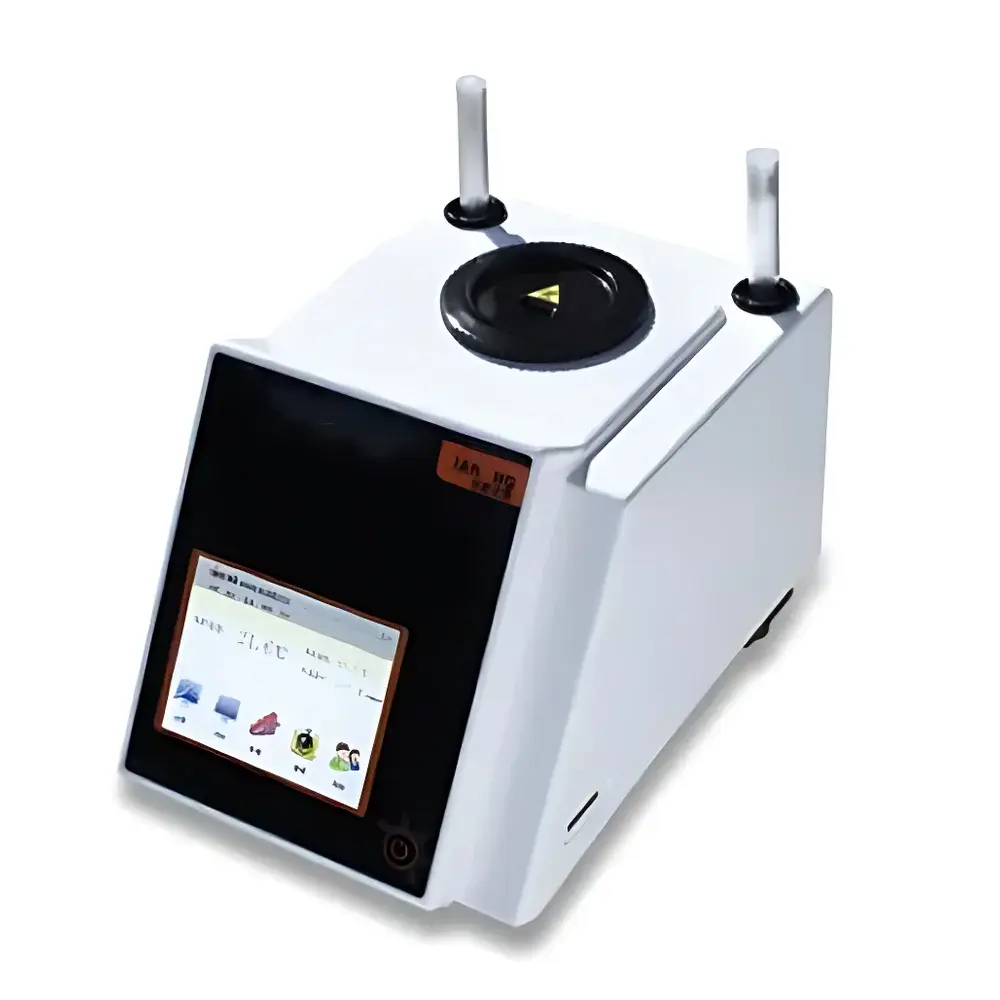
J60 Automated Melting Point Apparatus
| Origin | Shanghai, China |
|---|---|
| Manufacturer Type | Authorized Distributor |
| Origin Category | Domestic (PRC) |
| Model | J60 |
| Price Range | USD 7,000–14,000 |
| Temperature Range | Ambient to 400 °C |
| Heating Rate | 0.1–20 °C/min (200-step continuous adjustment) |
| Temperature Repeatability | ±0.1 °C (at 0.1 °C/min heating rate) |
| Temperature Accuracy | ±0.3 °C (<250 °C), ±0.5 °C (>250 °C) |
| Capillary Dimensions | OD 1.4 mm, ID 1.0 mm |
| Sample Capacity | 4 samples per run |
| Temperature Resolution | 0.1 °C |
| Display | TFT high-definition color LCD |
| Power Supply | 220 V, 50 Hz |
| Power Consumption | 120 W |
| Data Interfaces | USB, RS-232, Ethernet |
| User Accounts | 8 configurable profiles |
| Melting Curve Storage | 10 complete thermal profiles |
| Total Data Storage | 400 melting events |
| Detection Mode | Fully automated optical detection (no manual override) |
Overview
The J60 Automated Melting Point Apparatus is a precision thermal analysis instrument engineered for the accurate, reproducible, and standardized determination of melting points and melting ranges (onset, clear point, and interval) of crystalline organic solids. It operates on the principle of controlled heating combined with real-time digital image analysis of capillary-mounted samples—detecting phase transitions via optical contrast changes between solid and molten states. Designed in accordance with international pharmacopeial standards—including USP <741>, EP 2.2.17, and JP 2.60—the J60 delivers regulatory-compliant performance suitable for QC laboratories operating under GLP or GMP frameworks. Its ambient-to-400 °C temperature range accommodates both low-melting pharmaceutical intermediates and high-melting specialty polymers or metal-organic frameworks, while its 0.1 °C temperature resolution and calibrated accuracy ensure traceable results aligned with ISO/IEC 17025 metrological requirements.
Key Features
- Fully automated four-channel measurement: Simultaneous processing of up to four independent samples per cycle without cross-contamination or thermal crosstalk.
- Programmable heating control: 200-step continuously adjustable ramp rates from 0.1 to 20 °C/min—enabling method optimization for narrow-melting APIs or broad-melting excipients.
- Optical transition detection engine: High-sensitivity CCD-based imaging system captures real-time sample morphology changes; algorithmically identifies onset (initial collapse), midpoint, and clear point with timestamped event logging.
- Regulatory-ready data integrity: Built-in audit trail, user authentication (8 distinct roles), and electronic signature support—facilitating compliance with FDA 21 CFR Part 11 where enabled via networked deployment.
- Intuitive TFT color interface: 7-inch high-resolution display with touch navigation, real-time curve overlay, and on-screen calibration verification prompts.
- Multi-interface connectivity: Native support for USB mass storage export, RS-232 serial communication for legacy LIMS integration, and Ethernet for centralized instrument management and remote diagnostics.
Sample Compatibility & Compliance
The J60 accepts standard thin-walled capillaries (1.4 mm OD × 1.0 mm ID), compatible with ASTM E324-19 and Ph. Eur. 2.2.17 specifications. It is validated for use with powders, crystals, and microcrystalline suspensions commonly encountered in small-molecule drug development, agrochemical formulation, and fine chemical synthesis. All thermal calibrations are traceable to NIST-certified reference standards (e.g., indium, tin, lead, potassium nitrate). The instrument’s firmware includes preloaded pharmacopeial methods and supports user-defined SOPs with version-controlled parameter sets. Validation documentation (IQ/OQ/PQ templates) and calibration certificates are provided upon request to support laboratory accreditation audits.
Software & Data Management
Data acquisition and reporting are managed through embedded firmware—not external PC software—ensuring deterministic timing, reduced validation burden, and immunity to OS-level interference. Each test generates a timestamped record containing raw thermal curve data (temperature vs. time), derivative plot (dT/dt), annotated transition points, operator ID, and environmental metadata (date, instrument ID, method name). Up to 10 full melting curves (with image snapshots) and 400 discrete melting events are retained onboard. Export formats include CSV (for statistical analysis in JMP or Minitab) and PDF reports compliant with ALCOA+ principles—containing digital signatures, revision history, and change logs. Networked units support centralized data archiving via FTP or secure SFTP to enterprise document management systems.
Applications
- Pharmaceutical QC/QA: Identity confirmation and purity assessment of active pharmaceutical ingredients (APIs) and excipients per ICH Q5, Q6A, and compendial monographs.
- Academic research: Polymorph screening, eutectic behavior analysis, and thermal stability profiling in synthetic organic chemistry and materials science labs.
- Food & flavor chemistry: Verification of fatty acid composition, triglyceride purity, and adulteration detection in edible oils and waxes.
- Agrochemical development: Batch release testing of herbicides, fungicides, and plant growth regulators requiring strict thermal specification adherence.
- Contract manufacturing organizations (CMOs): Supporting regulatory submissions with auditable, repeatable, and transferable melting data packages.
FAQ
Does the J60 support manual intervention during a melting run?
No. The J60 is designed exclusively for fully automated operation; no manual override or real-time adjustment is permitted during assay execution to preserve data integrity and regulatory compliance.
Can the instrument be calibrated in-house using certified reference materials?
Yes. The built-in calibration routine accepts user-loaded NIST-traceable standards (e.g., pure indium, 112.9 °C) and automatically adjusts internal PID parameters—generating a calibration certificate with uncertainty budget per ISO/IEC 17025 Annex A.3.
Is remote monitoring or control possible over Ethernet?
Basic status polling and log retrieval are supported via HTTP API; however, live video streaming or interactive control is not implemented—consistent with IEC 62304 Class B medical device software safety requirements for analytical instrumentation.
What is the maximum allowable sample moisture content for reliable results?
Samples should be dried to ≤0.5% w/w residual moisture prior to loading, as uncontrolled hydration can cause premature collapse or depressed onset temperatures—particularly critical for hygroscopic APIs like ampicillin or tetracycline derivatives.



