
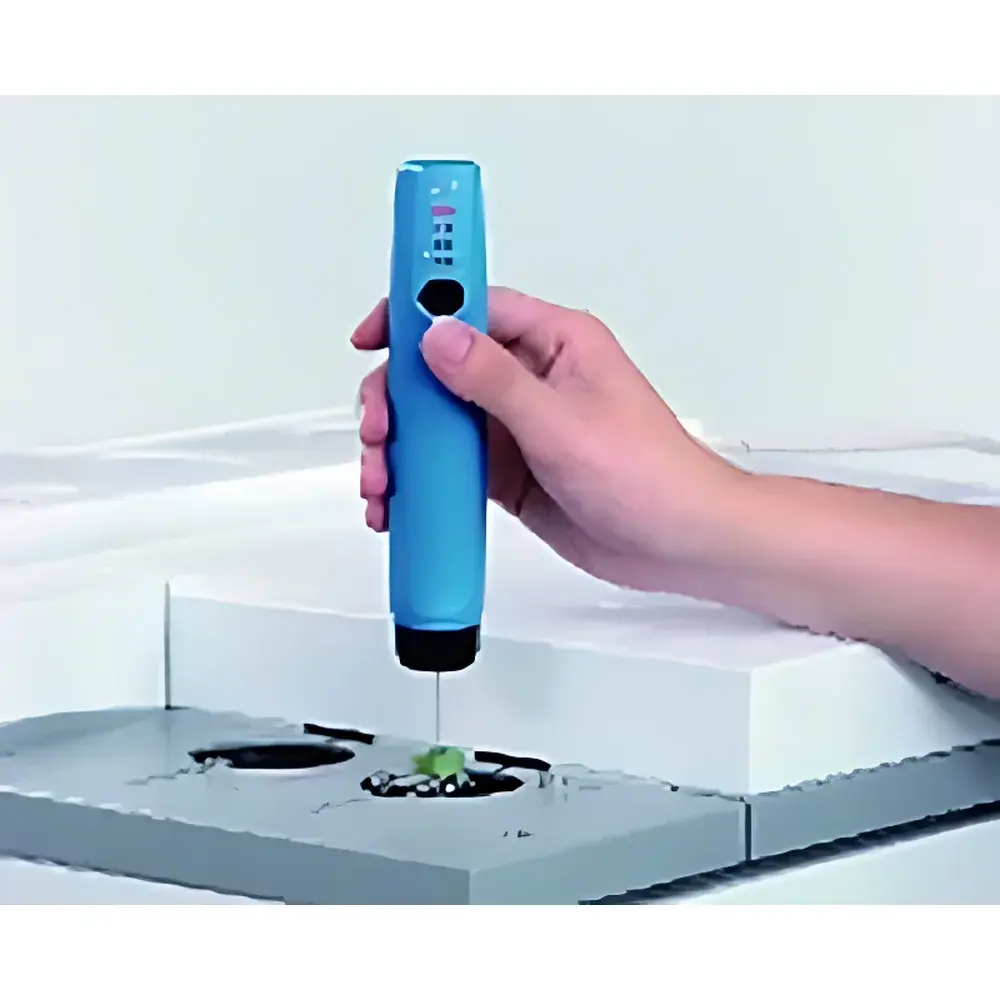
JAI JCI-22 Portable Curie-Point Pyrolyzer
| Brand | JAI |
|---|---|
| Origin | Japan |
| Instrument Type | Curie-Point Pyrolyzer |
| Model | JCI-22 |
| Sample Heating | 160–1140 °C (via Curie-point heated Pt foil) |
| Preheating Temperature | 150 °C (≈60 s ramp) |
| Pyrolysis Zone Dimensions | 9 × 20 mm Pt foil |
| Sample Tube | Quartz |
| Probe Outer Diameter × Length | 35 × 180 mm |
| Probe Weight | 110 g |
| HF Generator Output | 48 W, 600 kHz |
| GC Trigger Interface | Ready signal input & Start signal output |
| Carrier Gas | He at ≥0.5 MPa (supplied via standard JCI-22 5 L cylinder) |
| Controller Dimensions | 150 × 200 × 320 mm |
| Compatibility | Direct insertion into standard GC/GC–MS split/splitless inlets |
Overview
The JAI JCI-22 Portable Curie-Point Pyrolyzer is an engineered solution for on-demand, in-situ thermal degradation of solid, semi-solid, and volatile samples directly at the inlet of gas chromatographs (GC) or gas chromatography–mass spectrometers (GC–MS). Unlike conventional furnace-based pyrolyzers that rely on resistive heating and require extended thermal equilibration, the JCI-22 employs electromagnetic induction heating of a ferromagnetic platinum foil—activated precisely at its material-specific Curie temperature. This principle enables rapid, localized, and self-limiting thermal excitation (160–1140 °C), eliminating thermal lag, minimizing heat dissipation to surrounding components, and ensuring operator safety during manual probe handling. Its design bypasses vacuum system interruption, carrier gas reconfiguration, and mechanical integration with the GC manifold—making it the first commercially deployed pyrolyzer capable of true “injector-port” deployment without hardware modification.
Key Features
- Curie-point heating mechanism ensures precise, reproducible, and self-regulating sample pyrolysis—no external temperature calibration required per foil batch.
- Handheld probe (Ø35 × 180 mm, 110 g) with integrated quartz sample tube and Pt foil heater—designed for direct insertion into standard GC/GC–MS injection ports (split, splitless, or PTV).
- No system downtime: eliminates vacuum break, gas line rerouting, and bake-out procedures traditionally associated with benchtop pyrolyzer installation (saves 3–6 hours per setup).
- Full compatibility with automated GC accessories—including autosamplers, multi-purpose inlets, and cryo-trapping modules—without removal or reconfiguration.
- On-board high-frequency generator (48 W, 600 kHz) with TTL-level GC synchronization: accepts “ready” trigger from GC and outputs “start acquisition” pulse to initiate data collection.
- Integrated preheating zone (150 °C, ~60 s ramp) reduces condensation of thermally labile fragments prior to volatilization.
Sample Compatibility & Compliance
The JCI-22 supports direct analysis of polymers, rubbers, coatings, microplastics, forensic trace evidence, pharmaceutical excipients, and environmental particulates—including moisture-sensitive or air-reactive solids. Its inert quartz sample tube and low-residue Pt foil minimize catalytic side reactions and carbon buildup. The system complies with ASTM D7259 (Standard Test Method for Determination of Volatile Content in Plastics by Pyrolysis–Gas Chromatography) and supports GLP-aligned workflows through deterministic thermal control and traceable GC-triggered event logging. While not inherently 21 CFR Part 11 compliant, its discrete digital I/O signals enable integration with validated LIMS or chromatography data systems (CDS) supporting audit trail generation.
Software & Data Management
The JCI-22 operates as a hardware-peripheral device—requiring no dedicated software stack. All timing, triggering, and thermal activation are managed autonomously by the embedded controller. GC vendor software (e.g., Agilent OpenLab, Thermo Chromeleon, Shimadzu GCMSsolution) records pyrolysis events via synchronized start pulses. For method documentation and traceability, users configure pyrolysis parameters (target Curie temperature, preheat duration, dwell time) within GC sequence tables. Optional integration with third-party CDS platforms allows metadata tagging (e.g., sample ID, foil lot number, helium pressure log) alongside chromatographic data—supporting ISO/IEC 17025 documentation requirements.
Applications
- Rapid identification of polymer additives (plasticizers, flame retardants, antioxidants) in recycling streams.
- Microplastic characterization in environmental water and sediment matrices without solvent extraction.
- Forensic analysis of adhesives, paints, and textile fibers using minimal sample mass (≤100 µg).
- In-process quality control of cured elastomers and composite resins—monitoring crosslink density via characteristic fragment ratios.
- Thermal stability screening of battery separator materials and cathode binders under inert He atmosphere.
- Field-deployable analysis when paired with portable GC–MS systems (e.g., Torion, FLIR Griffin) using the included 5 L He cylinder (JCI-22 specification).
FAQ
Can the JCI-22 be used with all GC and GC–MS models?
Yes—provided the instrument features a standard 1/8″ or 1/4″ female threaded injection port and accepts TTL-level external start triggers. Compatibility has been verified with Agilent, Thermo Fisher, Shimadzu, PerkinElmer, and Bruker platforms.
Is helium the only permissible carrier gas?
Helium is mandatory due to its high thermal conductivity and non-reactive nature under pyrolysis conditions; hydrogen or nitrogen are not supported and may compromise Curie-point control or foil longevity.
How often must the Pt foil be replaced?
Under routine use (≤50 injections/day), the foil maintains stable Curie-point behavior for ≥500 cycles; replacement is indicated when observed pyrolysis temperature deviates by >15 °C from nominal setting.
Does the probe require cooling between injections?
No active cooling is needed—the probe’s low thermal mass and absence of residual heating allow immediate sequential injections; ambient air convection provides sufficient dissipation within <15 seconds.
Can liquid samples be introduced directly?
Yes—liquids are absorbed onto quartz wool or micro-porous silica support inside the quartz tube; vapor-phase introduction avoids splashing and ensures quantitative transfer upon heating.




