
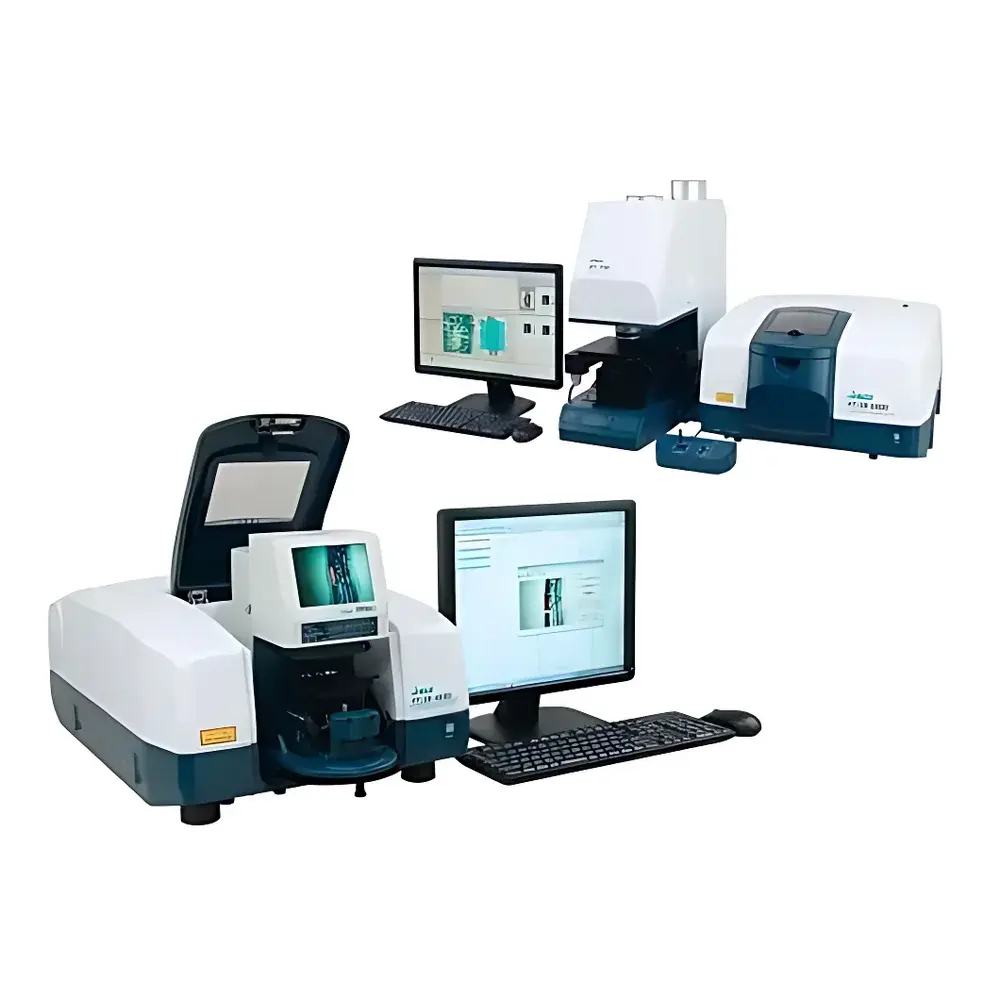
JASCO IRT-7200 FTIR Microscope System with 16-Channel MCT Detector
| Brand | JASCO |
|---|---|
| Origin | Japan |
| Model | IRT-7200 / IRT-5200 / IRT-1000 |
| Instrument Type | Laboratory FTIR Microscope |
| Wavenumber Range | 25,000–10 cm⁻¹ |
| Spectral Resolution | 0.7–0.07 cm⁻¹ |
| Scan Speed | 20 Hz |
| Signal-to-Noise Ratio | 25,000:1 to 55,000:1 |
| Detector Configuration | 16-channel MCT (IRT-7200), single-element MCT + CMOS visual camera (IRT-5200), compact ATR-integrated module (IRT-1000) |
| Optical Interface | Cassegrain objectives (×16, ×32 standard), ATR imaging capability |
| Software | JASCO Spectra Manager™ with mapping, time-resolved imaging, and co-registered spectral–spatial analysis modules |
Overview
The JASCO IRT-7200 is a high-performance Fourier Transform Infrared (FTIR) microscope system engineered for spatially resolved chemical characterization at the microscale. It operates on the principle of interferometric spectral acquisition coupled with focal-plane array detection, enabling simultaneous collection of infrared spectra across multiple sample locations without mechanical raster scanning. Unlike conventional single-point IR microscopes, the IRT-7200 integrates a 16-channel mercury cadmium telluride (MCT) detector with a high-speed automated XYZ stage, reducing mapping acquisition time by up to two orders of magnitude compared to legacy unit-cell systems. Its optical architecture supports both transmission, reflection, and attenuated total reflectance (ATR) measurement geometries—critical for heterogeneous solid samples, thin films, pharmaceutical tablets, polymer blends, and biological tissue sections. The system is fully compatible with JASCO’s FT/IR-6800 and FT/IR-6000 spectrometers, and when paired with the optional step-scan accessory, enables time-resolved IR imaging for kinetic studies of photochemical or thermal processes.
Key Features
- 16-channel linear MCT detector array for parallel spectral acquisition—enabling 160-point spectral mapping per second
- Dual-detector configuration (IRT-7200): simultaneous operation of array and single-element MCT detectors for hybrid quantitative–qualitative analysis
- Standard Cassegrain objectives (×16 and ×32) with diffraction-limited spatial resolution optimized for mid-IR wavelengths
- Integrated high-resolution CMOS camera (IRT-5200/IRT-7200) with LED illumination for real-time visual correlation of spectral data and morphology
- ATR imaging mode using diamond or Ge crystal objectives—providing surface-sensitive chemical mapping without sample sectioning
- Smart Mapping algorithm (IRT-5200) that compensates for manual stage positioning drift and enables reproducible multi-point analysis without motorized automation
- Compact modular design (IRT-1000) for in-spectrometer-bay integration—compatible with standard FTIR sample compartments and rapid swap protocols
Sample Compatibility & Compliance
The IRT series accommodates diverse sample forms including powders, cross-sectioned polymers, histological tissue slides, semiconductor wafers, and coated pharmaceutical granules. All models support ATR, transmission, and reflection modes, with optional accessories for liquid cells, environmental chambers, and heating stages. From a regulatory perspective, Spectra Manager™ software complies with data integrity requirements under FDA 21 CFR Part 11 (audit trail, electronic signatures, user access control), and supports GLP/GMP-aligned workflows including instrument qualification (IQ/OQ/PQ) documentation templates. Measurement protocols align with ASTM E1252 (standard practice for general techniques of infrared quantitative analysis) and ISO 1833-12 (determination of cellulose content in textiles via FTIR), while spectral libraries conform to NIST and Sadtler reference standards.
Software & Data Management
JASCO Spectra Manager™ v9+ serves as the unified platform for instrument control, spectral processing, and hyperspectral image analysis. It provides pixel-wise baseline correction, atmospheric compensation, multivariate curve resolution (MCR), hierarchical cluster analysis (HCA), and principal component analysis (PCA) for unsupervised classification of chemical domains. Hyperspectral datasets are stored in HDF5 format with embedded metadata (wavenumber calibration, stage coordinates, detector gain, aperture settings). Export options include CSV, JCAMP-DX, and ENVI-compatible BIL formats for third-party chemometrics tools. The software supports batch processing of large mapping datasets and includes built-in reporting modules compliant with internal SOPs and external audit requirements.
Applications
- Pharmaceutical: Identification of API distribution, excipient segregation, and coating uniformity in tablets and granules
- Materials Science: Phase mapping in polymer composites, oxidation state analysis in battery cathodes, and interfacial chemistry in laminated films
- Forensics: Trace evidence analysis of paint chips, fibers, and adhesives with sub-50 µm spatial resolution
- Life Sciences: Label-free histopathology of formalin-fixed paraffin-embedded (FFPE) tissues, lipid/protein ratio mapping in cryosections
- Microelectronics: Contamination identification on wafer surfaces, residue analysis in etch processes, and interlayer diffusion profiling
FAQ
What is the minimum spatial resolution achievable with the IRT-7200 under ATR mode?
Typical lateral resolution is ~3–5 µm depending on crystal geometry and contact quality; theoretical diffraction limit at 1000 cm⁻¹ is ~5.5 µm.
Can the IRT-5200 perform true hyperspectral imaging without an automated stage?
Yes—the Smart Mapping function uses visual frame registration and centroid tracking to reconstruct spatially aligned spectral maps from manually acquired point measurements.
Is the IRT-1000 compatible with non-JASCO FTIR spectrometers?
It is mechanically and optically designed for JASCO FT/IR series; interfacing with other brands requires custom beam alignment and may compromise throughput or alignment stability.
Does the system support real-time spectral feedback during ATR contact optimization?
Yes—live spectrum display with dynamic baseline update allows immediate assessment of contact pressure and crystal-sample coupling quality.
How is spectral calibration maintained across long-term mapping acquisitions?
Each scan includes internal He–Ne laser referencing; wavenumber accuracy is traceable to NIST SRM 1921b and verified daily using polystyrene film standards.




