
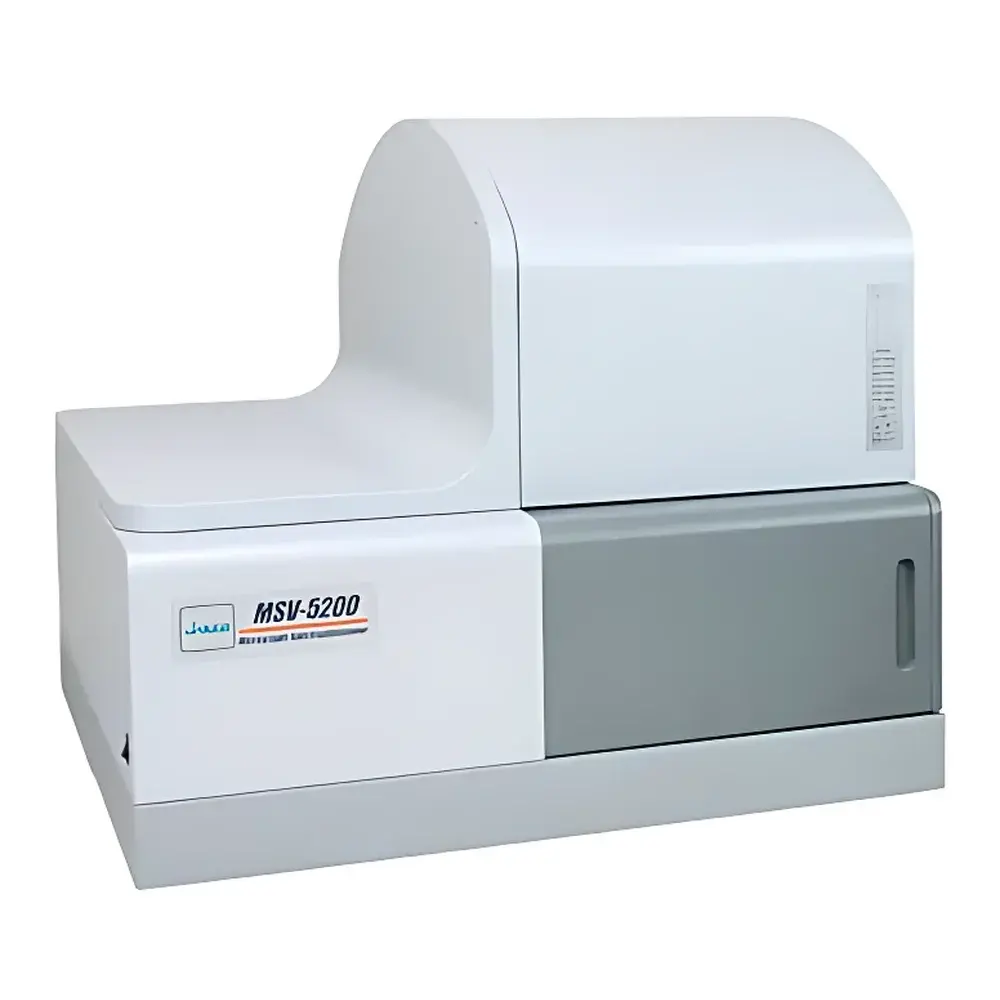
JASCO MVS-5000 Series Micro UV-Vis-NIR Spectrophotometer
| Brand | JASCO |
|---|---|
| Origin | Japan |
| Manufacturer Type | Authorized Distributor |
| Origin Category | Imported |
| Model | MVS-5000 Series |
| Instrument Architecture | Dual-Wavelength |
| Detector Type | Photomultiplier Tube (PMT) |
| Wavelength Range | 200–2700 nm |
| Automation Level | Motorized Wavelength Scanning |
| Spectral Bandwidth | 1–20 nm |
| Wavelength Accuracy | ±0.3 nm |
| Stray Light | <0.0001% (at 220 nm, NaI |
Overview
The JASCO MVS-5000 Series Micro UV-Vis-NIR Spectrophotometer is a high-precision, research-grade microspectrophotometer engineered for quantitative transmission and reflection spectral analysis of microscopic samples across an extended spectral range—from deep ultraviolet (200 nm) to near-infrared (2700 nm). Based on double-beam optical architecture with motorized monochromator scanning and PMT detection, the system delivers high photometric stability, excellent signal-to-noise ratio, and sub-micron spatial resolution. Its core design enables non-destructive, in-situ optical characterization of localized regions—such as individual semiconductor device features, thin-film stacks, microcrystalline domains, or optoelectronic material pixels—without requiring bulk sample preparation. The instrument operates on fundamental principles of absorbance, reflectance, and transmittance spectroscopy, calibrated traceably to NIST-traceable standards, supporting quantitative bandgap determination (Tauc plot analysis), film thickness modeling (via interference fringe analysis), and anisotropic optical property mapping under polarized illumination.
Key Features
- Extended spectral coverage from 200 nm to 2700 nm—encompassing UV, visible, and NIR regions in a single platform
- High-resolution monochromator with wavelength accuracy of ±0.3 nm and selectable spectral bandwidth (1–20 nm) for optimized resolution vs. throughput trade-offs
- Dual-beam optical path architecture ensuring real-time baseline correction and exceptional photometric stability during long-duration scans
- Micrometer-level spatial resolution: capable of spectral acquisition from areas as small as φ10 µm, enabled by integrated high-magnification microscope optics and precision XYZ stage control
- Integrated high-definition digital camera for real-time sample visualization, focus confirmation, and ROI (region-of-interest) positioning
- Standard polarization optics module supporting s- and p-polarized measurements—essential for evaluating birefringence, dichroism, and surface/interface effects
- Motorized, programmable XYZ translation stage (optional but factory-integrated) enabling automated spectral mapping, multi-point quantification, and line-scan profiling
Sample Compatibility & Compliance
The MVS-5000 Series accommodates solid, thin-film, and semi-transparent samples—including silicon wafers, OLED subpixels, perovskite microcrystals, photonic crystal slabs, and coated optical filters—without vacuum or cryogenic requirements. Sample mounting is compatible with standard microscope slides, TEM grids, and custom holders. All optical components comply with ISO 9022-3 (optical instruments—environmental testing) and meet CE marking requirements for electromagnetic compatibility (EMC Directive 2014/30/EU) and low-voltage safety (LVD Directive 2014/35/EU). Data acquisition protocols support audit-ready operation under GLP and GMP environments, with optional software modules providing 21 CFR Part 11-compliant electronic signatures, user access controls, and full audit trail logging.
Software & Data Management
Controlled via JASCO Spectra Manager™ II—a modular, Windows-based application designed for spectroscopic workflow automation—the system supports intuitive method setup, live spectral preview, batch measurement scheduling, and advanced post-processing (e.g., Kubelka-Munk transformation, derivative spectroscopy, multivariate curve resolution). Raw spectral data are saved in vendor-neutral ASCII and JCAMP-DX formats. Integration with third-party analysis platforms (MATLAB, Python via COM/ActiveX APIs) enables custom modeling of optical constants (n, k), layer thickness, and band structure. All measurement metadata—including instrument configuration, calibration history, environmental logs, and operator ID—are embedded in each dataset file to ensure full traceability.
Applications
- Bandgap evaluation of semiconductors and 2D materials (e.g., MoS₂, WS₂) via Tauc plot analysis of absorption edges
- Film thickness determination of dielectric and metallic layers using interference fringe modeling in reflectance spectra
- Micro-domain optical heterogeneity assessment in organic photovoltaic blends and ferroelectric thin films
- Polarization-resolved characterization of anisotropic nanostructures (e.g., aligned nanowires, liquid crystal domains)
- Quality assurance of micro-optical components (microlens arrays, diffractive optical elements) through point-by-point spectral uniformity mapping
- Forensic and art conservation analysis of pigment stratigraphy and varnish aging behavior at sub-100 µm scale
FAQ
What is the smallest measurable spot size?
The system achieves a minimum analysis area of φ10 µm using the standard 100× objective; spot size can be further reduced to ~5 µm with optional high-NA objectives.
Is fiber optic coupling supported?
No—the MVS-5000 is a dedicated microspectrophotometer with integrated microscope optics; external fiber input is not available, preserving spatial fidelity and throughput.
Can the system perform time-resolved measurements?
It is not configured for ultrafast kinetics; however, sequential spectral acquisition at user-defined intervals (down to ~100 ms per spectrum) supports slow dynamic processes such as thermal or humidity-induced optical changes.
Which calibration standards are supplied?
NIST-traceable holmium oxide (Ho₂O₃) and didymium filters for wavelength calibration, plus neutral density filters for photometric validation across UV-Vis-NIR ranges.
Is vacuum or purging required for UV measurements below 200 nm?
No—the optical path is sealed and nitrogen-purged internally; measurements down to 200 nm are performed in ambient lab conditions without external gas supply.




