
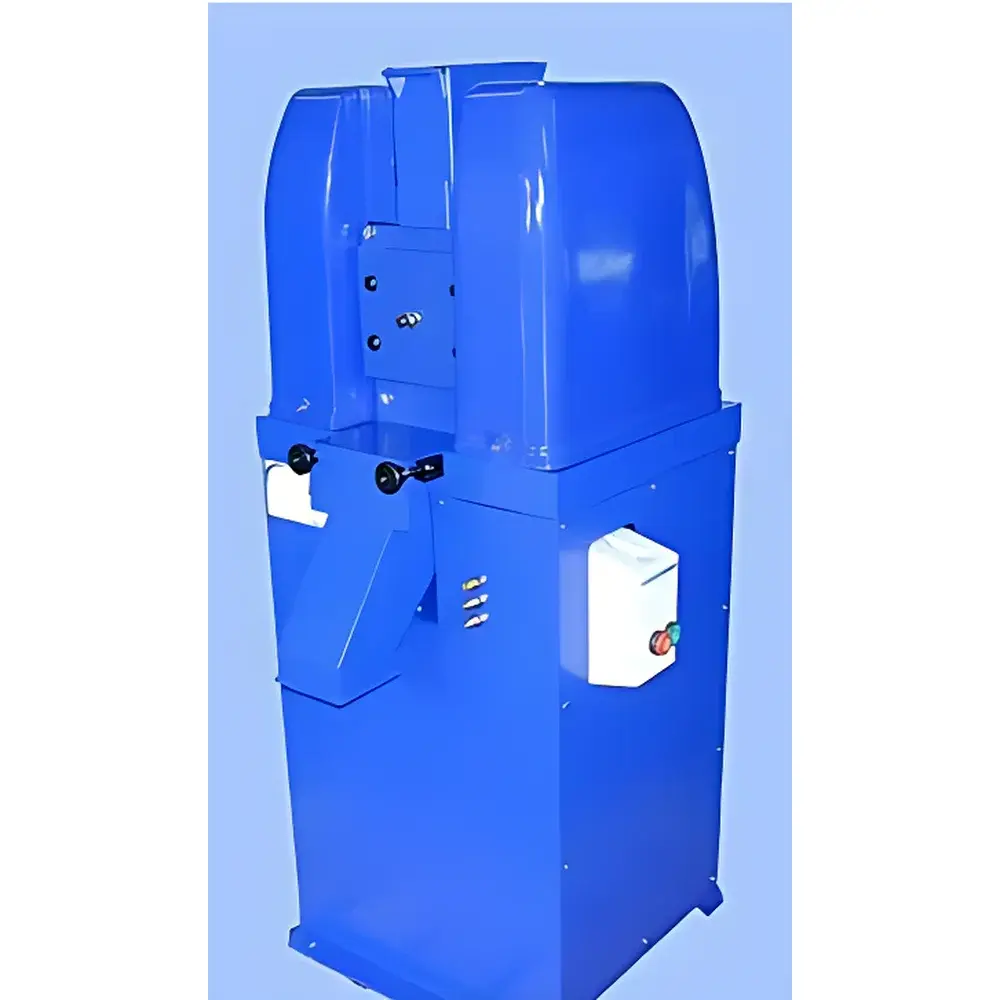
JAW2 Jaw Crusher – Imported from the UK
| Origin | UK |
|---|---|
| Manufacturer Type | Authorized Distributor |
| Origin Category | Imported |
| Model | JAW2 |
| Instrument Type | Jaw Crusher |
| Sample Applicability | Hard, Brittle, and Medium-Hard Materials |
| Output Particle Size | ≥ 0.5 mm |
| Maximum Feed Size | < 15 mm |
| Batch Processing Capacity | 152 × 76 mm feed opening |
Overview
The JAW2 Jaw Crusher is a precision-engineered laboratory-scale primary crushing instrument imported from the United Kingdom. Designed on the principle of compressive crushing via dual-motion single-toggle jaw mechanics, it delivers consistent, controlled size reduction for hard, brittle, and medium-hard materials—ideal for sample preparation prior to downstream analysis (e.g., XRF, XRD, ICP-OES, or sieve analysis). Its robust cast-iron frame, sealed spherical roller bearings, and high-torque 4.2 kW three-phase motor ensure stable operation under sustained loads. The crusher operates at 50 Hz, 400 V AC, meeting European industrial power standards and supporting GLP-compliant lab environments where reproducibility and mechanical traceability are essential.
Key Features
- Single-toggle jaw mechanism with patented bi-directional motion—enables higher throughput per kW while minimizing mechanical stress and energy consumption.
- Adjustable discharge gap: manually calibrated via precision micrometer scale, enabling reproducible control over final particle size distribution (typically 5 mm to >50 mm; fine output down to 0.5 mm achievable with secondary screening).
- Reinforced stainless-steel base and full perimeter guarding compliant with EN 61000-6-2 (EMC) and EN ISO 12100 (machine safety).
- Fully accessible crushing chamber with hinged feed hopper—designed to prevent material rebound and ensure operator safety during loading.
- Zero-point recalibration function compensates for jaw plate wear over time, maintaining dimensional consistency across extended service life.
- Interchangeable jaw plates in multiple material grades: manganese steel (standard), stainless steel (for low-contamination applications), tungsten carbide (for ultra-abrasive minerals), and lead-free anti-heavy-metal alloys (for environmental or regulatory compliance workflows).
- Braked motor with integrated safety cut-off switch—automatically de-energizes upon hopper opening or emergency stop activation.
- High-capacity 5 L collection bin with level indicator and quick-release mounting.
Sample Compatibility & Compliance
The JAW2 accepts feed particles up to 152 × 76 mm (max. 140 mm diameter), making it suitable for direct processing of bulk geological specimens, foundry sands, refractory bricks, sintered metal compacts, and polymer pellets. It is routinely deployed in accordance with ASTM C136 (sieve analysis of aggregates), ISO 679 (cement testing), and USP (particle size determination for pharmaceutical excipients). All structural components meet RoHS Directive 2011/65/EU requirements; electrical systems conform to CE marking directives (2014/30/EU EMC and 2014/35/EU LVD). Optional documentation packages support FDA 21 CFR Part 11–compliant audit trails when integrated with validated LIMS or ELN platforms.
Software & Data Management
While the JAW2 operates as a standalone electromechanical system without embedded firmware or touchscreen interface, its mechanical design supports integration into automated sample prep workflows. Optional digital load-cell retrofit kits (sold separately) enable real-time mass-throughput logging. All calibration records—including jaw gap settings, motor current draw baselines, and bearing temperature logs—can be maintained in accordance with ISO/IEC 17025:2017 Clause 7.7 (Equipment Records). Factory-supplied maintenance logbooks include torque specifications, lubrication schedules, and wear-limit thresholds for jaw plates and toggle links.
Applications
- Geological laboratories: Crushing core samples, ore chips, and slag prior to geochemical assay.
- Cement and construction materials testing: Preparing aggregates for gradation analysis per EN 933-1.
- Metallurgical R&D: Reducing sintered powder metallurgy parts for microstructural evaluation.
- Environmental labs: Homogenizing contaminated soils or fly ash for TCLP extraction (EPA Method 1311).
- Pharmaceutical QC: Initial size reduction of tablet granules or ceramic excipient batches before milling validation.
- Recycling & waste characterization: Fragmenting electronic scrap, battery casings, or composite debris for elemental leaching studies.
FAQ
What is the maximum feed size the JAW2 can accept?
The nominal feed opening is 152 × 76 mm; the practical upper limit for single-piece feed is 140 mm in diameter or length.
Is the JAW2 compatible with GMP or GLP-regulated environments?
Yes—its mechanical traceability, zero-point recalibration capability, and documented maintenance intervals align with GLP Annex III and EU GMP Annex 15 requirements for critical sample prep equipment.
Can jaw plate wear affect particle size consistency?
Wear-induced gap drift is mitigated by the built-in zero-point recalibration procedure, which restores dimensional accuracy without requiring disassembly.
What electrical infrastructure is required for installation?
A dedicated 400 V, 50 Hz, three-phase supply with 32 A circuit protection and proper earthing per IEC 60364-5-54 is mandatory.
Does the JAW2 require routine lubrication?
Yes—the toggle bearing and eccentric shaft require periodic grease application per the maintenance schedule (every 500 operating hours or annually, whichever occurs first).



