
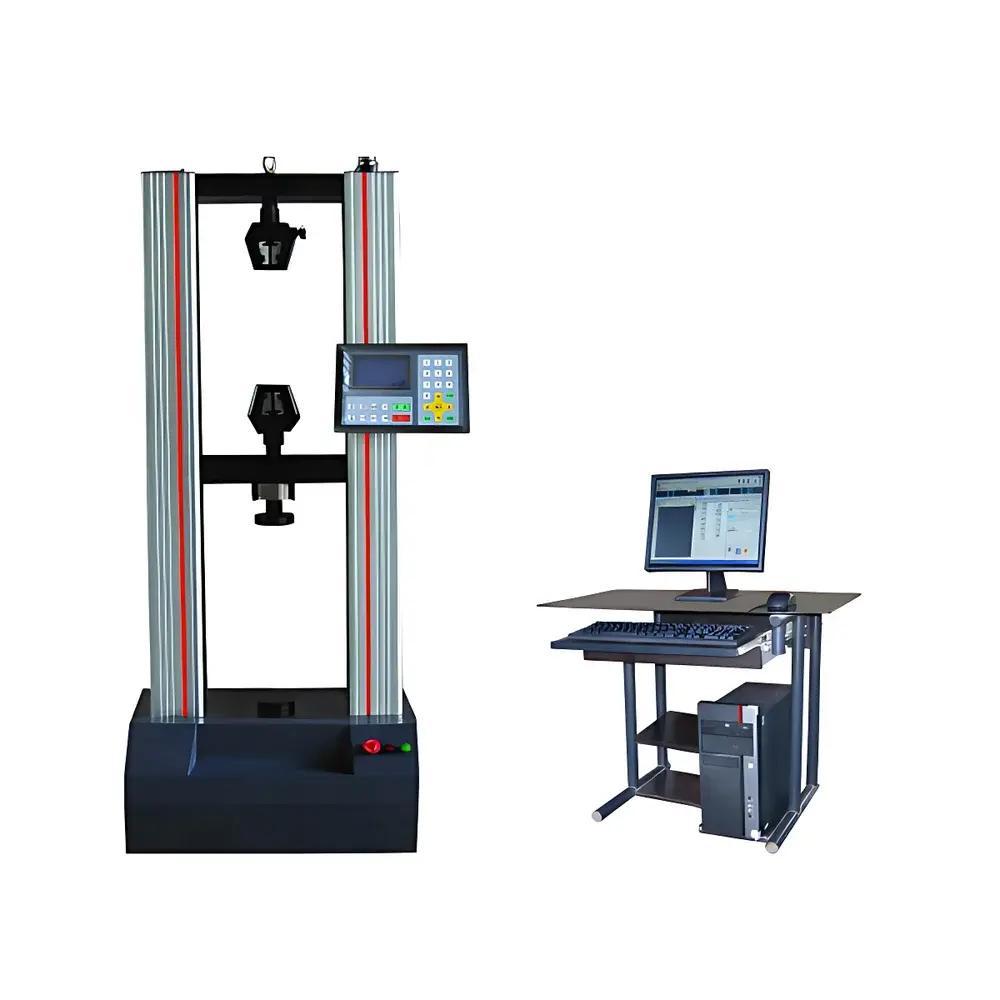
JB-121A Universal Testing Machine by Jiubin Instruments
| Brand | Jiubin Instruments |
|---|---|
| Origin | Shanghai, China |
| Manufacturer Type | Authorized Distributor |
| Country of Origin | China |
| Model | JB-121A |
| Instrument Type | Electromechanical Universal Testing Machine |
| Maximum Test Load | 50 kN |
| Accuracy Class | Class 1 (ISO 7500-1 / ASTM E4 compliant) |
| Speed Range | 0.001–500 mm/min |
| Effective Stroke | ~1000 mm |
| Load Resolution | 0.001 N |
| Load Accuracy | ±0.01% of full scale |
| Displacement Accuracy | ±0.005% (JIS B 7721 certified) |
| Encoder Resolution | 1000 P/R |
| Control System | Full-digital triple-closed-loop (force, displacement, strain) with adaptive PID algorithm |
| Drive Motor | Panasonic AC servo motor |
| Mechanical Transmission | High-precision ground ball screw (Taiwan-made) |
| Dual Display | Integrated touch HMI + PC-based software interface |
| Software | Windows-native, bilingual (CN/EN), GLP-compliant data audit trail, auto-report generation, curve replay & comparative analysis |
| Safety Features | Overload emergency stop, mechanical travel limits, leakage protection, automatic return-to-start and break-point pause |
| Power Supply | 220 V AC, 50/60 Hz |
| Dimensions (W×D×H) | 900 × 550 × 1800 mm |
| Weight | 450 kg |
Overview
The JB-121A Universal Testing Machine by Jiubin Instruments is an electromechanical materials testing system engineered for precision mechanical property evaluation across research laboratories, quality control departments, and industrial R&D facilities. Built on a robust dual-column floor-standing architecture, it implements a true triple-closed-loop digital control system—simultaneously regulating force, displacement, and strain via adaptive neuron-based PID algorithms. This architecture ensures seamless mode transitions (e.g., from load-controlled to displacement-controlled testing) without mechanical shock or data discontinuity—critical for high-fidelity characterization of viscoelastic, brittle, or strain-hardening materials. The system complies with ISO 7500-1:2018 (static calibration of force-proving instruments) and ASTM E4-23 (practices for force verification of testing machines), supporting traceable, auditable test execution under GLP and pre-GMP environments.
Key Features
- Full-digital triple-closed-loop control (force, displacement, strain) with real-time auto-tuning and online parameter identification.
- Panasonic AC servo motor drive coupled with a ground Taiwanese ball screw assembly, delivering smooth motion across the full speed range (0.001–500 mm/min) with <±0.005% displacement linearity.
- High-resolution load measurement: ±0.01% FS accuracy, 1/300,000 internal resolution, 0.001 N display resolution—validated per ISO 7500-1 Class 1 requirements.
- Dual independent operation modes: Standalone touchscreen HMI for rapid routine tests; PC-based software for advanced analysis, multi-curve comparison, and regulatory reporting.
- Bilingual (English/Chinese) software interface with configurable decimal places (2–3 digits), unit conversion (N, kN, kgf, lbf), password-protected parameter editing, and encrypted data backup to any local or network drive.
- Comprehensive safety architecture: Dual mechanical end-stop limit switches, electronic overload cutoff, earth-leakage circuit interruption, and automatic return-to-home upon test completion or failure detection.
- Standard USB 2.0 connectivity for all peripherals (load cell, encoder, I/O modules); no proprietary cabling—ensuring long-term serviceability and third-party device interoperability.
Sample Compatibility & Compliance
The JB-121A accommodates tensile, compression, flexural, peel, shear, and tear testing of metallic and non-metallic specimens per ASTM D638, D790, D3045, ISO 527, ISO 178, ISO 1133, EN 10002-1, GB/T 228.1, and USP . It supports standardized specimen geometries up to 50 kN ultimate load—including metals (steel, aluminum, titanium alloys), polymers (PE, PP, PET, PVC), elastomers, composites, paperboard, textiles, adhesives, biomedical sutures, and thin-film substrates. Optional fixtures (e.g., wedge-action grips, pneumatic clamps, bend jigs, peel testers) are available per ISO 20807 and ASTM E8/E9 mounting specifications. All firmware and software logs maintain time-stamped, immutable records compliant with FDA 21 CFR Part 11 Annex 11 requirements when configured with user authentication and electronic signature modules.
Software & Data Management
The embedded Windows-based testing software provides full lifecycle data governance: real-time plotting of stress–strain, load–displacement, load–time, and displacement–time curves; automated calculation of yield strength (upper/lower), tensile/compressive modulus, elongation at break, Poisson’s ratio, energy absorption (net, return, total), and custom-defined breakpoints (e.g., “load at 2% strain”, “strain at 500 N”). Curve replay enables post-test re-analysis without re-running experiments. Reports export in PDF, Excel, and XML formats—with embedded metadata (operator ID, timestamp, calibration certificate ID, environmental conditions). Audit trails record every parameter change, test initiation, result modification, and user login—retained for ≥10 years per configurable retention policy. Data encryption (AES-256) and role-based access control ensure integrity during multi-user deployment.
Applications
This system serves as a primary mechanical characterization platform in polymer science labs evaluating melt strength and creep compliance; in automotive QA labs verifying tensile integrity of seatbelt webbing, airbag fabrics, and composite chassis components; in packaging R&D validating seal peel strength and puncture resistance of laminated films; in medical device manufacturing confirming suture tensile performance per ISO 10993-12; and in academic materials engineering programs conducting fundamental studies on nanocomposite reinforcement mechanisms. Its wide dynamic range and sub-micron displacement resolution also support low-force micro-tensile testing of MEMS structures and hydrogel swelling kinetics when paired with optional environmental chambers.
FAQ
What international standards does the JB-121A comply with for force and displacement calibration?
It meets ISO 7500-1:2018 (Class 1) for static force calibration and JIS B 7721 for displacement accuracy verification.
Can the system generate 21 CFR Part 11-compliant audit trails out-of-the-box?
Yes—when deployed with enabled user authentication, electronic signatures, and immutable log archiving, it satisfies core Part 11 requirements for electronic records and signatures.
Is third-party calibration certification included with delivery?
A factory-issued ISO/IEC 17025-accredited calibration certificate (traceable to NIM China) is provided; annual recalibration services are available through authorized Jiubin service centers.
What is the maximum specimen height accommodated in compression mode?
With standard platens, the effective compression height is 1000 mm; extended-height configurations up to 1300 mm are available upon request.
Does the software support automated batch testing with pass/fail logic based on user-defined limits?
Yes—the sequence editor allows conditional branching, tolerance-based acceptance criteria, and auto-flagging of outliers against statistical control limits (e.g., X-bar/R charts).



