
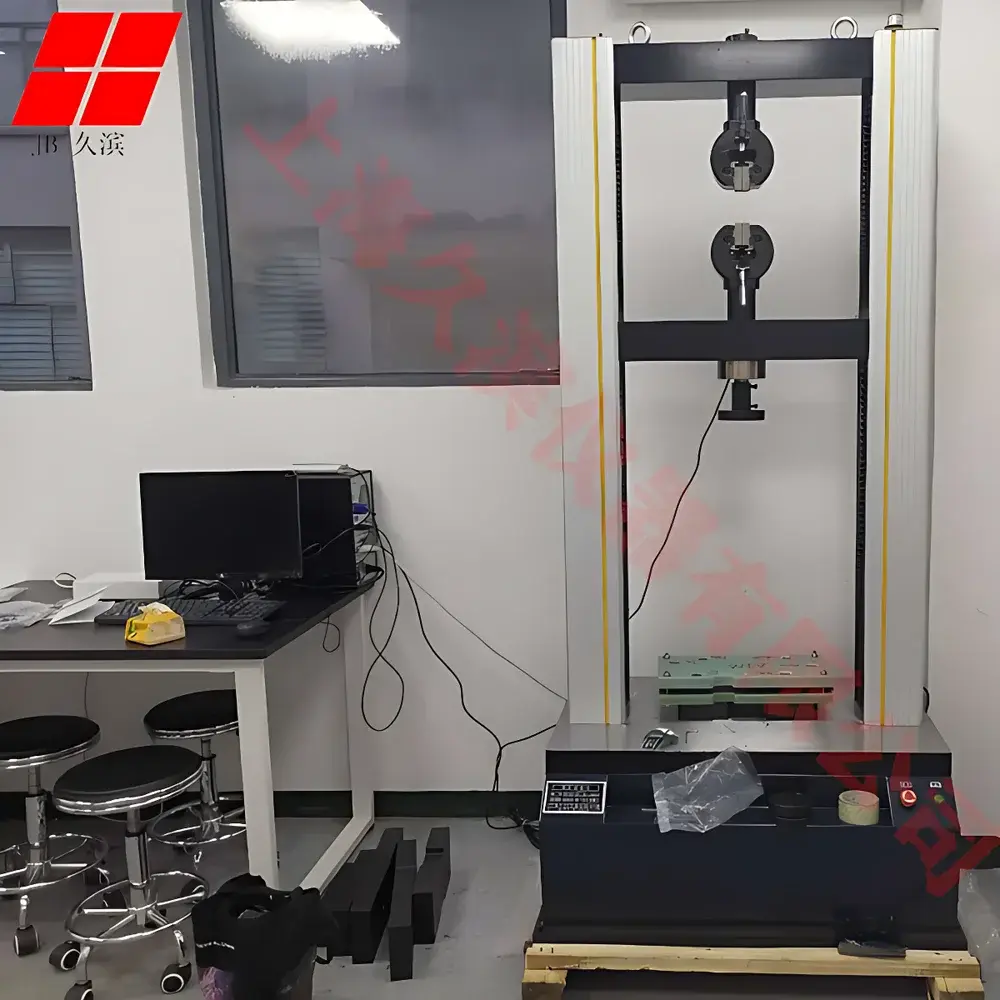
JB-128A EVA Photovoltaic Module Adhesive Peel Strength Tester
| Brand | Jiubin Instruments |
|---|---|
| Origin | Shanghai, China |
| Model | JB-128A |
| Max Load Capacity | 20 kN |
| Vertical Test Space | 800 mm |
| Force Sensor | Transcell (USA), 20 kN |
| Drive System | Panasonic AC Servo Motor & Controller (Japan) |
| Force Resolution | ±1/500,000 FS |
| Force Accuracy | ±0.5% of reading |
| Displacement Resolution | 0.05 mm |
| Displacement Accuracy | ±0.5% of reading |
| Strain Measurement Range | 0.2–100% FS |
| Strain Resolution | ±1/300,000 FS |
| Strain Accuracy | ±0.5% of reading |
| Speed Range | 0.001–500 mm/min (infinitely variable, segmented control) |
| Speed Accuracy | ±1% (<0.01 mm/min), ±0.5% (≥0.01 mm/min) |
| Force Rate Control | 0.5–6% FS/s |
| Strain Rate Control | 0.2–6% FS/s |
| Power Supply | AC 220 V, 50 Hz |
| Dimensions (W×D×H) | 800 × 400 × 1800 mm |
| Weight | ~300 kg |
| Software | Dedicated bilingual (English/Chinese) test platform compliant with ASTM D903, ISO 8510-2, and GB/T 2790–1995 |
Overview
The JB-128A EVA Photovoltaic Module Adhesive Peel Strength Tester is a precision universal testing system engineered for quantitative mechanical characterization of adhesive interfaces in photovoltaic module laminates. It operates on the principle of controlled tensile separation under standardized 180° peel geometry, as defined in GB/T 2790–1995, ASTM D903, and ISO 8510-2. Designed specifically for evaluating ethylene-vinyl acetate (EVA) encapsulant adhesion to rigid substrates—including tempered glass (3.2 mm) and polymer-based backsheet materials—the instrument delivers traceable, reproducible force-displacement data essential for quality assurance, process validation, and accelerated aging studies in solar manufacturing. Its architecture integrates high-fidelity load measurement, sub-micron displacement tracking, and real-time strain monitoring—enabling simultaneous evaluation of peel strength, interfacial toughness, and post-yield delamination behavior across temperature- and humidity-conditioned specimens.
Key Features
- High-resolution dual-channel acquisition: 20 kN Transcell load cell (±0.5% accuracy) coupled with optical encoder-based displacement sensing (0.05 mm resolution) and optional extensometer-grade strain measurement (±1/300,000 FS full-scale resolution).
- Panasonic AC servo drive system with closed-loop velocity control: Enables precise speed regulation from 0.001 to 500 mm/min, meeting strict requirements for low-speed peel initiation (e.g., 100 ± 10 mm/min per GB/T 2790) and high-speed fatigue cycling.
- Modular gripping configuration: Dual pneumatic or mechanical clamps with parallel alignment mechanism ensure uniform stress distribution across 15 mm-wide specimen width—critical for eliminating edge effects and achieving ASTM-compliant load transmission.
- Integrated deformation measurement capability: Built-in digital extensometer support allows direct quantification of elastic and plastic deformation in both EVA and substrate layers during peel propagation—supporting modulus estimation and failure mode analysis.
- Bilingual software platform with audit-trail functionality: Complies with GLP and 21 CFR Part 11 requirements for electronic records, including user authentication, version-controlled test methods, automatic metadata logging (operator ID, timestamp, environmental conditions), and PDF report generation with embedded raw curves.
Sample Compatibility & Compliance
The JB-128A accommodates standard photovoltaic peel specimens per GB/T 2790–1995: 15 mm × 300 mm strips cut from laminated assemblies of 300 mm × 300 mm tempered glass/EVA and 310 mm × 310 mm backsheet/EVA composites. Specimens are preconditioned per GB/T 2918–1998 (23 °C, 50% RH, ≥2 h) or subjected to accelerated conditioning protocols—including boiling water immersion (3 h at 100 °C)—to assess hydrothermal stability of the EVA–substrate interface. The system supports comparative testing against reference materials per IEC 61215-2 MQT 17 (adhesion after damp heat) and UL 1703 Annex D (peel strength verification). All mechanical outputs—including average peel force (N), normalized peel strength (N/15 mm), and energy dissipation per unit width (J/m)—are calculated and reported in accordance with ISO 8510-2 Annex A.
Software & Data Management
The embedded JB-TestSuite software provides full workflow automation: method setup (predefined templates for 180° peel, T-peel, and shear tests), real-time curve visualization (force vs. displacement, stress vs. strain), auto-detection of peel onset and steady-state regions, and statistical aggregation across replicate specimens (n ≥ 5). Data export options include CSV (raw time-series), XML (structured metadata), and PDF (formatted reports with pass/fail flags based on user-defined thresholds—e.g., ≥15 N/15 mm for EVA–backsheet adhesion). Audit logs record all parameter modifications, calibration events, and operator actions—ensuring compliance with ISO/IEC 17025 accreditation requirements for testing laboratories.
Applications
- Quantitative validation of EVA encapsulant adhesion to front glass and rear backsheets during incoming material qualification.
- Process optimization of lamination parameters (temperature, pressure, dwell time) via correlation of peel strength with crosslink density (measured independently by FTIR or gel content).
- Failure analysis of field-degraded modules: comparison of peel strength retention after UV exposure, thermal cycling (IEC 61215-2 MQT 11), and humidity freeze (MQT 12).
- Development of alternative encapsulants (POE, silicone, thermoplastic polyolefins) requiring equivalent or superior interfacial durability under accelerated stress conditions.
- Research into interfacial chemistry—e.g., effect of silane coupling agents, surface plasma treatment, or anti-PID coatings—on bond formation kinetics and long-term cohesive integrity.
FAQ
What standards does the JB-128A comply with for EVA peel testing?
It supports GB/T 2790–1995, ASTM D903, ISO 8510-2, IEC 61215-2 MQT 17, and UL 1703 Annex D—covering both baseline adhesion and post-stress performance evaluation.
Can the system perform tests other than 180° peel?
Yes—it is configurable for T-peel, 90° peel, tensile, compression, and flexural tests using interchangeable fixtures and software modules.
Is the software validated for regulated environments?
The JB-TestSuite includes 21 CFR Part 11-compliant features: electronic signatures, audit trails, and secure role-based access control—suitable for GMP/GLP-certified labs.
How is calibration traceability maintained?
Force calibration is performed using NIST-traceable deadweight standards; displacement calibration uses laser interferometry—certificates issued per ISO/IEC 17025.
Does the system support automated reporting for quality documentation?
Yes—customizable PDF reports include test parameters, statistical summaries, annotated force–displacement curves, and pass/fail determinations aligned with internal or customer specifications.



